

On this page
- When investing in a hydraulic oil press machine, one of the most important questions buyers ask is:
- 1. What Determines ROI of a Hydraulic Oil Press Machine?
- 2. Daily Production Capacity
- 3. Oil Yield Reference
- 4. ROI Calculation Example
- 5. Realistic Profit Expectation
- 6. Why Hydraulic Oil Press Has High ROI?
- 7. Important Note About Heating
- 8. Conclusion
When investing in a hydraulic oil press machine, one of the most important questions buyers ask is:
How long will it take to recover the cost, and how much profit can I make?
This article provides a practical ROI (Return on Investment) analysis based on real production data and typical market conditions.
1. What Determines ROI of a Hydraulic Oil Press Machine?
The return on investment mainly depends on the following factors:
- Machine purchase cost
- Daily processing capacity
- Oil yield rate
- Raw material price
- Local oil selling price
- Labor and electricity cost
- Working hours and batch frequency
Unlike screw presses, hydraulic oil presses focus on high oil quality and stable yield, which makes them very suitable for small and medium edible oil businesses.
2. Daily Production Capacity
Hydraulic oil press machines usually work in batch mode.
For standard models:
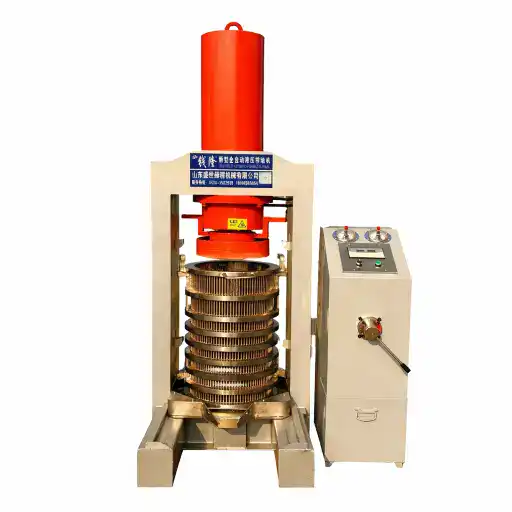
- Standard barrel diameter: 390mm
- Maximum loading capacity: up to 100 kg per batch
- Recommended real working load: about 60–80 kg per batch
- Typical working cycle: 30–40 minutes (hot pressing)
- Cold pressing cycle: 1.5–2 hours
In real production, most users can easily achieve:
At least 4 batches per day
So daily raw material input is approximately:
100 kg × 4 batches = 400 kg per day
3. Oil Yield Reference
Oil yield depends on seed type and process:
| Material | Hot Press Yield | Cold Press Yield |
|---|---|---|
| Peanut | 38% – 44% | 35% – 42% |
| Sesame | 42% – 48% | 40% – 45% |
| Sunflower | 35% – 40% | 33% – 38% |
| Rapeseed | 30% – 36% | 28% – 34% |
Cold pressing does not mean low yield — it mainly means longer pressing time.
If cold pressing runs long enough (around 2 hours), the oil yield can be very close to hot pressing.
4. ROI Calculation Example
Here is a realistic ROI example for a peanut oil business:
Basic Assumptions
- Machine cost: USD 5,000
- Daily capacity: 400 kg peanuts
- Oil yield: 40%
- Daily oil output: 160 kg
- Local oil selling price: USD 3 / kg
- Working days per month: 26 days
Revenue
- Daily revenue: 160 kg × $3 = $480 / day
- Monthly revenue: $480 × 26 = $12,480 / month
Estimated Monthly Costs
- Raw materials
- Electricity
- Labor
- Packaging
Estimated total: $6,000 / month
Monthly Profit
$12,480 – $6,000 = $6,480 / month
Payback Period
Machine cost ÷ Monthly profit
$5,000 ÷ $6,480 ≈ 0.77 months
➡️ Investment can be recovered in about 3–4 weeks under ideal conditions.
5. Realistic Profit Expectation
In real business, you should consider:
- Market price fluctuations
- Seasonal raw material cost
- Operator skill
- Machine utilization rate
- Local electricity and labor costs
A more conservative estimation:
Payback period: 2–4 months
Annual ROI: 300% – 600% is very common
6. Why Hydraulic Oil Press Has High ROI?
Compared with other oil extraction machines:
Advantages
- High oil quality → higher selling price
- Stable oil yield
- Low maintenance cost
- Simple operation
- Suitable for many oil seeds
- Very popular for small factories and startups
Hydraulic oil presses are especially suitable for:
- Village oil workshops
- Small edible oil factories
- Organic cold-pressed oil brands
- Agricultural cooperatives
7. Important Note About Heating
Most hydraulic oil press machines do not include built-in heating systems.
Hot pressing usually requires:
- External roasting machine
- Drum roaster
- Electric or gas roaster
This design is actually better because:
- Heating and pressing are separated
- Easier temperature control
- Better oil quality
- Lower equipment failure rate
8. Conclusion
A hydraulic oil press machine is not only a piece of equipment, but a high-return production tool.
With:
- 4 batches per day
- 400 kg raw material
- 40% oil yield
It is very realistic to achieve:
Monthly profit: $3,000 – $6,000+
Payback period: 1–3 months
For anyone entering the edible oil business, hydraulic oil press machines offer one of the best ROI ratios in agricultural machinery.
Project planning
Configure the right oil press and production line
Send your oilseed, target output, bottle or packaging requirements, power supply, and destination country. We will match the machine, supporting equipment, and line layout.