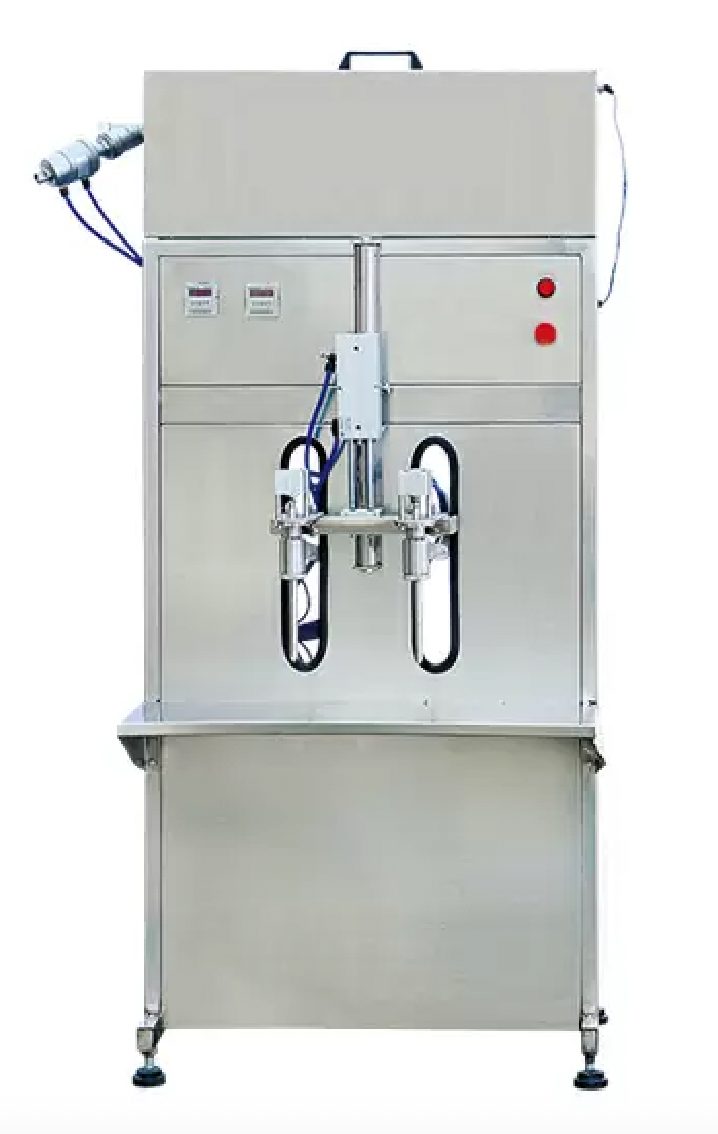
Two-head timed gravity filling
Fill two 0.5–5 L containers with a controlled self-flow cycle
This semi-automatic machine opens two pneumatic filling valves for a programmed time while a compatible low-viscosity liquid flows by gravity. It is intended for free-flowing products; manual bottle placement or an optional conveyor arrangement must be defined for the required line.
Measuring principle
Filling time and a stable liquid head determine the delivered volume
The valves do not weigh the container or directly totalize flow. The recipe holds each valve open for a selected interval, so practical output changes when viscosity, temperature, supply level, pressure head, nozzle restriction, or bottle position changes.
Cold or viscous edible oil may fall outside the useful application
The source describes this as a low-viscosity, free-flowing-liquid machine. An edible oil that thickens at the filling temperature can change cycle time and delivered volume or may require another filling principle, product heating, or a separately engineered feed arrangement.
Application boundary
Use timed self-flow only after the product and container have been tested
The current page lists edible oil, cooking oil, water, beverages, chemical liquids, and daily chemical products. These examples require different sanitation, material, temperature, and safety provisions, none of which can be inferred from the application list alone.
0.5–5 L source range
The stated adjustable range assumes a container and liquid that can be filled within the available timing and nozzle arrangement.
Two simultaneous nozzles
Two filling heads can serve two containers per cycle. Confirm whether both bottles receive acceptably matched flow under the actual supply conditions.
Pneumatic internal valves
The source describes internally sealing pneumatic valves for drip control. Product stringing, viscosity, nozzle wetting, and cutoff behavior still require a trial.
Semi-automatic container handling
Define bottle placement, start command, removal, cap transfer, and rejected fills. The source lists a conveyor as an option but does not describe its controls or scope.
Published technical data
Interpret the range, speed, and error within the source limitations
The live page does not state the test liquid, viscosity, temperature, supply-head variation, fill size, bottle geometry, operator method, sample count, or timing basis for the performance figures.
| Parameter | Source-listed value | Buyer confirmation |
|---|---|---|
| Filling volume | 0.5–5 L, adjustable | Test the actual liquid and every required container volume, especially the smallest and largest. |
| Published filling speed | 200–800 bottles/hour | Request the tested fill volume, liquid, head pressure, operator cycle, and whether both heads were counted. |
| Published filling error | ≤±0.5%, based on maximum volume | The source wording combines ≤ and ±; define the exact calculation, denominator, reference measure, sample count, and liquid conditions. |
| Working voltage | 220 V | Confirm frequency, phase, plug or terminal method, protection, and destination standard. |
| Working air pressure | 0.4–1.0 MPa | Confirm the recommended regulated setpoint and maximum allowable pressure on the delivered nameplate. |
| Electrical power | <300 W, excluding air compressor | Confirm installed load and all optional electrical accessories. |
| Air consumption | <0.2 m³/min | Confirm the duty basis, air quality, connection, and compressor receiver capacity. |
The buyer supplies the compressed-air source
The source explicitly states that an air compressor is not included. Size the compressor and receiver from the verified operating pressure, consumption, duty cycle, other plant users, and required air quality rather than from motor power alone.
Liquid assumptions
Define the product condition at the nozzle
- Product name, composition, density, viscosity curve, and normal filling temperature
- Particles, pulp, suspended solids, foaming, gas release, crystallization, or solidification risk
- Required product-supply level, tank arrangement, head variation, hose length, and nozzle restriction
- Required wetted-material grade, seals, hoses, surface finish, and cleaning chemicals
- Food, beverage, chemical, or flammable-product sanitation and safety requirements
Container assumptions
Match the neck, height, and fill level
- Bottle or can material, nominal volume, dimensions, neck opening, and allowable variation
- Required net quantity, fill level, headspace, and whether volume or mass is the acceptance basis
- Container rigidity, stability, placement fixture, nozzle clearance, and splash control
- Two-head spacing and whether the production mix requires frequent mechanical adjustment
- Cap application, bottle transfer, labeling, and handling immediately after filling
Construction and options
Do not infer wetted materials from an optional outer body
The source lists a stainless-steel body, explosion-proof configuration, conveyor, bottle-positioning device, and customized voltage as options. It does not state the standard or optional stainless grade, product-contact path, gasket materials, electrical certification, or included conveyor scope.
- Request a component-level material schedule for tank, pipe, valve, nozzle, hose, and seals.
- Specify the required electrical and hazardous-area standard rather than only the word “explosion-proof.”
- Approve a layout and control description for any conveyor or bottle-positioning option.
Gravity filling needs recipe control when conditions change
A time setting validated for one oil temperature and supply level may not deliver the same amount after the tank level, viscosity, nozzle, or bottle changes. Establish checks at startup and after every product, temperature, container, or supply adjustment.
Operation and quality checks
Validate the time recipe with measured fills
- Prime the product path and stabilize temperature and supply level before setting time.
- Measure both nozzles separately across repeated fills and record the acceptance method.
- Check for splash, foam, bottle movement, nozzle contact, drips, and unequal head flow.
- Recheck after refilling the supply tank and at the lowest expected operating level.
- Segregate underfill, overfill, contaminated, damaged, or incorrectly positioned containers.
Maintenance and safety
Keep valves, nozzles, and air preparation consistent
- Clean the product path using a method approved for the liquid and construction materials.
- Inspect valve seats, seals, nozzles, hoses, clamps, pneumatic cylinders, solenoids, and sensors.
- Drain and service the air filter and regulator and verify the pressure setting.
- Protect operators from pinch points, unexpected valve movement, spills, and unsuitable chemical exposure.
- Keep spare seals, valve components, tubing, solenoids, nozzles, switches, and recommended tools.
Buyer configuration checklist
Send product samples and every required bottle size
- Liquid name, density, viscosity and temperature range, hazard data, and cleaning method
- Required fill volumes, bottles per hour, production schedule, and number of changeovers
- Container drawings or samples, neck opening, height, stability, and closure method
- Supply-tank arrangement, liquid level variation, pipework, and available floor height
- Acceptance definition for fill quantity and separate results required from both heads
- Voltage, frequency, compressed-air supply, and any area-classification requirement
- Downstream capping and labeling plan, workshop layout, destination, and documents
Choose another principle when timed gravity is unstable
If product viscosity, temperature, supply head, or fill quantity changes too widely for repeatable timed filling, compare a weighing, piston, or flow-meter machine using the actual product and package.
Compare filling principles
Select the meter around the liquid and container
Prove the two-head result with the real liquid and bottles
Send the product data, temperature range, fill volumes, bottle samples, supply-tank arrangement, required rate, acceptance method, utilities, layout, and destination country.