Single-head automatic quantitative filler
Automatic conveyor filling for qualified glass bottles and non-carbonated liquids
The current source describes one filling head, a 50 mL-5 L adjustment range, float-type liquid-level control, electric setting adjustment, and automatic bottle handling through the filling station. It should be treated as a specific filler, not as a complete capping and labeling line.
Source-listed operating range
Verify the broad filling range at each real production format
The published values do not include the test liquid, temperature, bottle-neck range, bottle-height range, sample size, measuring method, or utility conditions.
One filling head
A single nozzle fills one bottle position at a time on the conveyor.
50 mL-5 L
Published stepless filling-volume range; practical limits require product and bottle testing.
±0.2%
Published average filling error with no stated test method or operating conditions.
Glass bottles
The technical table limits the stated application to various-height glass bottles and non-carbonated liquids.
Automatic filling sequence
Coordinate bottle position, product level, and the filling command
The source describes automatic quantitative filling with bottle-position protection. Final sensor logic, conveyor indexing, nozzle movement, and reject handling need a model-specific functional description.
Application boundary
Start with the limits stated in the technical table
The page narrative mentions liquor, beverages, liquid medicines, edible oils, and other non-carbonated liquids. Its technical table specifically states glass bottles and non-carbonated liquids. Do not extend that claim to carbonated products, plastic bottles, volatile solvents, hazardous liquids, suspensions, or corrosive products without written compatibility review.
- Provide viscosity, density, temperature, foaming, volatility, and particulate data.
- Confirm product compatibility with every wetted metal, hose, seal, valve, and lubricant.
- Define the cleaning and product-change method before selecting the product path.
- Test the smallest and largest planned fill volumes with the actual liquid.
- Obtain local process-safety review for pharmaceutical, alcoholic, chemical, or regulated products.
“Fully automatic” applies to the filling station
The current page does not establish automatic empty-bottle unscrambling, cap feeding, capping, labeling, coding, inspection, or case packing as included supply. Each downstream function needs separate confirmation.
Source-described functions
Control functions that require an acceptance test
Float-level control
The source describes an automatic float valve intended to maintain the machine liquid level.
Electric quantity adjustment
Stepless synchronous adjustment and an LCD digital display are listed for filling setup.
Bottle-position protection
Elastic bottle support and a no-fill condition for an incorrectly positioned bottle are described.
Soft start and speed control
The page lists gradual startup and stepless speed regulation for the machine rhythm.
Bottle protection reduces risk; it is not a zero-breakage guarantee
Glass quality, dimensional variation, bottle damage, guide setup, conveyor impacts, nozzle alignment, and operator intervention can still cause breakage. Define a bottle-breakage and product-contamination procedure for the installed line.
Published technical data
The source contains two conflicting 5 L output figures
Both values are preserved below. Neither should be used as final acceptance performance until the manufacturer confirms the correct range and test conditions in writing.
| Parameter | Source-listed value | Required confirmation |
|---|---|---|
| Filling type | Automatic quantitative filling | Obtain the measuring principle and functional sequence. |
| Filling heads | 1 | Confirm nozzle, bottle-position, and conveyor-indexing arrangement. |
| Filling volume | 50 mL-5 L | Test the intended product at each required pack size. |
| Published average error | ±0.2% (also written as ±2‰) | Define whether error is by mass or volume, the sample size, and the test conditions. |
| Output stated in feature text | 300-360 bottles/hour per valve, based on 5 L bottles | Conflicts with the technical table and requires correction. |
| Output stated in technical table | 200-300 bottles/hour, 5 L reference | Conflicts with the feature text and requires correction. |
| Speed control | Stepless variable speed | Confirm practical speed limits and conveyor control method. |
| Liquid-level control | Float-valve automatic control | Confirm feed pressure, tank arrangement, level band, and overflow protection. |
| Quantity adjustment | Electric synchronous adjustment | Confirm adjustment resolution, recipes, calibration, and password control. |
| Display | LCD digital display | Confirm interface functions and language. |
| Applicable containers | Glass bottles of various heights | Obtain actual height, body, base, and neck ranges plus approved samples. |
| Suitable product class | Non-carbonated liquids | Complete liquid and wetted-material compatibility review. |
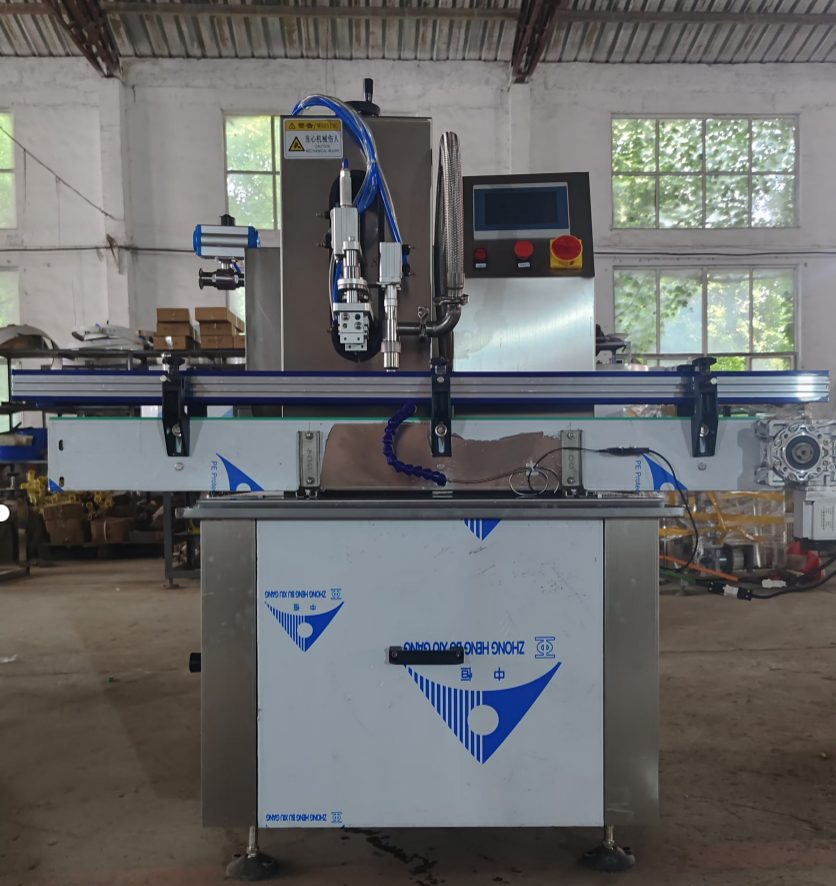
Current equipment image
Use the photo to begin the layout review, not to infer missing specifications
The hosted image shows a single filling station, conveyor, control panel, product-feed components, and a freestanding machine cabinet. The source does not publish dimensions, conveyor height, machine weight, voltage, power, air requirements, pump duty, contact-material grade, or guard specification.
- Request a signed general-arrangement drawing with service clearances.
- Confirm bottle travel direction and upstream/downstream conveyor interfaces.
- Identify every product-contact component and its material.
- Obtain the electrical, pneumatic, product-feed, and drainage schedules.
- Confirm guards, interlocks, emergency stops, and safe access points.
Bottle qualification
Approve the glass bottle at operating speed
- Nominal and brimful volume, overall height, body diameter, neck finish, and opening
- Base flatness, wall strength, dimensional tolerances, and filled-bottle weight
- Required fill target and available headspace before closure
- Bottle guide, support, sensor, and nozzle position for every format
- Change parts and setup values required across the 50 mL-5 L published range
- Breakage detection, cleanup, affected-product isolation, and restart procedure
Filling acceptance
Define what will be measured and how
- Reference liquid, temperature, density, and supply condition
- Target quantity by mass, volume, or fill level and the permitted tolerance
- Sample count, measurement instrument, calibration status, and calculation method
- Required sustained speed, test duration, and permitted stops or rejects
- Smallest and largest bottle formats plus a normal production format
- Drip, splash, foam, bottle contamination, and retained-product criteria
Line integration
Add capping and packaging as separate confirmed modules
The filler should exchange stop, ready, fault, and bottle-flow conditions with connected conveyors and downstream equipment. Buffer space is required if the capper or labeler can stop while filling continues.
- Empty-bottle feeding and accumulation
- Cap placement and capping method
- Optional nitrogen dosing where the package is validated
- Labeling, coding, inspection, rejection, and carton handling
Single head does not automatically mean low or high capacity
Useful output depends on fill volume, liquid behavior, bottle positioning, the corrected speed specification, and downstream line balance. Compare an accepted single-head cycle with multi-head alternatives using the same bottle and liquid.
Cleaning and maintenance
Control the product path and filling calibration
- Drain and clean the tank, feed line, valves, measuring components, and nozzle as specified.
- Inspect seals, hoses, clamps, level control, sensors, guides, conveyor, and drives.
- Recheck fill quantity after product change, format change, maintenance, or prolonged shutdown.
- Record setup values for each approved bottle and liquid combination.
- Order spare wetted parts and control components against the final bill of materials.
Safety planning
Isolate every energy source before intervention
- Provide lockout for electrical, pneumatic, product-pressure, pump, conveyor, and stored-energy sources.
- Guard nozzle movement, bottle handling, conveyor drives, and transfer pinch points.
- Verify emergency-stop coverage and safe restart after a blocked or broken bottle.
- Provide spill containment and controls appropriate to the actual liquid.
- Complete local machinery, electrical, hygiene, and process-safety review before use.
Quotation checklist
Resolve the speed conflict before ordering
Liquid data
Product, density, viscosity, temperature, safety information, cleaning method, and representative sample.
Bottle data
Glass bottle drawings and samples for every size, including neck, base, tolerances, and filled weight.
Acceptance data
Corrected output, target quantity, tolerance method, sample count, test duration, and reject criteria.
Site data
Layout, utilities, upstream and downstream interfaces, local standards, destination, and spare-parts plan.
Related filling equipment
Compare the automation and package boundaries
Confirm the single-head filler with one accepted bottle and liquid
Send liquid data, glass bottle samples and drawings, filling targets, corrected output requirement, acceptance method, line interfaces, utilities, workshop layout, and destination country.