Automatic carton handling after bottle packing
Adjust to mixed carton sizes and apply top-and-bottom tape seals
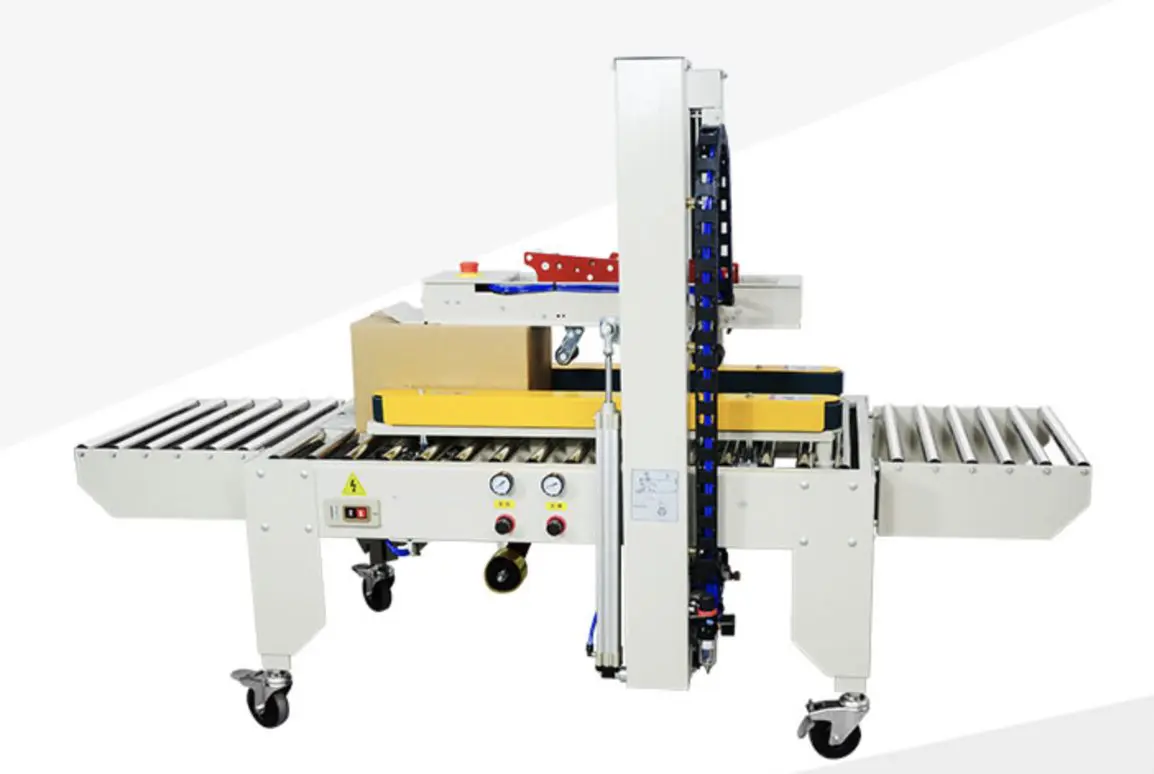
This automatic case sealer is an end-of-line packaging machine. It detects the presented carton size, adjusts its working width and height, transports the case with side belts, and applies adhesive tape to close the top and bottom. It does not measure or fill liquid.
Position in the packaging route
Seal the shipping case only after the bottles are finished and packed
The carton sealer belongs after filling, closure application, labeling, coding, inspection, and bottle grouping. Confirm which upstream machines are included because a carton erector, bottle case packer, checkweigher, and palletizing system are separate functions unless specifically listed in the proposal.
Application boundary
Choose it for variable corrugated cases within the verified working envelope
The source page positions automatic size adjustment as the main reason to select this machine. Practical compatibility still depends on carton geometry, flap condition, packed weight, tape, case spacing, and the way cartons enter and leave the sealer.
Automatic width and height adjustment
The current page states that the machine detects carton size and adjusts without manual width or height setting when carton specifications change.
Side-belt transport
Side conveyor belts are source-listed for moving the carton through the sealing section. Confirm belt contact, grip, and stability with the packed case.
Top-and-bottom tape closure
The published application is uniform tape sealing on the upper and lower carton seams. Tape width and adhesive must match the case board and shipping environment.
Mixed-size line planning
Automatic adjustment supports frequent size changes, but the source does not state the detection sequence, minimum spacing, changeover delay, or mixed-case test conditions.
The published length range needs written clarification
The live table lists carton length as “L150-∞”. This indicates a stated minimum of 150 mm but gives no finite maximum. Conveyor layout, flap geometry, case stability, tape-head cycle, and downstream transfer still impose practical limits, so approve the longest and shortest carton samples before ordering.
Published technical data
Use the source values as a sample-test and quotation checklist
The following figures reproduce the current page. The source does not identify the carton length, packed weight, tape, spacing, or test protocol behind the stated throughput.
| Parameter | Source-listed value | Buyer confirmation |
|---|---|---|
| Conveyor speed | 20 m/min | Confirm whether this is fixed or adjustable and how it coordinates with the packer and discharge conveyor. |
| Published sealing rate | Approximately 10–20 cartons/min | Request the carton size, gap, tape length, packed weight, and continuous-run basis used for this rate. |
| Carton size range | L150–∞ x W150–500 x H140–500 mm | Approve actual minimum and maximum samples; the source gives no finite maximum length. |
| Power supply | 110 / 220 V, 50 / 60 Hz, single phase | Specify one final voltage and frequency and confirm plug, breaker, and local electrical requirements. |
| Power consumption | 360 W | Confirm installed load on the final nameplate and whether conveyors or options alter it. |
| Adhesive tape width | 48 / 60 / 75 mm | Confirm compatible roll core, roll diameter, adhesive, film or paper backing, and tape-head setup. |
| Compressed-air consumption | 200 NL/min | Confirm air quality, connection size, duty basis, and whether the value covers peak or average demand. |
| Required air pressure | 0.6 MPa | Provide regulated, dry compressed air at the machine connection. |
| Table height | 600 + 150 mm | The notation is ambiguous on the source page; request a drawing that states nominal height and adjustment range. |
| Machine dimensions | 1170 x 900 x 1350 mm | The source excludes front and rear roller tables; include all conveyors and service clearance in the layout. |
| Machine weight | 180 kg | Confirm net, shipping, and installed weight plus lifting and anchoring points. |
Carton and tape trials
Test the real packed case before approving the machine
A dimensional match does not prove reliable transport or tape adhesion. Send representative cartons, or provide complete drawings and packing data, so the proposal can address the actual case construction and line conditions.
- Minimum, typical, and maximum carton length, width, and height
- Corrugated board grade, flap style, joint, surface condition, and recycled-content variability
- Empty and packed weight, bottle arrangement, center of gravity, and liquid leakage controls
- Tape width, backing, adhesive, roll dimensions, and storage temperature
- Incoming carton orientation, spacing, side-guide condition, and downstream transfer height
- Required seal pattern, tape overlap, appearance standard, and sample acceptance criteria
Line integration
Define every carton-handling handoff
- Confirm whether carton erection and bottom preparation occur manually or with a separate machine.
- Define how bottles are grouped and loaded and whether a case packer is part of the project.
- Match conveyor height, direction, speed, controls, and accumulation at both interfaces.
- Specify carton detection, jam response, upstream stop request, and downstream-ready signals.
- Allow space for rejected cases, tape changes, cleaning, maintenance, and operator access.
Utilities, safety, and service
Confirm the delivered protection and wear-part scope
- Request the electrical diagram, pneumatic diagram, emergency-stop arrangement, guards, warning labels, and lockout procedure.
- The source mentions safety protection but does not list specific devices or compliance standards.
- Inspect and service belts, rollers, tape heads, cutters, springs, sensors, air preparation, cylinders, and fasteners.
- Order spare blades, belts, rollers, tape-head wear parts, sensors, solenoid valves, seals, and recommended tools.
- Provide dry compressed air and remove tape dust, adhesive residue, loose board fibers, and damaged cartons.
Buyer configuration checklist
Send the case data together with the full packaging sequence
- Product and bottle type, bottles per carton, and packed-case weight
- Carton drawings, physical samples, board grade, flap style, and size mix
- Required cartons per minute and expected change pattern between sizes
- Tape specification and required top-and-bottom seal appearance
- Upstream case loading method and downstream palletizing or dispatch method
- Conveyor elevations, line direction, available floor space, and access route
- Voltage, frequency, compressed-air supply, destination, and documentation needs
Keep carton handling separate from liquid filling accuracy
The case sealer starts after bottles have already been filled, closed, and packed. Filling range, liquid viscosity, dosing accuracy, bottle-neck control, and product-contact sanitation belong to the upstream filling equipment, not this carton machine.
Related packaging equipment
Build the bottle line before specifying the shipping-case station
Verify the carton, tape, and conveyor handoffs together
Send carton samples or drawings, packed weight, size mix, required rate, tape specification, upstream and downstream equipment, utilities, workshop layout, and destination country.