Press-on plastic-cap module for automatic bottling lines
Seat compatible closures with synchronized double-row chain pressure
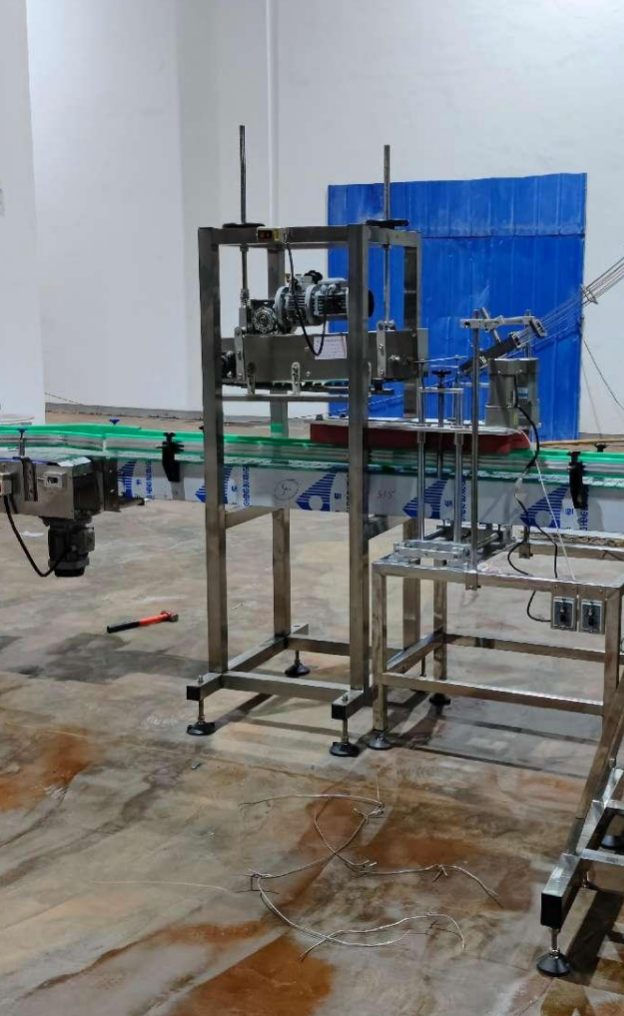
This machine combines a stainless-steel chain-plate conveyor with a synchronized compression section for source-listed plastic, anti-counterfeit, and tamper-evident caps. It belongs after filling and cap placement, then transfers the closed bottle toward labeling, coding, and packing.
Application boundary
Confirm a press-fit closure before selecting this capping principle
The current source describes compression of plastic caps. It does not document torque control for threaded screw caps, roll-on pilfer-proof heads, induction sealing, or a cap-sorting system. For roll-on aluminium and pilfer-proof caps, the TY-4 semi-automatic cap sealing machine is the matching machine.
Closure style
Source-listed applications include plastic, anti-counterfeit, and tamper-evident caps. Supply the closure drawing and samples so the seating method and security-ring behavior can be checked.
Bottle interface
The published bottle-height range is 150–400 mm. Bottle diameter, neck finish, shoulder shape, wall stiffness, and acceptable top load are not stated.
Cap presentation
A cap must be correctly placed on the neck before the synchronized chains apply pressure. Confirm whether cap placement is manual or supplied by a sorter, chute, and pick-off arrangement.
Product scope
The source positions the machine for edible oil, beverage, liquor, and other non-carbonated liquid lines. Product suitability still depends on the filled bottle, closure, hygiene plan, and required packaging standard.
Do not treat it as a universal screw capper
The page does not publish a torque range, chuck specification, spindle count, or torque-control method. Threaded closures should be reviewed against a separately confirmed capping head.
Operating sequence
Coordinate filling, cap placement, compression, and discharge
The final line sequence depends on the bottle and closure. The cap-placement method is not defined on the source page and must be included explicitly in the proposal.
Line interfaces
Match the mechanical handoffs before matching nominal speed
The source publishes conveyor travel speed, not bottle throughput. Bottle pitch, cap-placement reliability, accumulation, and downstream acceptance determine the usable line rate.
| Interface | Current source | Project confirmation |
|---|---|---|
| Upstream bottle feed | Compatible with an upstream filling machine | Confirm bottle pitch, guide-rail width, fill temperature, product on the neck, and any required accumulation. |
| Main conveyor | Stainless-steel chain plate; 3–14 m/min adjustable speed | Confirm conveyor height, working width, travel direction, transfer plates, speed-control method, and line-level setpoint. |
| Cap supply | Not published | Define manual placement or the included sorter, elevator, chute, cap detector, low-cap alarm, and change parts. |
| Compression zone | Synchronized double-row chain pressing | Confirm working gap, height adjustment, pressure setting, bottle support, security-band clearance, and approved closure test. |
| Downstream transfer | Described as suitable for labeling and packaging integration | Confirm discharge height, back-pressure limits, bottle spacing, reject handling, and the next conveyor speed. |
| Controls | 0.37 kW motor; other control details not published | Confirm voltage, frequency, phase, inverter, sensors, PLC or relay logic, emergency stop, alarms, and external line signals. |
| Guarding | Not published | Specify access guarding around chains, sprockets, drives, bottle pinch points, and any cap-feeding equipment. |
Published specification
Source-listed reference values for the current machine
These figures reproduce the live product page. Confirm the final drawing, electrical data, adjustment method, and tested bottle-cap combination in the technical quotation.
| Parameter | Source-listed value | Buyer check |
|---|---|---|
| Suitable bottle height | 150–400 mm | Submit the complete bottle drawing; no diameter or neck range is published. |
| Motor power | 0.37 kW | Confirm supply voltage, frequency, phase, motor data, and speed-control hardware. |
| Running speed | 3–14 m/min, adjustable | This is conveyor speed, not a guaranteed bottles-per-minute output. |
| Machine dimensions | 1000 × 750 × 1600 mm | Confirm dimension order, conveyor height, adjustment envelope, and service clearance. |
| Conveyor type | Stainless-steel chain plate | Confirm chain width, pitch, grade, guide-rail material, and transfer interfaces. |
| Cap type | Plastic caps / anti-counterfeit caps | Approve cap and bottle samples through a seating and security-band test. |
| Machine body | Source describes stainless-steel construction | Confirm material grade and which frame, cover, fastener, and product-zone components are included. |
No throughput test basis is published
The source does not state bottle diameter, cap geometry, bottle pitch, cap-feed method, line efficiency, or test duration. Use 3–14 m/min only for conveyor-interface planning until a complete bottle trial establishes practical output.
Bottle and cap approval
Test the complete package, not only nominal dimensions
- Bottle drawing, material, filled weight, height, diameter, neck finish, shoulder profile, and top-load limit
- Cap drawing, resin, diameter, height, liner, tamper band, security ring, and required seated position
- Filled-product temperature, neck cleanliness, expected bottle deformation, and leakage criteria
- Accepted visual marks, cap-height tolerance, security-feature inspection, and pull-off or retention test
- Representative production samples from the intended bottle and cap suppliers
Change parts and adjustments
Define what changes between bottle formats
- Guide-rail width, conveyor transfer, bottle support, and compression-chain height and gap
- Cap chute, escapement, pick-off, or placement tooling when automatic cap feeding is included
- Bottle spacing device or timing mechanism, if required for the selected line speed
- Recipes, mechanical scales, tools, and documented changeover sequence
- Change-part list with format identification and storage arrangement
Operation and safety
Control bottle jams without exposing the chain drive
- Keep chain, sprocket, drive, and bottle pinch points guarded during production.
- Provide accessible stop controls and a documented isolation procedure before clearing jams.
- Interlock the cap-feed and compression section with upstream and downstream stop conditions.
- Reject tilted caps, missing caps, damaged security bands, and unstable bottles before packing.
- Confirm local machine-safety requirements and the final guarding scope before shipment.
Maintenance and spares
Inspect wear and alignment before closure quality changes
- Request part numbers for chains, sprockets, guides, bearings, motor, drive, sensors, and cap-handling parts.
- Check chain tension, synchronized tracking, guide alignment, fasteners, and conveyor transfer points.
- Clean product residue from the bottle path without contaminating lubricated components.
- Record settings for each approved bottle and cap format.
- Include the recommended startup spares, lubrication schedule, and wear limits in the documentation package.
Quotation checklist
Information needed for a line-ready capping proposal
- Bottle and cap drawings, samples, materials, supplier tolerances, and filled product weight
- Required bottles per minute, current conveyor speed, bottle pitch, and operating hours
- Cap placement method and whether a cap sorter, elevator, chute, and low-level alarm are required
- Upstream filler discharge height and downstream labeling or coding equipment
- Electrical supply, compressed-air availability if any accessory needs it, and preferred line-control signals
- Workshop layout, conveyor direction, access, cleaning plan, destination, and safety requirements
Request a bottle-and-cap trial report
A useful approval record should identify the exact bottle and cap, conveyor setting, compression adjustment, tested speed, sample quantity, seated-cap result, leakage check, appearance, and any observed bottle deformation.
Related packaging equipment
Connect bottle feeding, filling, closure, labeling, and coding
Validate the closure before fixing the capping-line layout
Send bottle and cap samples, drawings, required output, cap-feed plan, upstream and downstream machine data, conveyor height and direction, utilities, workshop layout, and destination country.