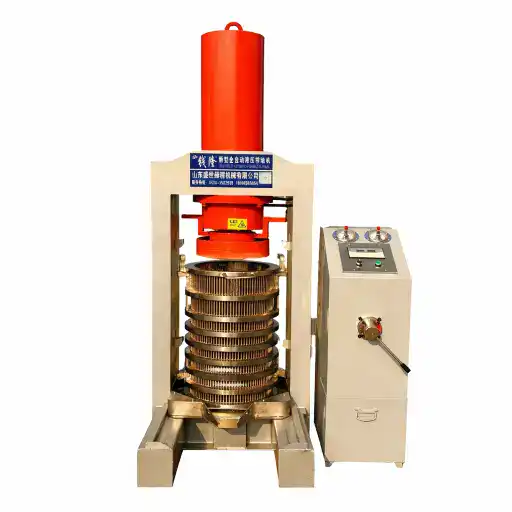
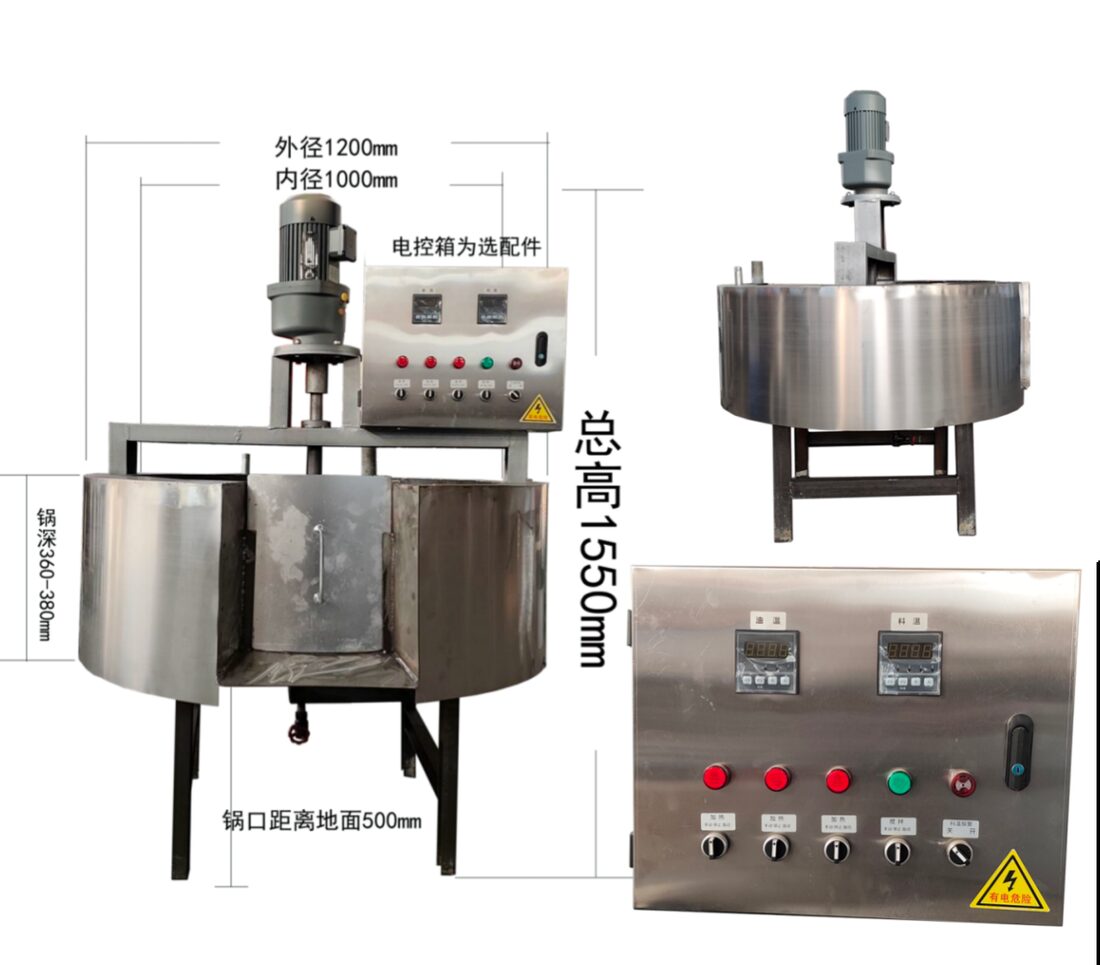
Electric thermal-oil flat-bottomed wok
Condition crushed oilseed before a hot-press batch
This agitated wok uses staged electric heating through a thermal-oil jacket. It is positioned after cleaning and size reduction and before the hydraulic press when the selected process requires roasted or heated material.
Hot-press process position
Keep preparation, heating, and pressing in one operating rhythm
The wok is not a standalone oil-production solution. Its useful output is a prepared batch that can move into the hydraulic press at the selected condition and without unnecessary waiting.
Do not assume one recipe for every oilseed
Loading, heat input, agitation, moisture adjustment, residence time, and discharge condition depend on the material and product target. Request a material-specific operating basis rather than copying a peanut or sesame setting to another seed.
Construction and control
An insulated, agitated pot with staged electric heating
The points below come from the current page. Confirm the precise contact materials, thermal-oil circuit, control functions, and supplied electrical components before production.
Reinforced double-layer bottom
The source describes a reinforced double-layer base that contains the heat-transfer arrangement below the material zone.
Thermal-oil electric heating
Electric elements heat the circulating or contained thermal oil, which transfers heat into the pot rather than exposing the batch directly to the elements.
Motor-reducer agitation
A geared drive rotates the agitator to move material across the flat-bottomed pot during the heating stage.
Insulated stainless-clad body
The published description identifies rock-wool insulation around the pot body and stainless-steel outer cladding.
Published specification
Use the current dimensions and loads for site planning
The live page does not provide a material-specific batch capacity or cycle time. Confirm both through a test basis for the actual oilseed and prepared feed form.
| Parameter | Source-listed value | Project confirmation |
|---|---|---|
| Equipment dimensions | 1200 x 1200 x 1550 mm | Confirm the final drawing, service clearances, and shipping dimensions. |
| Pot outer / inner diameter | 1200 / 1000 mm | Confirm usable diameter and agitator sweep. |
| Pot depth | 360–380 mm | Confirm usable fill level for the selected material. |
| Discharge outlet | 260 mm wide; 500 mm above floor | Match the receiving trolley, tray, or press-loading method. |
| Agitator motor | 1.1 kW | Confirm motor voltage, phase, frequency, and reducer ratio. |
| Heating power selections | 9 / 18 / 27 kW | Confirm the switching logic and installed protection. |
| Total connected power | 27 + 1.1 kW | Size the cable, breaker, isolation, and local supply accordingly. |
| Approximate machine weight | 308 kg | Confirm packed weight and lifting points. |
| Legacy thermal-oil entry | 350# / 50 kg, buyer supplied | Obtain the approved fluid specification and fill procedure in writing. |
Optional electrical control
Specify what the control cabinet actually automates
The current page describes an optional control box with stepped heating, alarms, automatic heating start and stop, and automatic agitator start and stop. Confirm the supplied sensors and logic behind each function.
- Temperature sensor location and displayed process value
- Setpoint control, alarm conditions, and heater interlocks
- Agitator start, stop, overload, and emergency-stop behavior
- Thermal-oil overtemperature and low-level protection where applicable
- Control language, enclosure rating, electrical drawings, and spare components
The control cabinet is source-listed as optional
Do not assume the pictured cabinet or every automation function is included in the base machine. Put cabinet scope, sensors, alarms, heating stages, motor controls, and destination electrical standard into the signed quotation.
Machine reference video
Check loading, agitation, and discharge access
Use the existing video to discuss how material enters the pot, where the operator stands, how the agitator and cover area are accessed, and what receives the hot batch at the discharge outlet.
Operation and utilities
Plan for heat, motion, and hot-material transfer
- Confirm the site can support the listed 28.1 kW connected load.
- Use only the approved heat-transfer fluid and documented fill quantity.
- Provide guarded, unobstructed access to loading and discharge points.
- Keep the transfer path to the hydraulic press short and controlled.
- Define startup, heat-up, loading, discharge, shutdown, and cooldown procedures.
Cleaning and maintenance
Make the pot and thermal system serviceable
- Request cleaning instructions for the pot, agitator, shaft area, and discharge outlet.
- Inspect the reducer, motor, bearings, fasteners, and agitator clearance on schedule.
- Record the thermal-oil inspection and replacement basis supplied with the machine.
- Confirm heater, sensor, contactor, controller, seal, and bearing spare-part numbers.
- Never reach into the pot or work on the agitator until power is isolated and locked out.
Buyer configuration checklist
Define the batch entering and leaving the wok
- Oilseed type, variety, cleanliness, and sample photos
- Whole, shelled, cracked, granular, or powdered feed condition
- Incoming moisture and required heated-batch condition
- Planned batch weight, batches per hour, and operating hours
- Press model, barrel size, press count, and loading method
- Voltage, frequency, phase, workshop layout, and destination
Capacity is deliberately not stated on this page
The current source provides machine dimensions and installed power but no reliable batch-capacity figure. Ask for a test or written recommendation based on the material bulk density, prepared particle form, fill depth, and required heating cycle.
Related hot-press equipment
Complete the preparation and pressing route
Match the wok to the oilseed and press schedule
Send the raw material, prepared feed form, batch requirement, heating route, press model, electrical supply, workshop dimensions, and destination country.