
On this page
- Why Tonnage Is Only a Marketing Number
- Real Industrial Model Naming Logic
- Why Cylinder Diameter Directly Affects Oil Yield
- Standard Cold Press Barrel Is the Same for All Models
- Why High-Value Seeds Need Higher Pressure
- How to Choose the Right Model in Practice
- The Engineering Truth Most Suppliers Won’t Tell You
- Conclusion
In industrial cold oil pressing, many buyers focus only on “tonnage” — such as 370 ton, 500 ton or 630 ton hydraulic presses.
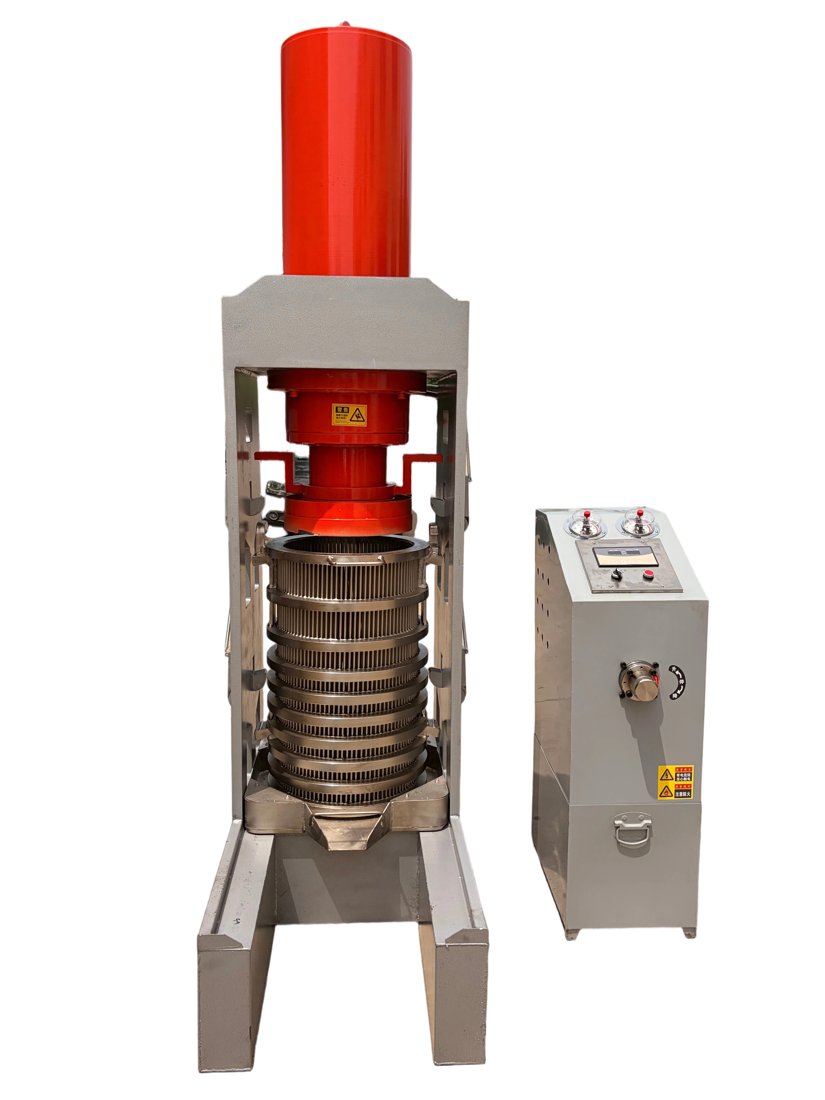
However, in real engineering systems, machine models are not defined by tonnage, but by hydraulic cylinder diameter.
Tonnage is only a calculated result.
Cylinder diameter is the true physical parameter that determines working pressure, pressing force, and final oil yield.
Understanding this difference is critical when selecting a cold press system for high-value oilseeds.
Why Tonnage Is Only a Marketing Number
The working pressure of a hydraulic oil press is calculated by a simple formula:
Pressing Force = Hydraulic Pressure × Cylinder Area
This means:
- The hydraulic system pressure (MPa) is almost the same 60MPA for all models.
- The only real variable is cylinder diameter.
- Larger cylinder = larger area = higher real pressing force.
So when suppliers say:
- 370 ton
- 500 ton
- 630 ton
These numbers are not machine types.
They are just theoretical force values converted from cylinder size.
Real Industrial Model Naming Logic
In professional manufacturing, cold press models are named by hydraulic cylinder diameter, not by tonnage.
Typical industrial mapping:
| Cylinder Diameter (mm) | Real Working Pressure |
|---|---|
| 355 mm | ≈ 370 ton |
| 400 mm | ≈ 410 ton |
| 426 mm | ≈ 500 ton |
| 480 mm | ≈ 600 ton |
| 500 mm | ≈ 630 ton |
So when you see:
- “426 model” → it means 426 mm cylinder
- “500 ton” → it means about 426 mm cylinder
The 426 is the machine model.
500 ton is only the calculated result.
Why Cylinder Diameter Directly Affects Oil Yield
In cold pressing, oil yield depends on:
- How well oil cells are broken (pre-press stage)
- How much real mechanical force is applied (hydraulic stage)
Cylinder diameter controls:
- Maximum compressive stress inside the pressing chamber
- Residual oil content in oil cake
- Final extraction efficiency
Simply put:
Larger cylinder = stronger internal stress = lower residual oil = higher yield
This effect becomes very obvious for hard and high-value seeds.
Standard Cold Press Barrel Is the Same for All Models
An important industrial fact many buyers don’t know:
All cold press models from 370–630 ton use the same standard barrel size:
- Inner diameter: 390 mm
- Height: 800 mm
- Batch capacity: 60–100 kg
- With pre-press compaction: up to 100 kg per batch
So:
- The material volume is the same
- The barrel is the same
- Only the cylinder diameter changes the pressure
That is why higher models do not increase capacity —
they increase extraction depth.
Why High-Value Seeds Need Higher Pressure
Cold pressing is mostly used for high-value oilseeds such as:
- Walnut
- Almond
- Pine nut
- Perilla seed
- Hemp seed
- Flaxseed
- Tea seed (Camellia)
- Pumpkin seed
- Sea buckthorn
These materials share the same features:
- Hard structure
- Low free oil
- Thick cell walls
- High residual oil risk
If pressure is not high enough:
- Oil cake remains soft
- Residual oil increases
- Economic loss becomes significant
For these materials:
Pressure selection directly affects ROI, not just yield percentage.
How to Choose the Right Model in Practice
For Medium-Value Oilseeds
Examples: flaxseed, sunflower, pumpkin seed
Recommended:
- 426 model (≈ 500 ton) Best balance between:
- Investment cost
- Energy consumption
- Yield improvement
For High-Value Oilseeds
Examples: almond, walnut, pine nut, tea seed
Recommended:
- 500 model (≈ 630 ton) Because:
- Each extra 1–2% yield pays back the machine quickly
- Residual oil reduction is economically critical
The Engineering Truth Most Suppliers Won’t Tell You
In real industrial design:
There is no such thing as a “500 ton machine model”.
There is only a “426 mm cylinder machine”.
Everything else is:
- marketing language
- sales conversion
- or simplified for non-technical buyers
But in serious cold press systems:
Cylinder diameter is the real machine identity.
Conclusion
When selecting a cold press hydraulic oil press:
Do not ask:
“How many tons is this machine?”
Ask instead:
“What is the cylinder diameter?”
Because:
- Cylinder diameter defines real force
- Real force defines oil yield
- Oil yield defines your profit
And in cold pressing, profit is always a pressure problem, not a capacity problem.
Project planning
Configure the right oil press and production line
Send your oilseed, target output, bottle or packaging requirements, power supply, and destination country. We will match the machine, supporting equipment, and line layout.