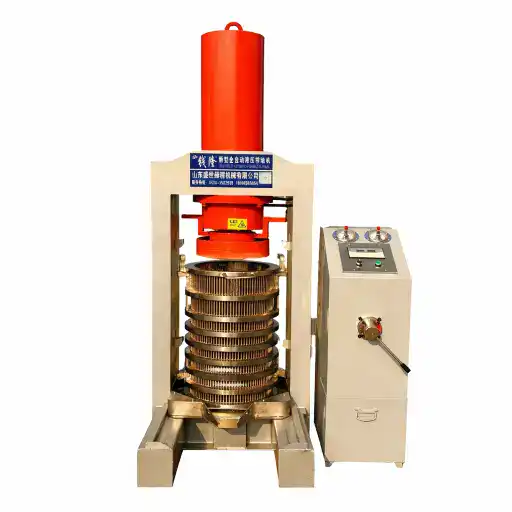
Hydraulic oil press machine guide
Compare the process route, barrel, force, and operating envelope
The current range includes 300 and 325 models for prepared hot-press materials, five higher-force models for hydraulic cold-press projects, and compact KHOP machines for smaller batches. Select from the oilseed and process requirement, not from tonnage alone.


Working principle
Hydraulic presses extract oil in controlled batches
Prepared material is loaded into a pressing barrel. The hydraulic system moves the cylinder and applies force through the pressing assembly. Oil exits through the barrel’s oil paths, while compressed material remains as cake for unloading after the cycle.
- Batch production requires loading and cake-removal time around the pressure cycle.
- The barrel geometry and prepared feed affect loading range and cake pressure.
- Oil collection, settling or filtration, and cake handling are separate process steps.
- The oilseed route may require cleaning, crushing, heating, roasting, or conditioning first.
Hydraulic-system pressure is not press force
The current full-size pages list a 60 MPa system pressure while model down pressure ranges from 300 to 630 tons. Barrel diameter and cake area also affect the listed cake surface pressure. Keep these values in separate comparison columns.
Full-size model map
Seven published models from 300 to 630 tons down pressure
All figures below are summarized from the current first-party hot- and cold-press family pages. Press volume is a barrel reference, not a guaranteed load or output for every material.
| Process family | Model | Down pressure | System pressure | Published barrel choices | Published press-volume range |
|---|---|---|---|---|---|
| Prepared hot pressing | 300 | 300 tons | 60 MPa | 390 x 800 mm or 300 x 800 mm | 5-100 kg or 5-60 kg by barrel |
| 325 | 325 tons | 60 MPa | 390 x 800 mm or 300 x 800 mm | 5-100 kg or 5-60 kg by barrel | |
| Hydraulic cold pressing | 355 | 370 tons | 60 MPa | 390 x 800 mm or 300 x 800 mm | 5-100 kg or 5-60 kg by barrel |
| 400 | 410 tons | 60 MPa | 390 x 800 mm or 300 x 800 mm | 5-100 kg or 5-60 kg by barrel | |
| 426 | 500 tons | 60 MPa | 390 x 800 mm or 300 x 800 mm | 5-100 kg or 5-60 kg by barrel | |
| 480 | 600 tons | 60 MPa | 390 x 800 mm or 300 x 800 mm | 5-100 kg or 5-60 kg by barrel | |
| 500 | 630 tons | 60 MPa | 390 x 800 mm or 300 x 800 mm | 5-100 kg or 5-60 kg by barrel |
Barrel selection
Choose batch range and cake area before stepping up the model
The product pages offer two 800 mm-high barrel references. The narrower barrel reduces the published press-volume range while increasing the page’s listed cake surface-pressure values.
390 mm barrel
The full-size pages publish a 5-100 kg press-volume range for crushed or powdered feed. This range must still be confirmed for the actual oilseed, particle form, loading method, and process route.
- 390 mm internal-diameter reference
- 800 mm barrel height
- Higher listed machine weight than the corresponding 300 mm configuration
300 mm barrel
The pages publish a 5-60 kg press-volume range and higher listed cake surface pressure. Confirm the required cake diameter, loading arrangement, and actual batch test before selecting it.
- 300 mm internal-diameter reference
- 800 mm barrel height
- Lower published press-volume range for the full-size families
Engineering-unit conflict
The source tables label cake surface pressure as MPa/cm2, and one cold-press sentence uses Pa/cm2 for a value that the table presents as MPa/cm2. Confirm the unit, formula, and drawing basis in the technical quotation before comparing another machine.
Operating references
Published cycle figures are planning inputs, not universal capacity
| Current family page | Published cycle reference | Conditions still required |
|---|---|---|
| Models 300 / 325 | 30-40 minutes per barrel excluding feeding and cake unloading; two barrels in 1.5 hours including those tasks | Oilseed, preparation, batch load, operator, pressure sequence, temperature, cleaning, and downtime. |
| Models 355-500 | 2 hours per barrel excluding feeding and cake unloading; two barrels in 4.5 hours including those tasks | Material, particle form, batch load, temperature limit, pressure sequence, oil-flow end point, and cleaning. |
| Compact KHOP pages | Individual pages publish 24-hour capacity references but do not publish the cycle, material, utilization, or finished-oil basis | Use model-specific batch and repeated material tests instead of converting the headline directly to saleable oil. |
Core machine systems
Confirm each assembly in the quoted configuration
The current product pages describe these systems at family level. Require a model-specific component list, drawing, electrical diagram, spare-parts list, and final packing list.
Pressing barrel
Material chamber and oil paths
The full-size pages describe welded trapezoidal key bars and a forged reinforcing flange. Confirm selected diameter, material specification, cleaning access, and supplied accessories.
Hydraulic station
Pumps, valves, gauges, and protection
The pages describe a high-low dual-pump arrangement, relief and safety valves, directional control, and dual pressure gauges. Confirm the component schedule and operating settings.
Cylinder and frame
Force path and guiding elements
The source identifies alloy cylinder tubing, seals, guide bands, and different frame descriptions for the hot- and cold-press families. Confirm the ordered model drawing and service method.
Drive and control
Motor, electrical package, and sequence
The full-size pages list a 2.2 kW motor and microcomputer control at family level. Confirm voltage, phase, frequency, current, protection, control language, and final nameplate data.

Selection sequence
Choose the machine in five evidence-based steps
- Define the material. State oilseed, shell condition, cleanliness, moisture, particle form, oil content when known, and provide a sample.
- Define the process. Choose the hot- or cold-press route and state preparation and maximum allowable temperature.
- Define the work. Set batch target, operating hours, complete cycle, cleaning, staffing, and required oil and cake condition.
- Select barrel and force. Use a material test and engineering data rather than moving to the highest tonnage automatically.
- Check the site and line. Confirm dimensions, weight, access, floor, power, filtration, storage, packaging, installation, and spares.
Compact hydraulic models
Use a separate shop-scale selection route
The KHOP-10KG, KHOP-15KG, and KHOP-20KG pages publish different dimensions, weights, electrical references, and 24-hour capacity figures. The parent page also contains conflicting statements about material suitability, so written confirmation and a representative test are required.
Supporting equipment
The press is one section of the production route
Source limitation
The previous guide presented broad oil-quality, purity, wear, cost, and suitability advantages without a common comparison test. It also repeated barrel loads and cycle claims without all material conditions. This revision keeps model data traceable to the current product pages and marks the missing engineering or test basis.
Restored original media
Hydraulic press model photographs
Original hot-press and cold-press machine views restored to the model guide.

300-325 hydraulic oil press machine
Original photograph restored from the earlier page.
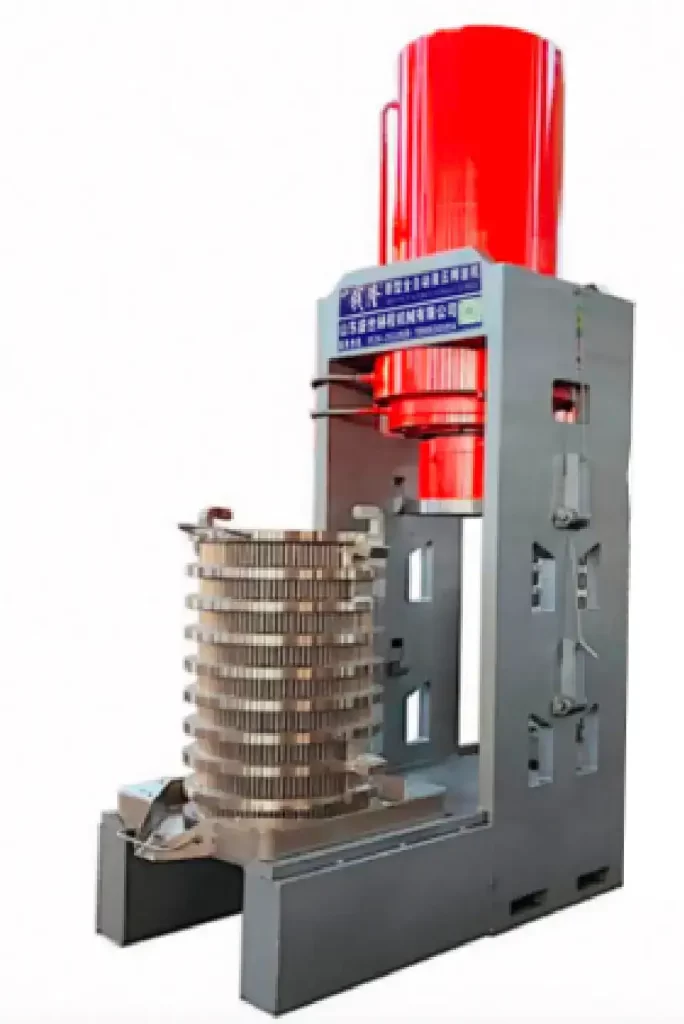
Restored machine detail
Original photograph restored from the earlier page.
Send the oilseed and the operating requirement
Include feed condition, hot- or cold-press route, batch target, work schedule, temperature limit, required oil and cake condition, site, power, destination, and supporting-equipment scope.