
On this page
- Hydraulic Oil Press Capacity Explained: The Truth Behind 100kg Per Batch
- Introduction: Why Capacity Is So Confusing in the Oil Press Industry
- The Truth About the “100kg Standard Barrel”
- Is 60kg Based on Whole Seeds?
- What Is Pre-Pressing and Why Is It Used?
- Why Sesame Uses Only 30kg Per Batch
- Cold Press vs Hot Press: Time Difference
- Real Industrial Capacity Summary
- Common Misunderstandings About Oil Press Capacity
- Final Conclusion: What Capacity Should Buyers Trust?
- Final Insight
- If you are looking for a reliable hydraulic oil press machine with real production capacity, we can provide professional guidance based on your material, production scale, and operation method.
Hydraulic Oil Press Capacity Explained: The Truth Behind 100kg Per Batch
Introduction: Why Capacity Is So Confusing in the Oil Press Industry
If you search for hydraulic oil press machines, you will often see claims like:
- “100kg per batch”
- “Large capacity barrel”
- “High output hydraulic press”
However, in real production, capacity is one of the most misunderstood parameters in the oil pressing industry.
The numbers shown in brochures are usually theoretical maximum values, not the actual working capacity used in oil mills.
This article explains the real industrial capacity based on practical factory operation and engineering logic.
The Truth About the “100kg Standard Barrel”
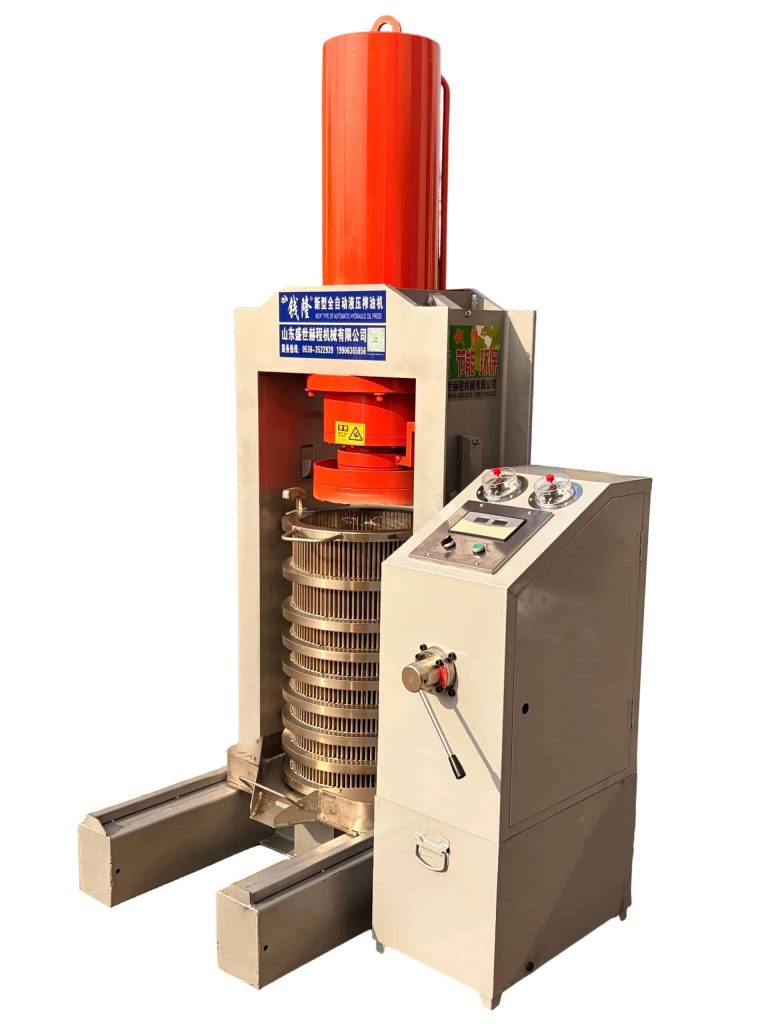
Most hydraulic oil press machines use a standard large barrel with:
- Inner diameter: around 390mm
- Height: around 800mm
Theoretically, this barrel can hold up to 100kg of material.
However:
👉 100kg is the extreme limit, not the normal working capacity
In real production, most factories load:
- Around 60kg per batch
- And start pressing immediately
This is because once the crushed material fills the barrel, it is already physically full under normal conditions.
Is 60kg Based on Whole Seeds?
No — this is a very common misunderstanding.
Even the 60kg working capacity is already based on crushed material, not whole seeds.
In real oil mills:
- All oil materials are crushed before pressing
- Whole seeds are almost never pressed directly
- Capacity data always refers to processed feedstock
👉 So 60kg is not “low” — it represents real industrial production capacity.
What Is Pre-Pressing and Why Is It Used?
Pre-pressing is a simple compression step performed by the hydraulic system to:
- Remove air gaps
- Increase material density
- Allow more material to fit inside the barrel
With pre-pressing:
- The same barrel can reach close to 100kg capacity
However:
- This is not standard daily operation
- It increases cycle time
- It reduces overall efficiency
👉 In most factories, pre-pressing is optional
👉 60kg direct loading is the mainstream working method
Why Sesame Uses Only 30kg Per Batch
Sesame is a special case in hydraulic oil pressing.
In real production, sesame is typically processed using:
- Small barrel (around 300mm diameter)
- Around 30kg per batch
- No pre-pressing
The Key Reason: Fast In, Fast Out
This is not primarily about oil quality, but about pressing cycle efficiency and thermal stability.
Sesame pressing requires a short and efficient pressing cycle.
If the batch size is too large:
- Pressing time becomes longer
- Heat dissipates during the process
- Internal temperature drops
- Oil flow efficiency decreases
As a result:
- Oil yield may decrease
- Pressing becomes unstable
Why Smaller Batches Work Better
Using smaller batches allows:
- Faster pressure buildup
- Shorter pressing cycle
- Better heat retention during pressing
- More stable oil discharge
👉 The goal is not “better quality from smaller volume”
👉 The real goal is maintaining an efficient and stable pressing process
Cold Press vs Hot Press: Time Difference
Another key factor affecting real capacity is pressing time.
Typical working cycles:
| Pressing Mode | Time Per Batch | Material reference |
|---|---|---|
| Hot pressing | 30–40 minutes | sesame, tea seed, walnut, peanut, soybean, flax, rapeseed, mustard, sunflower seed, etc. Also suit for oil sludge, oil residue, meal, waste clay, animal oil residue, medicinal residue dehydration. |
| Cold pressing | Around 2 hours | Walnut, sea buckthorn oil, perilla seed, coconut oil, tea seed, hemp seed, flaxseed, almond, pine nut, pumpkin seed, chemical waste clay, activated carbon decolorizer, etc |
This means:
- Hot pressing → higher hourly output
- Cold pressing → lower throughput, higher nutritional retention
👉 Capacity must always be evaluated together with time per batch
Real Industrial Capacity Summary
| Material Type | Barrel Size | Real Load |
|---|---|---|
| Most seeds & nuts | 390mm standard | ~60kg |
| Max limit (with pre-press) | 390mm | ~100kg |
| Sesame | 300mm small | ~30kg |
Common Misunderstandings About Oil Press Capacity
Bigger Barrel = Higher Output ❌
Not always. Real output depends on cycle time and process efficiency.
Maximum Capacity = Working Capacity ❌
Maximum values are rarely used in real production.
Lower Capacity Means Lower Performance ❌
In some cases (like sesame), lower capacity improves process stability.
Final Conclusion: What Capacity Should Buyers Trust?
When evaluating a hydraulic oil press machine, do not ask:
👉 “What is the maximum capacity?”
Instead, ask:
👉 “What is the real working capacity per batch in continuous production?”
The honest answer in most real oil mills is:
- ~60kg per batch for standard materials
- ~30kg per batch for sesame
- ~100kg only with pre-pressing (not daily use)
Final Insight
There is a clear difference between:
- Marketing numbers
- Engineering reality
Understanding this difference will help buyers make better decisions and avoid misleading specifications.
If you are looking for a reliable hydraulic oil press machine with real production capacity, we can provide professional guidance based on your material, production scale, and operation method.
👉 Contact us now for:
- Real capacity recommendation
- Machine configuration advice
- Quotation and technical support
Project planning
Configure the right oil press and production line
Send your oilseed, target output, bottle or packaging requirements, power supply, and destination country. We will match the machine, supporting equipment, and line layout.