
On this page
- Hydraulic Press Structure Comparison Guide
- 1️⃣ Material Characteristics Comparison
- 2️⃣ Barrel Structure Difference
- Sesame Structure
- Other Oil Seeds Structure
- 3️⃣ Hydraulic Model Selection Logic
- For Sesame:
- For Other Oil Seeds:
- 4️⃣ Production Rhythm Difference
- 5️⃣ Oil Yield Stability
- 6️⃣ Investment Strategy Perspective
- Final Engineering Conclusion
- FAQ
- Get the right oil-seed press recommendation
Hydraulic Press Structure Comparison Guide
Choosing the correct hydraulic oil press structure depends heavily on the raw material.
Many oil mill investors assume all oil seeds can be processed using the same barrel size and machine configuration. In reality, sesame requires a completely different structural approach compared to other oil materials.
This guide explains the key engineering differences.
1️⃣ Material Characteristics Comparison
| Factor | Sesame | Other Oil Seeds (Peanut, Soybean, Sunflower, etc.) |
|---|---|---|
| Particle size | Very small | Medium to large |
| Flowability under pressure | Very high | Moderate |
| Structural cohesion after heating | Strong (hot press) | Varies |
| Suitable pressing type | Hot press only | Hot or cold press |
| Pressure concentration requirement | Very high | Standard |
Because sesame particles are small and mobile, they require stronger pressure concentration within a smaller chamber.
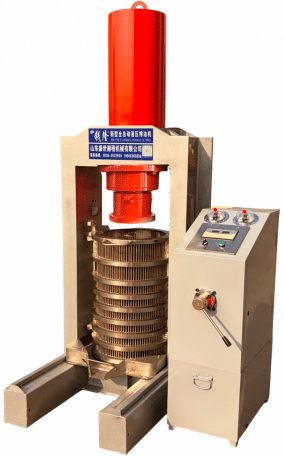
2️⃣ Barrel Structure Difference
Sesame Structure
- Barrel inner diameter: 300mm
- Batch capacity: 30kg
- No pre-press
- Hot press only
- One batch at a time
Why 300mm?
A smaller chamber:
- Concentrates hydraulic force
- Prevents sideways material movement
- Ensures stable oil cake formation
- Maintains high oil yield
Using a 390mm standard barrel for sesame can cause:
- Loose cake formation
- Lower oil extraction rate
- Material escape
- Unstable pressure performance
Other Oil Seeds Structure
For peanut, soybean, sunflower, etc.:
- Standard barrel inner diameter: 390mm
- Extreme capacity: 100kg
- Recommended working load: around 60kg
- Pre-press allowed
- Suitable for hot or cold pressing
These materials:
- Have larger particle structure
- Are easier to compress
- Require less extreme pressure concentration
Therefore, larger barrels improve efficiency without sacrificing oil yield.
3️⃣ Hydraulic Model Selection Logic
Hydraulic model naming is based on cylinder diameter:
There is no 390 series machine.
For Sesame:
- 300 model
- 325 model
These models use a channel steel frame structure, ideal for hot pressing cycles.
For Other Oil Seeds:
- 355–500 models are commonly selected
- Designed more for cold press positioning
- Larger structural load capacity
4️⃣ Production Rhythm Difference
Sesame
- Roast first
- Load 30kg
- Press
- Release
- Repeat
Clear batch production rhythm.
Other Oil Seeds
- Can pre-press
- Can load up to 60kg working capacity
- More flexible production scheduling
- Suitable for higher batch efficiency
5️⃣ Oil Yield Stability
Incorrect barrel selection for sesame leads to:
- Lower oil yield
- Inconsistent cake density
- More residual oil
- Reduced profitability
Correct structural matching ensures:
- Stable hydraulic pressure
- Consistent oil cake
- Predictable output
- Better return on investment
6️⃣ Investment Strategy Perspective
For investors:
Starting with Sesame Only
- 300 or 325 model
- 300mm barrel
- Hot press configuration
- Lower initial investment
- Stable small-scale production
Multi-Material Oil Mill
- Standard 390mm barrel
- Larger cylinder models
- Cold + hot press flexibility
- Higher capacity potential
Selecting based on material strategy is more important than simply choosing a larger machine.
Final Engineering Conclusion
Sesame is not just another oil seed.
It requires:
- Smaller pressing chamber
- Concentrated hydraulic force
- Hot press-only processing
- Specific machine configuration
Other oil seeds can use larger barrels and more flexible configurations.
Understanding these structural differences prevents:
- Equipment mismatch
- Yield loss
- Operational inefficiency
- Investment mistakes
For production startup please refer to the hydraulic sesame oil production line
FAQ
Why is sesame different from peanut or soybean?
Sesame is smaller, more mobile under pressure, and more sensitive to structure and pressure concentration than many other oil seeds.
Which model is better for sesame retail business?
For small retail and fresh-oil selling, Korean type or KHOP small hydraulic models are usually more suitable.
Which model is better for premium sesame batch production?
For medium premium batch production, 325 hydraulic oil press is usually the stronger recommendation.
Get the right oil-seed press recommendation
If you tell us which oil seed you plan to process and whether the goal is shop retail, premium batch production, or continuous output, we can recommend the right structure and machine route. You can also review our Korean type small hydraulic oil press machine, 325 hydraulic oil press machine, or go to Contact Us to request a quote.
Related resources
- Hydraulic Oil Press Machine Price by Model
- Sesame Oil Production Guide
- Hydraulic vs Screw Press for Sesame Oil
Korean-Type Hydraulic Press in Operation
This original factory video shows a stainless-steel Korean-type hydraulic press during batch operation. Use it as a visual reference; confirm the quoted model, material, batch load, and output separately.
Project planning
Configure the right oil press and production line
Send your oilseed, target output, bottle or packaging requirements, power supply, and destination country. We will match the machine, supporting equipment, and line layout.