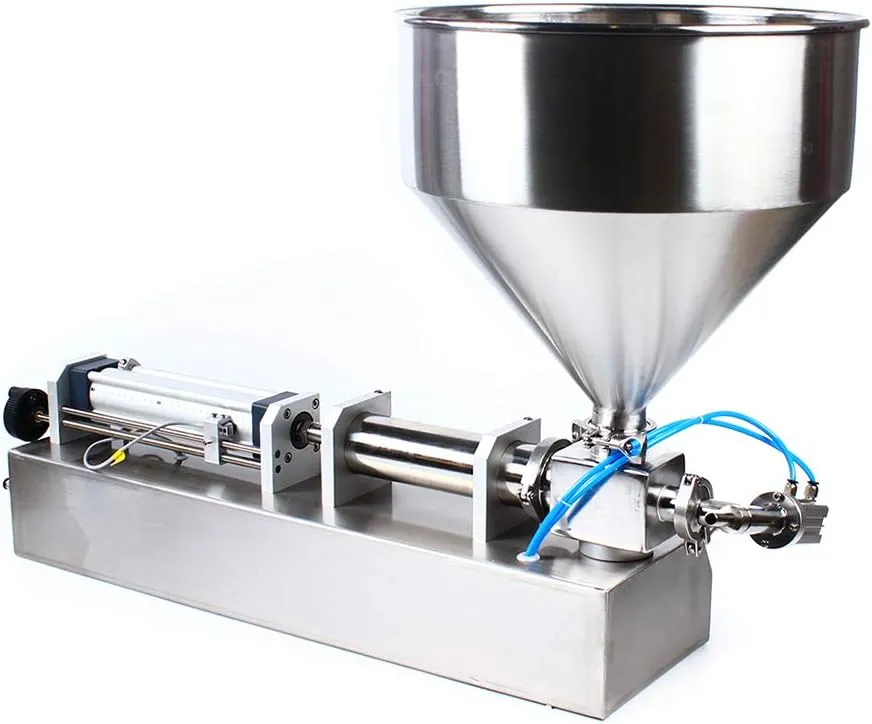
50-500 mL pneumatic piston sauce and paste filler
Volumetric filling for sauces, creams, pastes and suitable liquids
This semi-automatic filling machine measures each dose by piston stroke and uses compressed air as its working power. It is mainly used for sauces and paste materials, while also filling suitable free-flowing liquids. The operator places each container below the nozzle and starts the filling cycle by foot pedal.
Working principle
Piston measurement with compressed-air drive
The piston cylinder draws product from the hopper and dispenses a repeatable volume through the filling nozzle. The fill volume is adjusted by changing the piston stroke.
Piston volumetric dosing
Each cycle measures product by the effective piston-cylinder volume rather than by gravity alone.
Compressed-air power
Pneumatic components drive the filling action. A suitable external air compressor is required.
50-500 mL range
The published adjustable range suits jars, bottles, tubes and other small or medium containers.
Liquid and paste materials
The valve, nozzle and seals are selected according to viscosity, particles, temperature and product chemistry.
Operating sequence
Simple semi-automatic operation for flexible production
The operator controls container placement and starts each cycle, making the machine practical for small batches, frequent product changes and businesses that do not need a full conveyor line.
Typical materials
Designed primarily for sauces and pastes, with broad liquid compatibility
Typical products include water, fruit juice, edible oil, sauce, ketchup, honey, peanut butter, toothpaste, cosmetic cream, hand cream, shampoo, gel and other liquid or paste materials.
- Food: sauce, chili sauce, ketchup, mustard, honey, syrup, peanut butter, juice and edible oil.
- Cosmetics: cosmetic cream, hand cream, lotion, shampoo, gel and skin-care paste.
- Pharmaceutical products: suitable liquid, gel and paste products after contact-material confirmation.
- Chemical products: detergent, glue, lubricant and other compatible liquid or paste materials.
Sauce and paste filling is the main application
The piston measuring system is especially useful when gravity filling is unsuitable for a thicker product. Products containing particles may require a larger valve and nozzle. Send the material viscosity, particle size and filling temperature so the correct configuration can be selected.
Machine details
Stainless steel product path with adjustable piston stroke
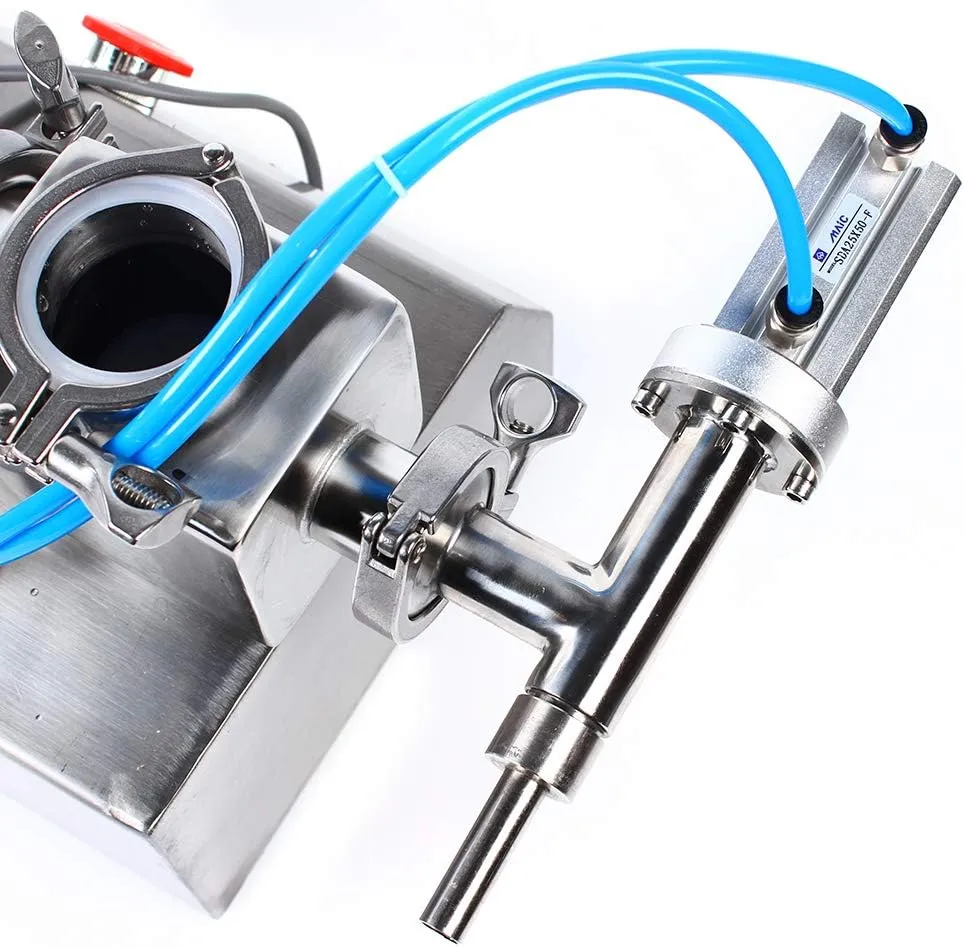
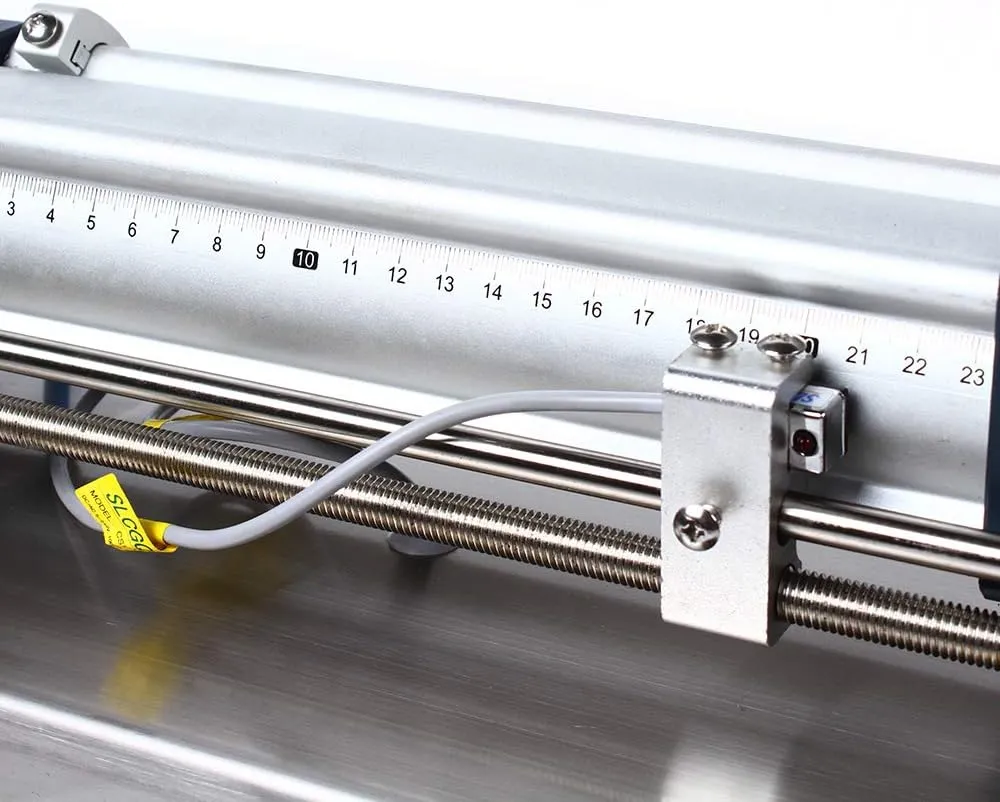
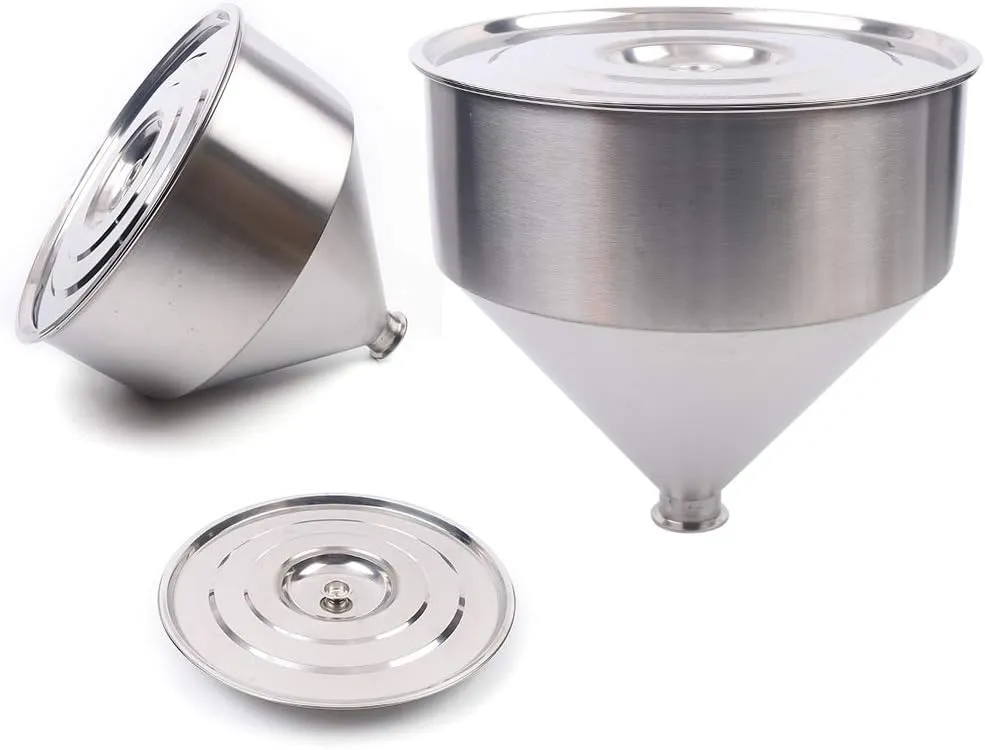
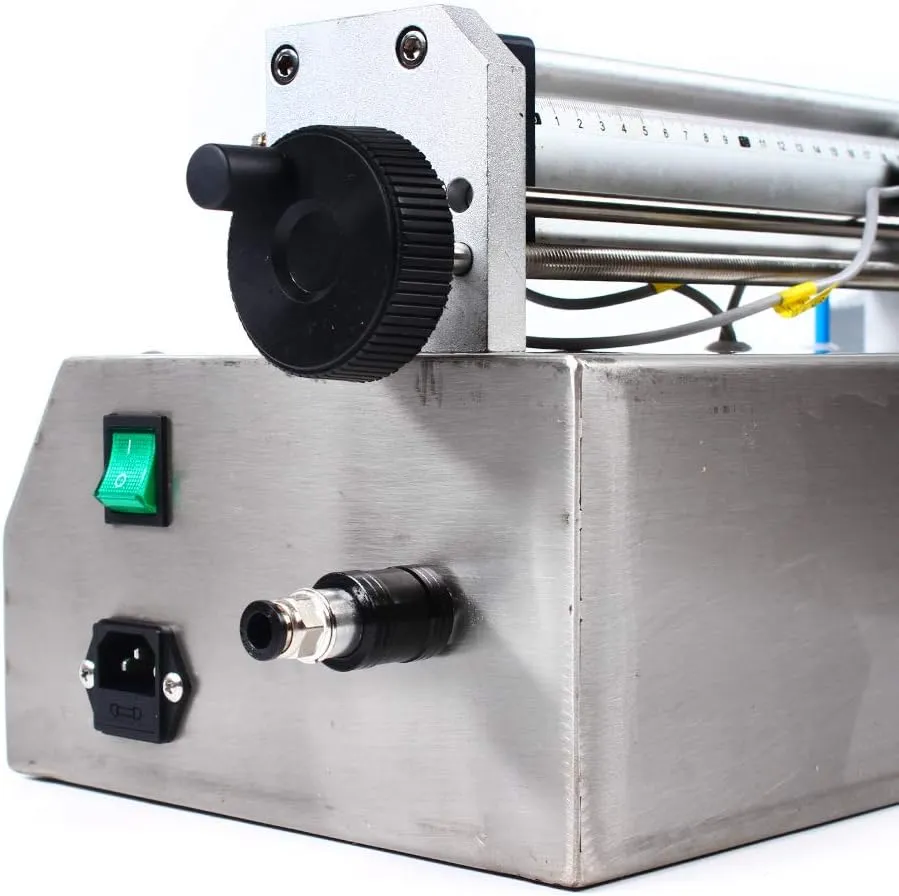
The horizontal layout provides direct access to the hopper, cylinder, adjustment scale, pneumatic components and filling nozzle for operation and cleaning.
Technical reference
50-500 mL single-head pneumatic piston filler
Final speed and filling accuracy depend on product viscosity, fill volume, temperature, particles, air supply, container opening and operator rhythm.
| Parameter | Reference value | Order confirmation |
|---|---|---|
| Measuring method | Piston volumetric measurement | Confirm the cylinder size and practical range for the required fill volume. |
| Working power | Compressed air | An external compressor is required; confirm pressure and air consumption. |
| Machine configuration | Horizontal, semi-automatic, single head | The operator positions and removes each container. |
| Filling volume | 50-500 mL | Confirm minimum, normal and maximum working volumes with the actual product. |
| Published accuracy | ±1% | Confirm by trial filling with the actual material and container. |
| Published speed | 1-25 containers/min | Actual output varies substantially with volume, viscosity and operator method. |
| Electrical reference | 110 V / 60 Hz, 30 W | Order voltage and frequency can be confirmed for the destination country. |
| Machine dimensions | 950 x 350 x 350 mm | Confirm the final hopper, nozzle and working-clearance dimensions. |
| Construction | 304 stainless steel | Confirm product-contact metals, seals, hoses and valve materials. |
| Compressor reference | 800 W, 30 L | Select the compressor after confirming required air pressure and flow. |
Installation and operation
Prepare clean compressed air and enough operator space
- Use a stable, clean compressed-air supply suitable for the final pneumatic cylinder.
- Allow space for hopper loading, container positioning, foot-pedal use and filled-container removal.
- Keep product temperature consistent when filling honey, peanut butter, cream or other viscous materials.
- Prime the product path and make trial fills before starting each batch.
- Recheck the filled amount after changing volume, product, temperature or air pressure.
Cleaning and maintenance
Release air pressure before disassembly
- Disconnect electrical power and release pneumatic pressure before cleaning or service.
- Clean the hopper, valve, piston cylinder, nozzle and seals with a product-compatible method.
- Inspect seals, clamps, hoses, fittings, regulator, foot pedal and nozzle regularly.
- Select food-grade contact parts and cleaning procedures for food or pharmaceutical applications.
- Keep a replacement seal set matched to the ordered cylinder and valve configuration.
Quotation information
Send product details before selecting the valve and nozzle
- Product name, ingredients, viscosity and filling temperature
- Particle size and concentration for sauces containing solids
- Minimum, normal and maximum filling volumes
- Container material, opening diameter, height and sample photos
- Target containers per minute and working hours per day
- Voltage, frequency, compressed-air conditions and destination country
When an automatic line is more suitable
Choose an automatic conveyor filling line when you need continuous container feeding, coordinated capping and labeling, higher daily output or less dependence on operator rhythm.
More machine views
Product-contact parts and complete machine configuration
These photographs show additional views of the hopper, piston cylinder, frame and pneumatic layout.
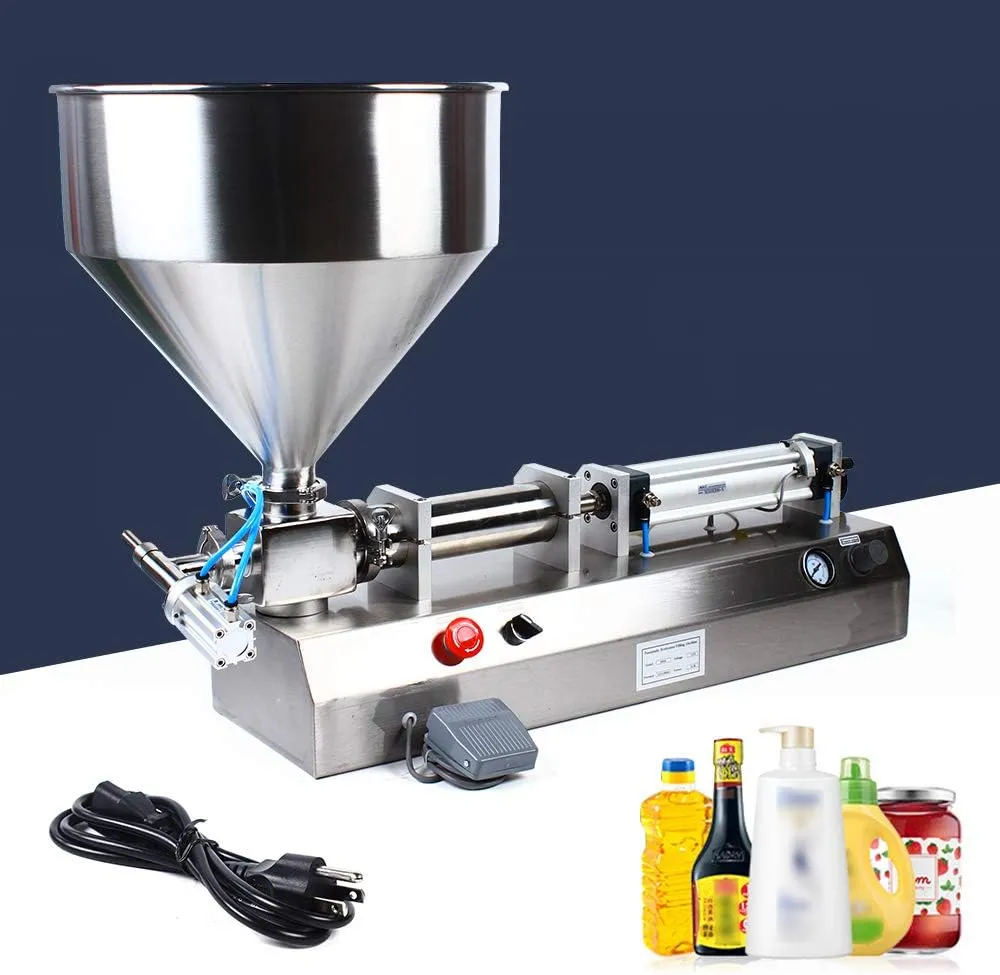
Horizontal pneumatic layout
Compact single-head configuration for operator-loaded containers and flexible batches.
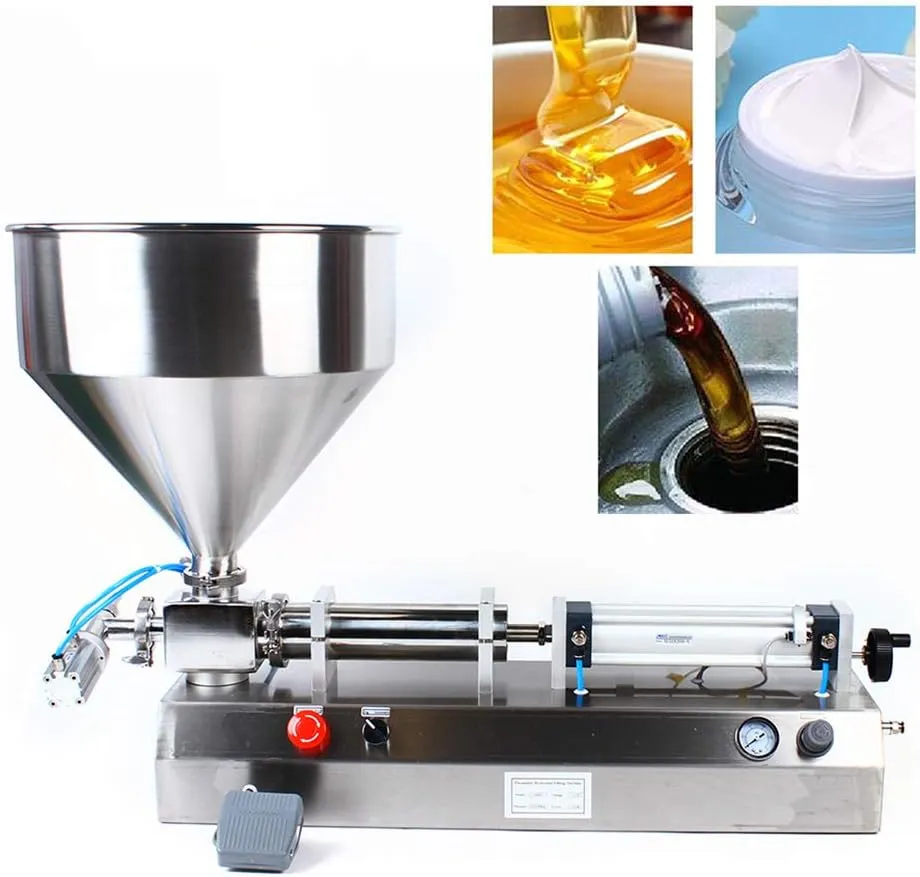
Hopper and piston assembly
Accessible product path supports adjustment, product changeover and routine cleaning.
Container reference
Confirm the real container and product before production
The machine can be configured for different containers, but the opening diameter, fill height and product behavior must be checked together.
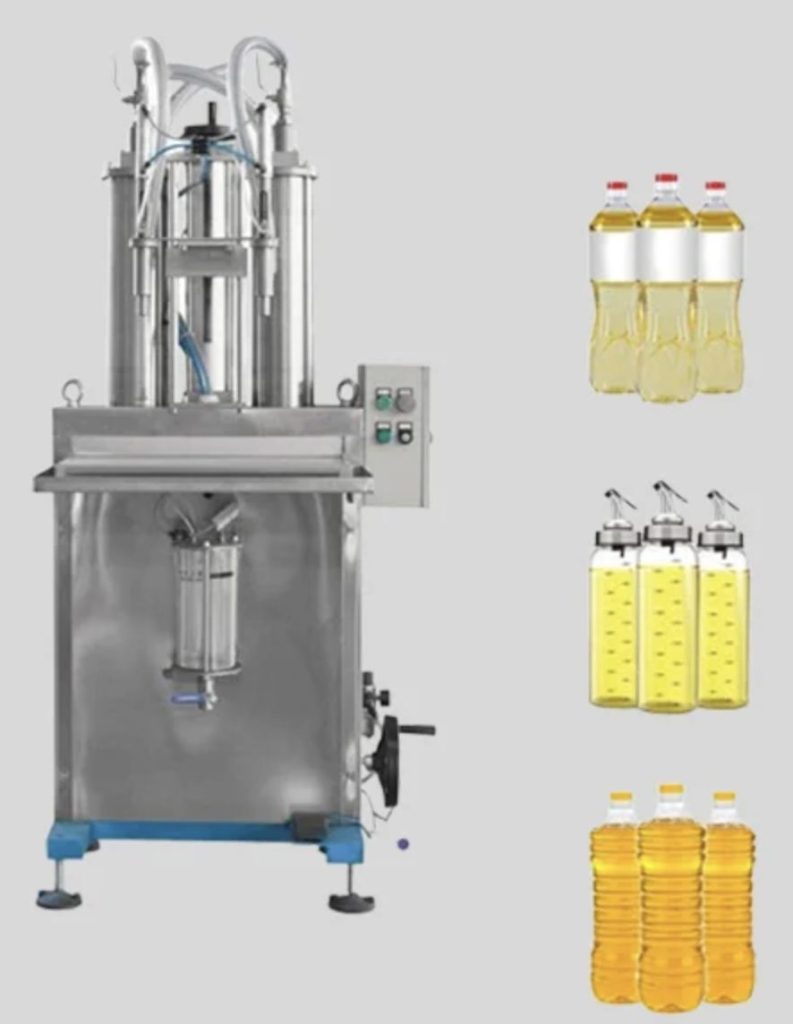
Sample container setup
Provide container photos and dimensions so the nozzle height and filling method can be confirmed.
Related filling equipment
Choose equipment by material, container and production method
Automatic filling lineReview conveyor-based filling and coordinated downstream packaging modules.
Single-head automatic liquid fillerFor free-flowing liquids with automatic container transport.
Bottle capping machineAdd closure feeding and tightening after the filling process.
Detailed machine page
Open the piston filler configuration
Use the child page for the viscous-material application range and machine configuration.
Confirm your sauce or paste before selecting the filler
Send the product name, viscosity, particles, filling temperature, volume range, container opening, target output, compressed-air conditions and destination country.