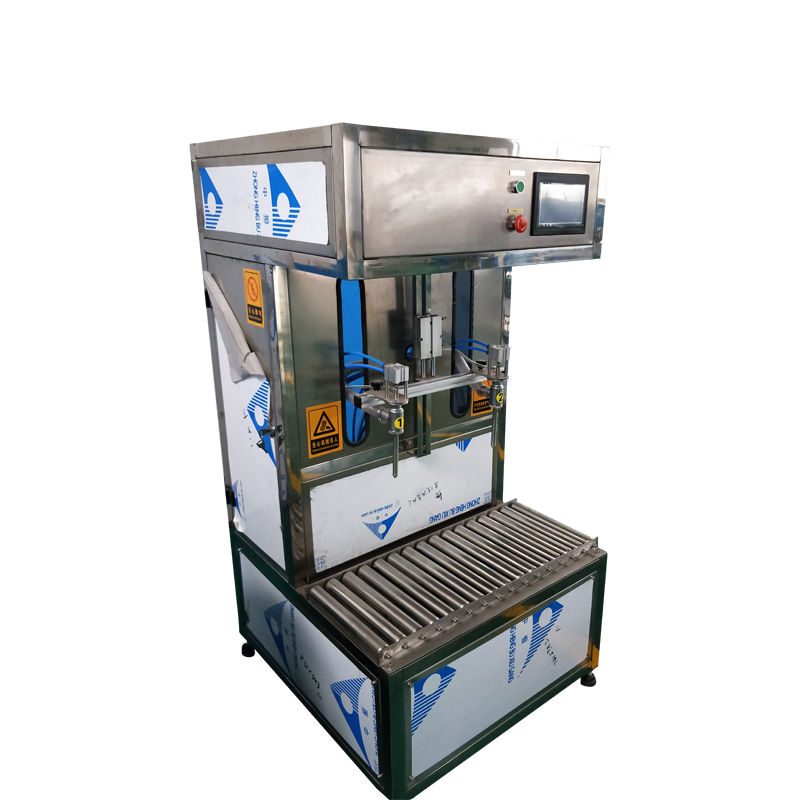
Two-head semi-automatic flow-meter filler
Meter free-flowing edible oil and other pumpable liquids
The ZRBLG-2 combines a gear flow meter, built-in gear pump, PLC, touch screen, two filling heads, and a non-powered roller conveyor. It is the flow-based choice for liquids that remain compatible with the meter, pump, valves, seals, and cleaning method.
Filler selection
Use flow measurement only when the liquid suits it
Flow-meter filling is not a substitute specification for weighing or piston filling. Select the measuring method after reviewing package size, product viscosity, operating temperature, and acceptance criteria.
Small or viscous packages
Use a piston filler where the source-listed displacement ranges and viscous-product application fit the container.
View piston filling →Medium containers by weight
Use the two-head weighing filler when net mass is the required control value.
View weighing filling →Free-flowing edible oil
Use this flow-meter model after confirming the liquid remains pumpable and measurable across the operating temperature range.
Current machine100-200 kg drums
Use the separate single-head drum weighing machine for the published large-barrel mass range.
View drum filling →Operating sequence
Pump the liquid, measure flow, and stop at the recipe target
The final recipe must be calibrated with the actual liquid, temperature, hose arrangement, valve, and package. The public source does not state a filling range or numeric accuracy.
Application boundary
Start with viscosity, temperature, and chemical compatibility
- Source-listed products: edible and cooking oils, industrial oils, lubricants, chemical liquids, and non-carbonated fluids.
- Flow behavior: provide viscosity and density across the real filling-temperature range, not only at room temperature.
- Product quality: identify suspended solids, crystallization, air entrainment, foaming, and contamination limits.
- Package: confirm container volume, opening, height, material, stability, cap, and acceptable splash or foam level.
- Liquid path: verify the gear meter, pump, valves, seals, hoses, and product-contact surfaces against the product and cleaning chemicals.
No published filling range or accuracy value
The current page describes precise flow-meter filling but gives neither a volume range nor a numeric tolerance. The target package sizes, calibration liquid, allowable deviation, test method, and acceptance sample must be stated in the technical quotation.
Source-hosted machine video
Review the two-head operator cycle and roller platform
The demonstration shows the machine arrangement, but its liquid, package volume, temperature, recipe, cycle time, and measured result are not published. Use it to assess workflow rather than as an acceptance test.
- Check container loading and removal at both heads.
- Confirm nozzle and optional valve geometry against the bottle opening.
- Review hose movement, drip capture, and cleaning access.
- Plan the downstream capping, sealing, labeling, and coding steps.
Published reference data
ZRBLG-2 source-listed specification
The capacity reference is tied to a 5 L fill, but the source does not identify the test liquid, temperature, operator method, or acceptance tolerance.
| Parameter | Source-listed value | Confirmation required |
|---|---|---|
| Model | ZRBLG-2 | Confirm final configured model and component list. |
| Filling heads | 2 | Confirm valve type and simultaneous operating sequence. |
| Capacity | 300 drums/hour, based on 5 L | Source wording uses “drums”; liquid, temperature, handling, and test conditions are not stated. |
| Compressed air | 0.6 MPa | Confirm air quality, connection, and consumption; consumption is not published. |
| Power supply | 380 V / 50 Hz, three-phase | Confirm site voltage, cable, plug, and protective devices. |
| Installed power | 2.2 kW | Confirm included gear-pump and motor configuration. |
| Machine dimensions | 800 × 900 × 1650 mm | Allow access for containers, hoses, cleaning, and service. |
| Filling range | Not published | State every target volume and container in the inquiry. |
| Numeric accuracy | Not published | Agree tolerance, calibration, and factory acceptance method. |
Source-listed configuration
Metering, pumping, and operator controls
- PLC control system and touch-screen interface
- Gear flow meter
- Built-in gear oil pump
- Stainless steel frame and structure
- Non-powered roller conveyor
- Optional umbrella-type or column-type filling valves
Stainless structure does not define the entire contact path
The source does not identify a stainless grade or state which meter, pump, valve, hose, seal, and fitting surfaces contact the product. Food and chemical projects should receive a complete wetted-parts list and cleaning review.
Line integration
Give the gear pump a stable, clean liquid supply
- Define source tank elevation, suction distance, hose diameter, filtration, and priming method.
- Avoid uncontrolled air entering the product path, because it can affect metering and package appearance.
- Confirm whether recirculation, product recovery, flushing, or dedicated paths are needed.
- Match container transfer and operator cycle to the required hourly output.
- Coordinate capping, sealing, labeling, coding, and final package inspection.
Calibration and controls
Validate a recipe for every liquid and fill size
- Set and verify the target using the agreed reference measuring method.
- Repeat checks after product, temperature, meter, pump, valve, or fill-size changes.
- Define operator access, recipe protection, batch records, alarms, and reject handling.
- Confirm valve response and nozzle behavior at the start and end of each fill.
- Document calibration results and the approved operating window.
Maintenance planning
Protect the meter and pump from contamination and dry running
- Inspect and clean filters, meter, pump, valves, nozzles, hoses, and drip areas on a planned schedule.
- Follow the supplied priming, flushing, drainage, and storage procedure.
- Check seals and valve closure when changing liquid or cleaning chemical.
- Verify calibration after service to any metering or flow-control component.
- Order spare meter, pump, valve, seal, sensor, and control parts against the final serial number.
Operating and product-safety review
Guard moving nozzles and pinch points, isolate electrical and compressed-air energy before service, and provide spill containment. Food, chemical, flammable, or reactive liquids require separate review of hygiene, materials, grounding, ventilation, electrical classification, and local regulations.
Quotation checklist
Supply the data needed to select and calibrate the flow path
Related equipment
Build the meter into the wider filling and packaging section
Validate the meter using your oil, temperature, and bottle
Send liquid properties, package drawings and samples, target volumes, required output, allowable deviation, utilities, and layout for a configuration review.