Stainless steel wet-milling equipment
Choose the colloid mill around product flow, cleaning access, and line layout
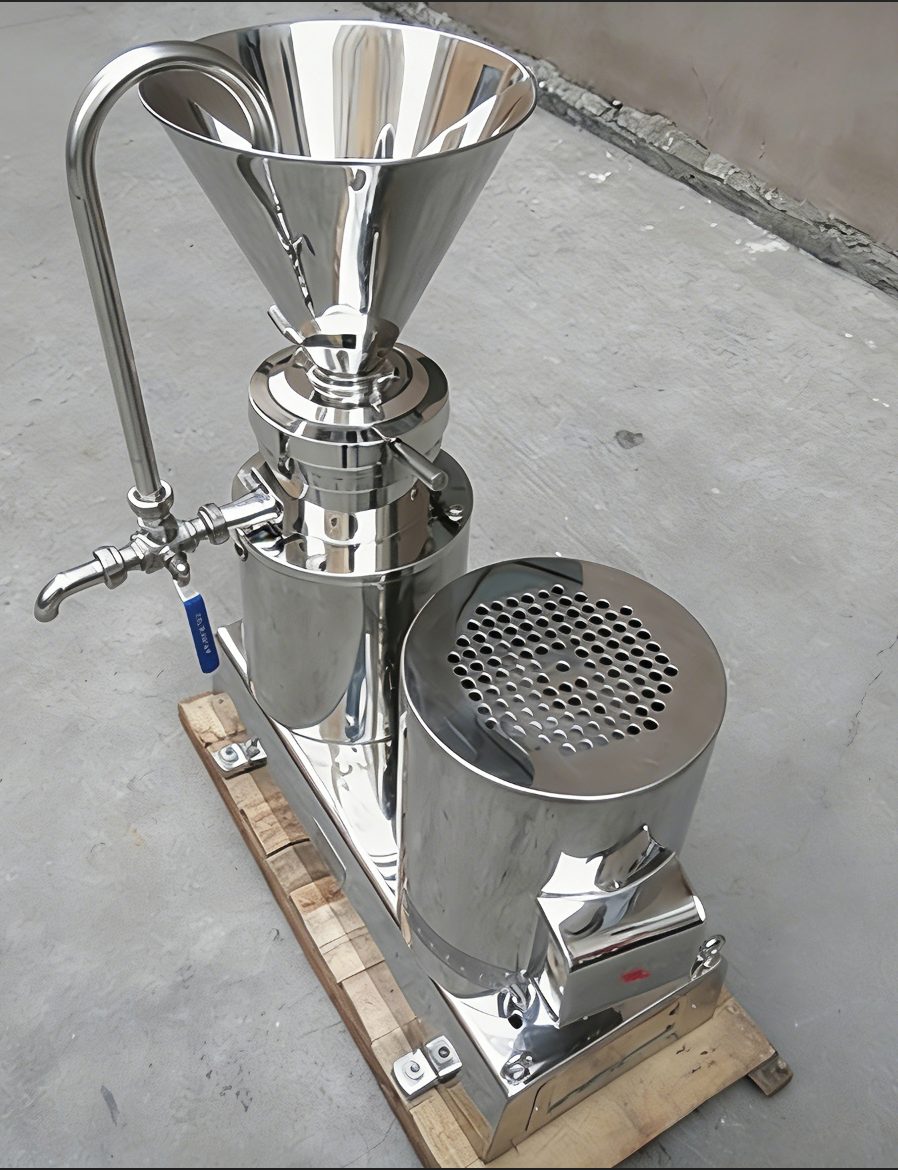
Horizontal, vertical, and split-type colloid mills use a rotor-and-stator grinding zone for wet grinding, dispersion, homogenization, and emulsification. The correct arrangement depends on the prepared feed, viscosity, circulation plan, temperature control, cleaning method, and available service space.
Application boundary
Use a colloid mill for wet or semi-fluid feed, not dry cocoa press cake
The material entering the grinding zone must be able to move through the inlet and rotor-stator gap. Dry, brittle cake follows a different size-reduction route using a powder grinder and screen.
Wet colloid milling
Paste, liquor, sauce, cream, and emulsion
The current pages list peanut butter, sesame paste, cocoa liquor, chili sauce, fruit jam, cosmetic cream, and chemical emulsions as typical applications. Feed preparation and flow behavior must be confirmed before model selection.
- Prepared liquid or semi-fluid feed
- Single-pass discharge or repeated circulation
- Rotor-stator gap selected through trials
- Cooling and temperature monitoring where required
Dry powder grinding
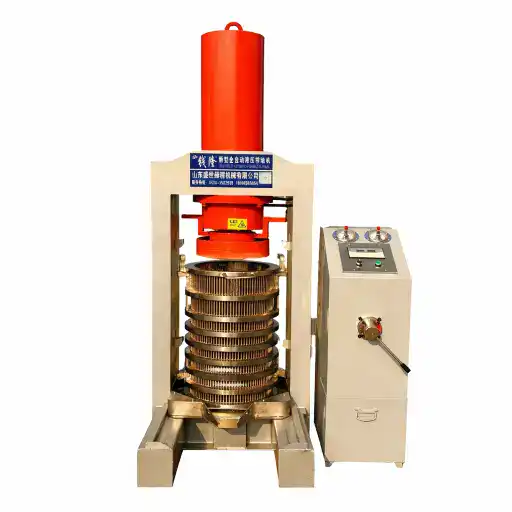
Cooled and prepared cocoa press cake
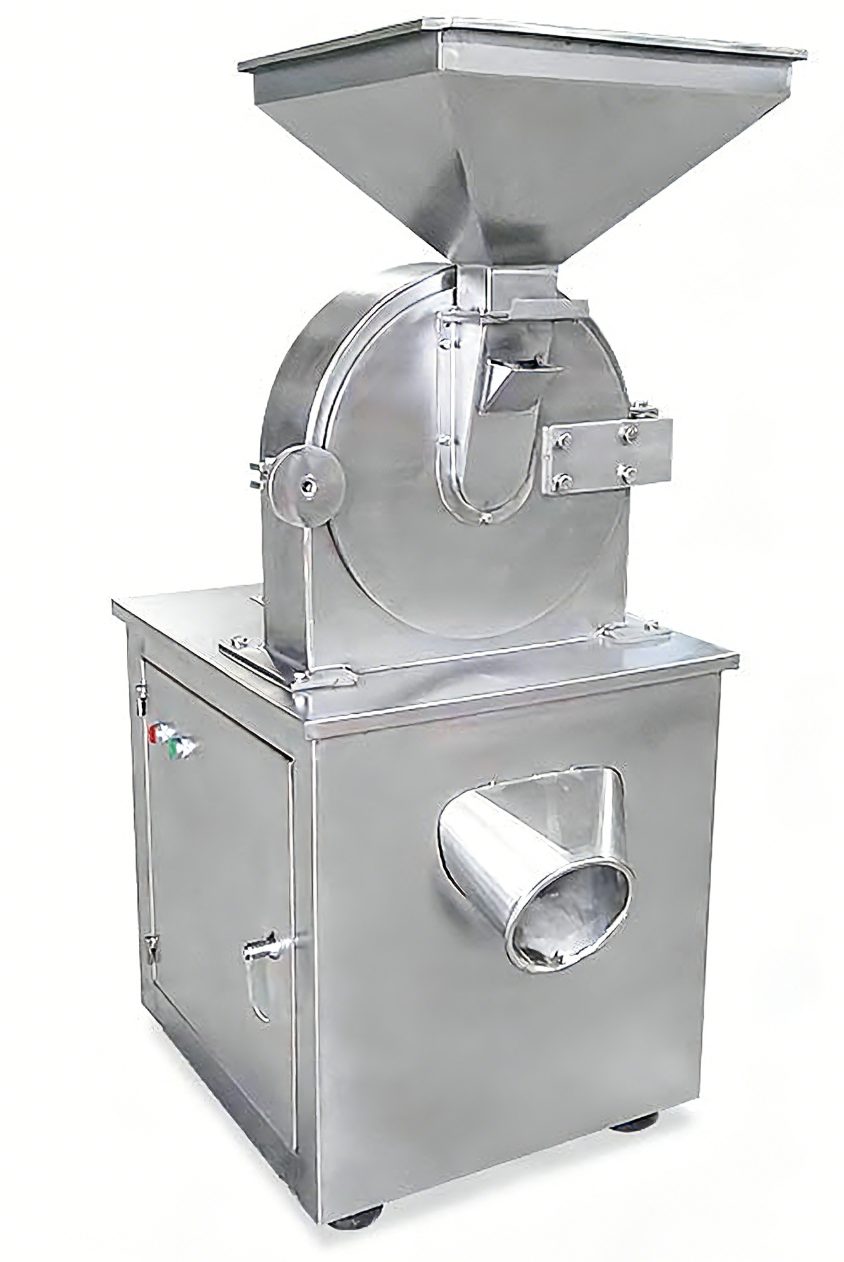
A cocoa powder mill uses impact, shear, friction, and a replaceable screen to reduce dry cake. It does not replace nib grinding into cocoa liquor, and a colloid mill does not replace the dry powder stage.
- Dry or conditioned brittle feed
- Pre-crushing to the approved inlet size
- Screen-selected powder classification
- Dust collection and temperature-control scope
Three machine arrangements
Select the drive and grinding-head layout before comparing model numbers
The source pages identify JMW as horizontal, JML as vertical, and JMF as split-type. Each page uses a similar model range, but the physical arrangement changes installation, access, piping, and cleaning decisions.
JMW series
Horizontal colloid mill
The source describes a horizontal motor and grinding chamber connected on a coaxial drive line, with a feed hopper, circulation pipe, and cooling-water connection.
JML series
Vertical colloid mill
The source describes a vertically mounted long-shaft motor driving the grinding head directly. This arrangement prioritizes a compact floor footprint and top-fed product path.
JMF series
Split-type colloid mill
The source separates the grinding-head and motor assemblies through a coupling arrangement, creating more flexibility for service access and equipment placement on the supplied base.
Operating sequence
Control the feed before tightening the grinding gap
The mill is one step in a preparation and transfer system. Stable results require a repeatable feed condition, a defined pass strategy, and a release test for the finished product.
Buyer selection matrix
Compare the installation around the same product sample
Do not select from a nominal throughput row alone. Ask each supplier configuration to process the same feed and document the same acceptance method.
| Decision point | Horizontal JMW | Vertical JML | Split-type JMF |
|---|---|---|---|
| Drive arrangement | Source-described coaxial horizontal motor and grinding head. | Source-described direct long-shaft vertical drive. | Source-described motor and grinding head separated through a coupling. |
| Feed and discharge | Confirm hopper, inlet elevation, outlet direction, and whether the return line is supplied. | Confirm gravity feed, outlet clearance, and the route back to a holding vessel. | Confirm head position, motor position, coupling guard, hopper, outlet, and return piping on the final base. |
| Service access | Allow axial access to the head, motor, seal, and coupling line. | Allow vertical access around the head and sufficient lifting or disassembly clearance. | Use the separated assemblies to plan access, while confirming the actual coupling and base layout. |
| Flow behavior | For all arrangements, verify inlet particle size, solids, viscosity, temperature, circulation resistance, and whether a feed or transfer pump is required. | ||
| Cleaning basis | Confirm drainability, dismantling steps, seal flushing, retained product, cleaning chemicals, rinse verification, and changeover procedure. | ||
Product-contact path
Specify every wetted component, not only the outer housing
- The source pages state that material-contact parts are stainless steel but do not identify the grade, surface finish, weld treatment, or certificates.
- Confirm hopper, inlet, rotor, stator, chamber, seal faces, outlet, valves, fittings, hoses, return pipe, and downstream vessel materials.
- Choose full-stainless or semi-stainless construction from the complete material schedule. The semi-stainless descriptions retain painted steel in the frame or motor housing.
- State food, cosmetic, pharmaceutical, or chemical cleaning requirements in the order rather than inferring them from appearance.
Viscosity and particle limits
Confirm that the product can enter, pass, and leave the mill
- Provide feed temperature, viscosity or flow description, solids content, largest particle, hardness, and any fibers or skins.
- The current overview distinguishes circulation for lower-viscosity material from direct discharge for higher-viscosity pastes such as peanut butter or sesame paste.
- High-viscosity material may require a different hopper, positive feed, shortened return path, or direct outlet; confirm through a sample trial.
- Never allow glass, quartz sand, metal fragments, or other hard foreign material into the grinding zone.
Source-data control
Resolve the current model-table conflicts before issuing a purchase order
The live pages contain useful model references, but they are not a controlled acceptance specification. Capacity depends on material properties, preparation, temperature, gap, pass count, and the test endpoint.
The JMF/B-50 rows do not agree
The family overview lists JMF/B-50 at 0.3–1 t/h and 1700–3500 r/min, while the split-type detail page lists 0.01–0.2 t/h and 2825 r/min. The pages also show a fineness entry of “≥2 µm” and an adjustment range of 1–0.01 without defining the test method or the adjustment unit. Request one revision-controlled datasheet and a product-specific test protocol.
What the datasheet should fix
Model, drive, ports, materials, and dimensions
- Exact model code and full- or semi-stainless construction
- Motor power, speed, voltage, phase, frequency, and protection
- Disc diameter, inlet, outlet, cooling connections, and seal arrangement
- Overall dimensions, weight, base holes, service clearances, and lifting points
What the trial should prove
Flow, temperature, texture, and cleaning
- Representative feed sample and preparation method
- Batch or continuous basis and number of passes
- Inlet and outlet temperature and cooling conditions
- Agreed particle-size, texture, viscosity, or dispersion test
Utilities and controls
Design the connections with the product route
- Confirm electrical supply, starter or control panel, overload protection, emergency stop, and rotation check.
- Define cooling-water quality, temperature, pressure, flow, inlet, outlet, drainage, and leak monitoring.
- Confirm any feed pump, holding tank, agitator, transfer pump, valves, return line, and temperature instruments.
- Plan floor drainage, washdown boundaries, ventilation, and safe access around the feed and discharge points.
Maintenance and safety
Protect the rotor, stator, seal, and operator
- The source pages prohibit empty running and reverse rotation. Establish a wet-start and shutdown procedure.
- Use lockout before opening the grinding head, coupling guard, motor, piping, or electrical enclosure.
- Inspect the mechanical seal, grinding surfaces, bearings, connections, return pipe, and cooling path at defined intervals.
- Request spare seals, rotor-stator parts, gaskets, bearings, tools, and a documented disassembly sequence.
Quotation checklist
Send the material and line conditions with the capacity request
- Product name, formulation, sample, food or industrial use, and cleaning standard
- Feed state, largest particle, solids, viscosity, temperature, and foreign-material controls
- Required product result and the laboratory method used to verify it
- Required flow, operating hours, passes, recirculation, and downstream transfer
- Preferred horizontal, vertical, or split arrangement and workshop dimensions
- Utilities, contact-material schedule, controls, spare parts, destination, and documentation
Related process equipment
Connect wet grinding to pressing and dry powder production
Choose the colloid mill from a real product sample and a controlled process target
Send the feed condition, required result, throughput basis, pass strategy, temperature limit, cleaning method, utilities, layout, and destination for a configuration review.