JMF split-type wet colloid mill
Separate the grinding head and motor arrangement for easier line integration
The JMF design uses distinct grinding-head and motor assemblies connected through a coupling system. It is intended for wet grinding, emulsification, homogenization, and mixing of prepared liquid or semi-liquid products while giving the project more freedom to arrange access around the head and drive.
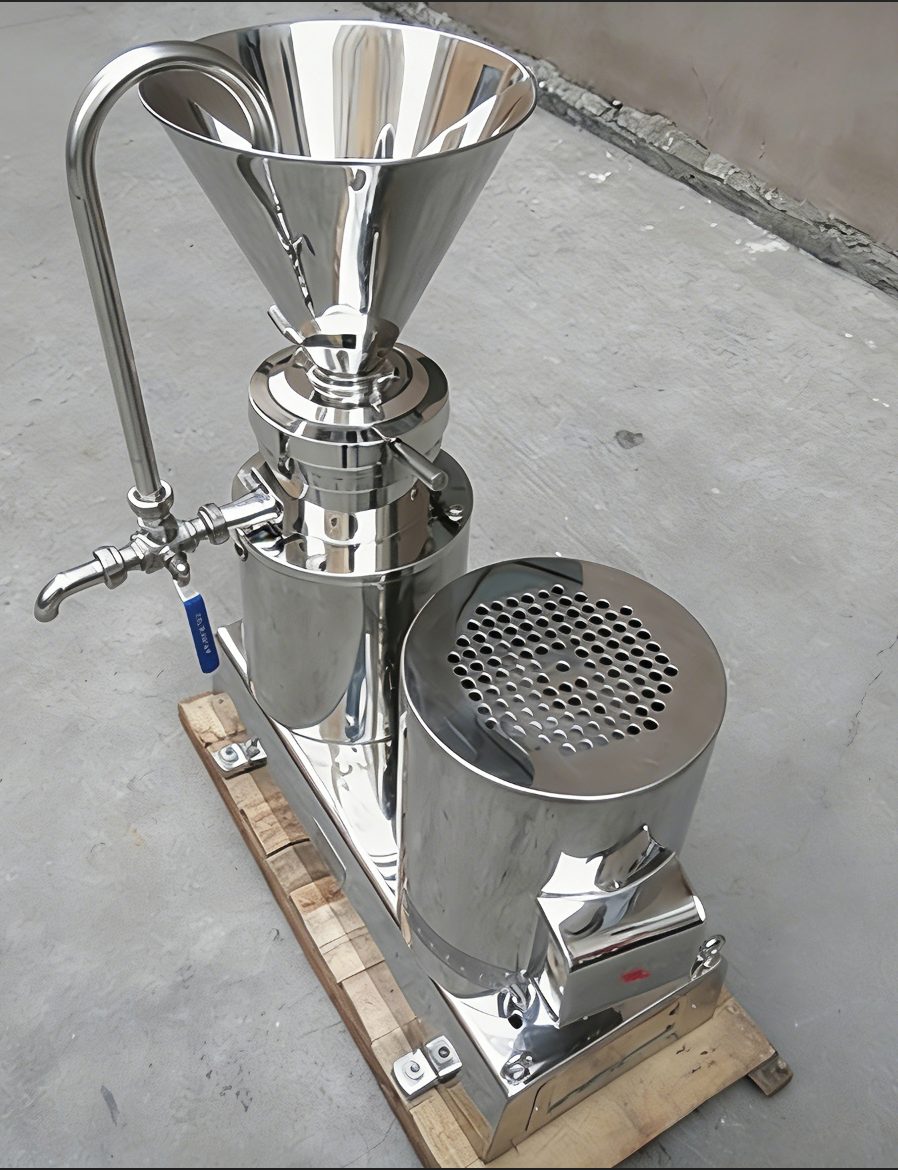
Visible machine arrangement
Grinding head, coupling drive, and motor on a serviceable base
The site photograph shows the feed hopper and grinding head beside the motor housing, with a stainless return pipe and valve. The source describes the motor and grinding head as separate assemblies connected by a coupling.
- Confirm coupling type, alignment method, guard, base construction, and mounting points.
- Confirm whether the supplied head and motor remain on one base or use a project-specific arrangement.
- Approve hopper size, inlet, outlet, return pipe, valve direction, and operator access from the GA drawing.
Why buyers choose split-type
Use the layout flexibility to improve service and product flow
- Plan access to the grinding head without treating the motor housing as part of the product-contact path.
- Place the outlet, return loop, vessel, and cleaning connections around the actual workshop layout.
- Confirm shaft alignment and coupling-guard removal space before fixing foundations or piping.
- Do not assume that a separated drive automatically solves high-viscosity feeding or circulation.
Application boundary
Use the JMF for wet or semi-fluid feed with a defined discharge route
The source lists peanut butter, sesame paste, chili sauce, fruit jam, cosmetic cream, and chemical emulsions. Product suitability must be established from the actual sample, not from the application name alone.
Circulation route
Repeat passes for material that can return reliably
The family overview describes a circulating pipeline arrangement for lower-viscosity material that requires repeated grinding. Confirm vessel agitation, line resistance, return flow, temperature rise, and the sampling endpoint.
- Return-line diameter, length, valve positions, and cleaning access
- Holding-vessel volume, agitation, and product-level control
- Pass count and test method for release
Direct outlet route
Discharge higher-viscosity paste without a long return loop
The family overview identifies direct outlet operation for higher-viscosity materials such as peanut butter or sesame paste. Confirm that the prepared product can feed, pass the head, and leave the outlet under trial conditions.
- Feed temperature, viscosity, solids, and largest particle
- Gravity, assisted, or positive feeding method
- Receiving vessel and downstream transfer method
Working principle
Adjust the rotor-stator gap against a verified product target
The motor turns the rotor relative to the stationary stator. Prepared material passes through the narrow gap and is subjected to shear, friction, turbulence, and vibration. The actual result depends on the material and process conditions.
Source-listed JMF references
Use the detail-page rows only as preliminary model references
The values below reproduce the current split-type detail page. They do not guarantee throughput or fineness for a specific paste, liquor, sauce, cream, or emulsion.
| Model | Source-listed capacity | Motor power | Speed | Grinding disc |
|---|---|---|---|---|
| JMF/B-50 | 0.01–0.2 t/h | 1.1 kW | 2825 r/min | Φ50 mm |
| JMF/B-80 | 0.3–1 t/h | 3 kW | 2880 r/min | Φ80 mm |
| JMF/B-100 | 0.5–2 t/h | 5.5 kW | 2900 r/min | Φ100 mm |
| JMF/B-120 | 0.7–3 t/h | 7.5 kW | 2900 r/min | Φ120 mm |
| JMF/B-140 | 1–4 t/h | 11 kW | 2930 r/min | Φ140 mm |
The family overview and detail page conflict
The family overview lists JMF/B-50 at 0.3–1 t/h and 1700–3500 r/min, while this detail page lists 0.01–0.2 t/h and 2825 r/min. It also lists “≥2 µm” fineness and an adjustment range of 1–0.01 without a defined method or unit. Request one revision-controlled JMF datasheet and a material-specific trial report.
Construction options
Confirm full- or semi-stainless construction component by component
- The source offers a semi-stainless configuration and a full-stainless sanitary configuration.
- Material-contact parts are described as stainless steel, but alloy grade, surface finish, weld treatment, and certificates are not stated.
- Confirm hopper, rotor, stator, chamber, seal, outlet, valves, fittings, return pipe, and downstream vessel materials.
- Separate external appearance from the actual wetted material schedule in the purchase order.
Drive and seal details
Control alignment, guarding, and leakage points
- Approve coupling type, alignment tolerance, guard, bearing arrangement, and base stiffness.
- Confirm mechanical-seal faces, elastomers, flushing or cooling, spare kit, and acceptable leakage criterion.
- Define motor voltage, phase, frequency, enclosure, starter, overload protection, and emergency stop.
- Request lifting points and a documented head, coupling, and motor service sequence.
Viscosity and temperature
Qualify product flow at the real operating temperature
- Provide feed temperature, viscosity or flow description, solids, largest particle, hardness, fibers, and formulation changes.
- Record inlet and outlet temperatures during every pass of the sample trial.
- Compare circulation with direct outlet operation for high-viscosity paste.
- Confirm whether a heated vessel, agitator, feed pump, transfer pump, or shortened pipe route is required.
Cooling and integration
Specify the water circuit and product piping together
- Confirm cooling-water quality, inlet temperature, pressure, flow, connection, and drainage.
- Define product inlet, outlet, return, sample point, valves, hoses, and sanitary fitting standards.
- Identify tanks, pumps, instruments, controls, and interlocks included in the quotation.
- Request a piping sketch for direct-discharge and recirculating alternatives.
Cleaning and changeover
Use the separated arrangement to plan access, not to assume cleanability
- Confirm drainability, retained product, head disassembly, return-line cleaning, seal flushing, and rinse verification.
- Document cleaning chemicals, temperatures, allergen or color changeover, and wastewater handling.
- Validate access to the rotor, stator, seal, coupling guard, hopper, outlet, and valves.
- Include replacement seals, gaskets, rotor-stator parts, bearings, and special tools in the spare-parts review.
Operating safety
Prevent dry running, reverse rotation, and hard-particle entry
- The source prohibits empty running and reverse motor rotation.
- Keep glass, quartz sand, metal debris, and other hard particles out of the grinding chamber.
- Use lockout before opening the grinding head, coupling guard, motor, piping, or electrical enclosure.
- Inspect alignment, guard condition, seal leakage, grinding surfaces, bearings, valves, and cooling flow on schedule.
Quotation checklist
Information needed for a JMF selection
- Product formulation, use, sample, and required finished result
- Feed size, solids, viscosity, temperature, fibers, and contaminant controls
- Required flow, operating hours, passes, circulation, and transfer method
- Preferred head and motor layout, service clearances, and workshop drawing
- Cleaning method, contact materials, utilities, controls, destination, and documents
Request a production drawing and sample-trial report
The approval package should identify the exact model, base, coupling and guard, ports, contact materials, sample, preparation, gap-setting method, pass count, temperature, finished-product test, and cleaning observations.
Related equipment
Compare drive arrangements and downstream processes
Configure the split-type colloid mill around flow, access, and alignment
Send the material, required result, throughput basis, pass strategy, temperature limit, cleaning method, preferred layout, utilities, workshop drawing, and destination.