
On this page
Buyers often ask for the “best” sesame cleaning machine, but the better question is: best for what kind of project? A machine that runs well for a 50 kg/day fresh-oil shop is wrong for a 5-ton commercial plant, and the other way around. This guide walks through the three project tiers — small mill, premium workshop, commercial factory — gives you a side-by-side comparison table, and explains the four buying factors most people get wrong.

Step 1: Start with the raw sesame, not the catalog
Machine selection should begin with the real condition of the sesame you buy, not with a spec sheet. Before looking at machine models, answer these:
- Is the raw sesame field-level (lots of stalk, dust, stones) or pre-cleaned (mostly seed)?
- Are stones and sand common in your supply, or rare?
- Do different suppliers deliver very different quality levels?
- Will the same line handle white sesame, black sesame and mixed lots?
- Do you need washing (water cleaning) or is dry cleaning enough?
The answer to the last question alone changes the whole machine category. Dry cleaning is cheaper and simpler. Washing + centrifugal drying needs drainage, water supply, food-grade stainless steel, and roughly 2× the budget — but it produces a visibly cleaner, more premium-looking finished oil.
Step 2: Define your production route
The next question is what happens after cleaning. Most sesame oil projects follow this route:
receiving → cleaning → (optional washing + drying) → roasting → hydraulic pressing → filtration → bottling
If your route includes roasting before pressing — which it should for any commercial sesame oil line — cleaning quality matters even more, because the roaster expects a uniform seed batch. If your layout is still being planned, review the sesame oil production line guide first and then match the cleaning section to the total flow.
The three project tiers
Tier 1: Small mill / fresh-oil shop (50–200 kg/day)
A small mill needs a simple, practical, affordable solution. Goals here are:
- remove the most common impurities (dust, husk, light foreign material)
- basic destoning to protect the press
- reduce manual sorting labor
- match a compact roaster + Korean-type or KHOP-class press
- avoid over-investing in oversized equipment
For this tier, a compact dry-cleaning machine (200–500 kg/h capacity) with a magnet trap and a basic destoner is usually enough. Pair it with our Korean-type small hydraulic press or a KHOP-10/15/20 KG model.
Tier 2: Premium workshop (200 kg–1 t/day)
A premium workshop is not just a bigger small mill. The business cares about product image, flavor consistency and process control. Buyers in this tier usually benefit from:
- better impurity removal (multi-stage screening + destoning + magnet)
- cleaner surface treatment before roasting (washing + centrifugal drying)
- food-grade stainless steel construction (304 minimum)
- independent drives for washing and drying so each section runs at its optimal speed
- a more professional front-end visible to retail customers
For this tier, a combined cleaning-and-drying machine (500–1,000 kg/h) is the right fit. It pairs with a Model 300 or Model 325 hot-press hydraulic oil press.
Tier 3: Commercial factory (1–5 t/day or more)
A commercial factory must think in terms of line balance, not isolated machines. The cleaning section here must match:
- hourly throughput of the plant
- transfer rhythm to roasting and pressing
- buffer storage and feeding logic
- sanitation workflow and food-safety audits
- future production expansion (typically 1.5–2× capacity headroom)
At this scale a single machine is rarely enough. A multi-stage sesame pre-cleaning line with separate pre-cleaning, destoning, washing, drying and grading is more appropriate. Pair with Model 355–500 cold-press models or a Model 325 hot-press array.
Side-by-side comparison
| Spec | Tier 1: Small mill | Tier 2: Premium workshop | Tier 3: Commercial factory |
|---|---|---|---|
| Daily throughput | 50–200 kg | 200 kg–1 t | 1–5 t (or more) |
| Cleaning method | Dry cleaning + basic destoner | Wash + centrifugal dry | Multi-stage line |
| Capacity rating | 200–500 kg/h | 500–1,000 kg/h | 1,000–3,000 kg/h |
| Material | Carbon steel + 304 contact parts | Full SS304 | Full SS304 or SS316 |
| Drainage required | No | Yes | Yes (with treatment) |
| Footprint | ~3–5 m² | ~10–15 m² | 30–80 m² |
| Power | 2–4 kW | 5–10 kW | 15–40 kW |
| Approx. budget (USD) | $1,500–$3,500 | $5,000–$12,000 | $18,000–$45,000+ |
| Recommended press | KHOP / Korean-type | Model 300 / 325 | Model 355–500 array |
Three machine categories explained
Basic dry impurity-removal machine
Vibrating screen + air aspiration + magnet trap. Good for lighter cleaning needs and dry processing routes. Cheap, simple, low maintenance. Cannot remove surface dirt that needs water.
Washing + centrifugal drying machine
Cleaning tank with screw conveyor → stone/heavy discharge area → centrifugal drying drum. Used when seed needs more thorough cleaning and surface water has to come off before roasting. Look for: dual-motor independent drives, food-grade SS304 contact, drainage planning. This is the workhorse for premium workshops.
Multi-stage pre-cleaning line
Sequence: rough screen → destoner → magnet → washer → centrifugal dryer → optional grading → buffer feeder. Best when capacity is high, raw material is unstable, or you need strong line control. Higher capex but the only realistic option above 1.5 t/day.
Four buying factors people get wrong
1. Water and drainage
If washing is involved, drainage and sanitation are part of the machine decision, not separate afterthoughts. Check water supply pressure and check whether your local rules need a wastewater pre-treatment tank before discharge — this catches many small workshops late in the project.
2. Workshop space
Even a good machine becomes inconvenient if it does not fit the available layout. A multi-stage line needs a straight 8–12 m run; if your workshop is L-shaped, you’ll need bend transfers that add cost.
3. Labor cost vs machine cost
Many buyers underestimate how much manual seed cleaning costs in time and consistency. At $5/h labor cost, a person sorting 30 kg/h gives effective sorting cost of $0.17/kg — over a year of 1 t/day, that’s $50,000+ in labor where a $5,000 machine pays back in 2 months.
4. Downstream equipment protection
If you’ve already invested in a Model 325 hot press at $8,000+, protecting it from stones and metal contamination is the strongest single reason to clean well. A scored press plate is $400–$800 plus 2–3 days of downtime — see our breakdown of impurity damage for the full picture.
How the cleaning choice affects press selection
The cleaner and more uniform the input, the easier the downstream press section runs. Cleaner seed → more uniform cake → 1–2 percentage points lower residual oil → less filter clogging. If you are picking the press itself, these pages help:
- Sesame hydraulic oil press machine (full range)
- Small sesame oil press machine (KHOP shop-front)
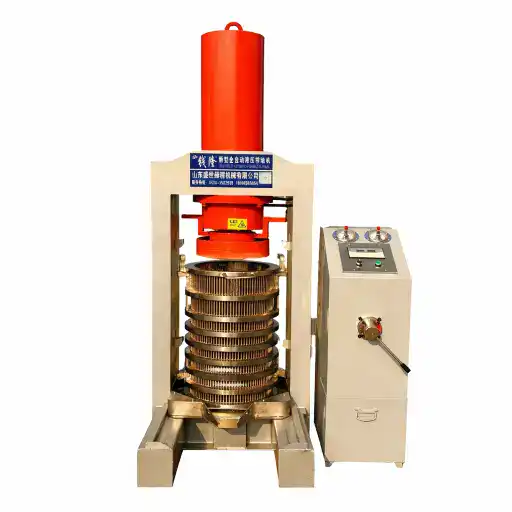
- Hot-press models 300 / 325
Common mistakes
- Choosing only by lowest price
- Buying a factory-scale machine for a workshop project (or vice versa)
- Ignoring the difference between washed and dry-cleaned routes
- Forgetting drainage, water supply and sanitation planning
- Skipping the destoner because “this batch looks clean”
- Not asking how the cleaner connects to roasting and pressing rhythm
FAQ
What is the best machine for a small sesame oil startup?
For 50–200 kg/day, a compact dry-cleaning machine with destoner and magnet trap, in the $1,500–$3,500 range. Skip washing at this tier — the drainage and sanitation overhead is not worth it.
When is washing + drying better than dry cleaning alone?
When raw sesame is dirtier than average, when surface cleanliness drives oil aroma and clarity, or when the brand is positioned as premium / cold-pressed / shop-front fresh oil.
When should I choose a multi-stage pre-cleaning line?
Above 1.5 t/day, or when raw material variability is high, or when the project needs documented food-safety control. Below that volume the line is over-specified.
What capacity should I buy with 1.5× headroom?
Always size cleaning capacity above the press capacity, not equal to it. Cleaning is the cheapest stage — over-sizing it by 50% costs little. Under-sizing it bottlenecks the entire line.
Can the cleaning machine be upgraded later?
Yes, but retrofitting a cleaning section into a finished workshop is 2–3× more expensive than building it in from the start. Plan for the next 3 years of capacity, not just today’s volume.
Stainless steel — SS304 or SS316?
SS304 is sufficient for sesame and most edible-oil applications. SS316 is required only when chlorinated water or aggressive cleaning chemicals are used regularly.
Conclusion
The right sesame cleaning machine depends on the real project, not on a generic spec sheet. Match the tier to your daily volume, decide between dry cleaning and washing based on product positioning, and always check downstream press protection. Do that, and the cleaning section becomes the cheapest, most reliable insurance policy on the line.
Tell us your raw sesame condition, daily target output and project tier — small mill, premium workshop or commercial factory. We’ll come back within 24 hours with a cleaning-machine recommendation matched to your roaster and press choice, plus a layout drawing and FOB quote.
Request a Quote for Your Sesame Cleaning + Pressing Line →
Related Reads
Project planning
Configure the right oil press and production line
Send your oilseed, target output, bottle or packaging requirements, power supply, and destination country. We will match the machine, supporting equipment, and line layout.