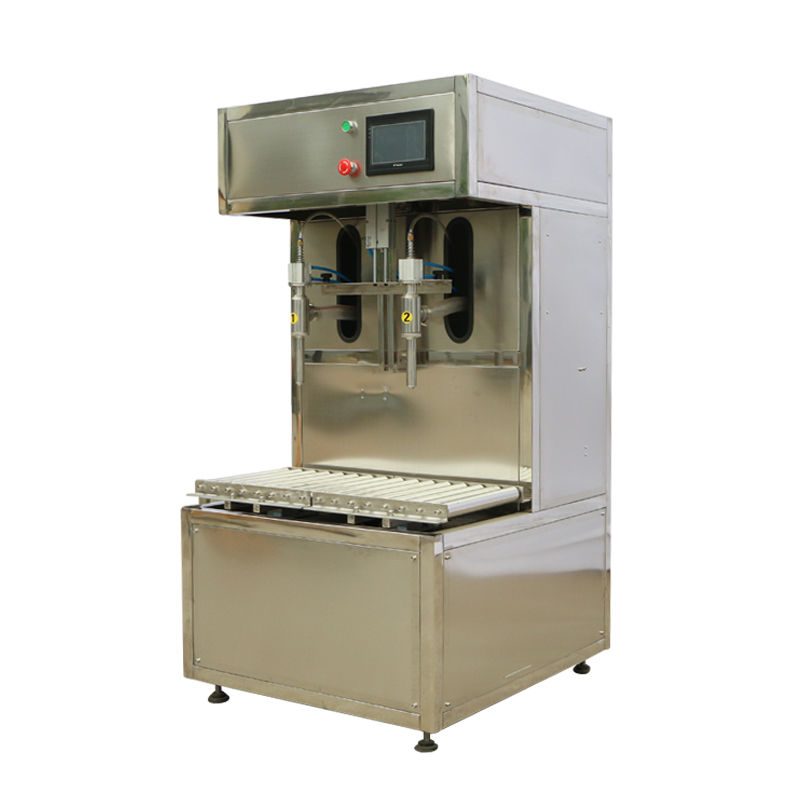
Two-head semi-automatic weighing filler
Fill medium jugs and pails by measured net weight
This machine combines two filling heads, a digital weighing module, submerged nozzles, and a built-in pump for liquid and semi-liquid products. It is the source-listed option for containers between small-bottle piston filling and 100-200 kg drum filling.
Filler selection
Choose by package size, measuring method, and liquid behavior
The four semi-automatic machines serve different jobs. Do not transfer a range, output, or accuracy figure from one machine to another.
Small bottles
Use a piston filler where a defined piston displacement and viscous or semi-viscous small-package filling are required.
View piston filling →Medium jugs and pails
Use this two-head weighing machine when the final mass is the control value and the container fits its weighing platform.
Current machineFree-flowing edible oil
Consider the flow-meter model for pumpable liquids after confirming viscosity, temperature, meter, valve, and cleaning compatibility.
View flow-meter filling →Large drums
Move to the single-head drum weighing machine for the separate source-listed 100-200 kg filling range.
View drum filling →Operating sequence
Pump, weigh, slow the flow, and release the filled container
Final valve timing and weighing recipes must be commissioned with the actual product, target mass, container, and operating temperature.
Application boundary
Evaluate the product and package together
- Source-listed products: edible oils, lubricant and antifreeze liquids, paints and coatings, liquid fertilizer and urea solution, syrup, and viscous liquids.
- Container fit: confirm footprint, empty weight, opening, height, stability, and access beneath both nozzles.
- Liquid behavior: confirm viscosity and temperature at filling, foam or splash tendency, suspended solids, and pump compatibility.
- Product contact: verify seals, hoses, pump, valves, and metal surfaces against food, chemical, or hygiene requirements.
- Acceptance: define target net weight, allowable deviation, sampling method, and calibration procedure before manufacture.
The source mixes volume and mass units
The public title identifies a 5-30 L machine, while the technical list states a filling range of 5 L-30 kg. Liters and kilograms are not interchangeable without product density. The confirmed minimum, maximum, container volume, and target net weight must therefore appear in the final quotation.
Source-hosted machine video
Review nozzle movement, platform access, and operator handling
Use the demonstration to review the physical workflow, then verify the production result with your own container and liquid. The source does not publish the product, fill size, cycle timing, or test conditions shown in the clip.
- Check whether one operator can load and remove both containers safely.
- Confirm the nozzle can enter the opening without touching the container.
- Confirm the roller platform and weighing area support the filled package.
- Plan the next capping, sealing, labeling, and coding steps.
Published reference data
Source-listed standard configuration
These values reproduce the current page. Output and accuracy test conditions are incomplete, so they should be treated as quotation and acceptance checkpoints rather than guaranteed project results.
| Parameter | Source-listed value | Confirmation required |
|---|---|---|
| Filling heads | 2 | Confirm simultaneous or independent operating sequence. |
| Filling range | 5 L-30 kg | Source mixes volume and mass; confirm limits for the actual density and container. |
| Capacity | 150-300 drums/hour, depending on viscosity | Fill quantity, product, operator method, and test conditions are not published. |
| Accuracy | ≤ ±0.5% | The percentage basis, target, calibration method, and test conditions are not stated. |
| Installed power | 2.5 kW | Confirm motor and pump configuration. |
| Compressed air | 0.6 MPa, clean air required | Confirm air quality, connection, and consumption; consumption is not published. |
| Power supply | 380 V / 50 Hz, customizable | Confirm phase, voltage, frequency, plug, cable, and protection. |
| Material | 304 stainless steel | Confirm which frame and product-contact parts this statement covers. |
| Machine weight | 220 kg | Confirm final configured shipping weight. |
| Machine dimensions | 850 × 900 × 1600 mm | Allow service, container handling, and operator clearance around the machine. |
Controls and liquid path
Source-listed machine configuration
- PLC control system and touch-screen interface
- Digital weighing module
- Built-in pump system
- Submerged filling nozzles
- Anti-drip valve design
Line integration
Define upstream supply and downstream package handling
- Provide a filtered, stable feed without air pockets or uncontrolled pressure changes.
- Specify buffer tank position, hose length, pump suction conditions, and return or drain arrangements.
- Confirm operator access, filled-container weight, roller transfer, and lifting requirements.
- Match capping, induction sealing, labeling, coding, and carton handling to the package.
- Determine whether product recovery, flushing, or dedicated liquid paths are needed between batches.
Maintenance planning
Protect weighing accuracy and keep the liquid path clean
- Keep the platform free of product buildup and mechanical side loads.
- Check load-cell zero, test weights, nozzle seals, valves, hoses, and pump condition on a planned schedule.
- Flush or clean all product-contact parts with a method compatible with the filled liquid.
- Record recipe, calibration, and replacement-part changes for each product.
- Confirm spare seals, valve parts, sensors, and load-cell identification from the final bill of materials.
Operating and product-safety review
Guard moving nozzles and pinch points, isolate electricity and compressed air before service, and plan spill control around the filling station. Food, chemical, flammable, or reactive products require a project-specific review of materials, electrical area classification, ventilation, grounding, cleaning, and local regulations.
Quotation checklist
Send the information needed to validate the machine
Related equipment
Connect weighing filling to the complete packaging route
Confirm the range using your liquid and container
Send product data, container drawings and samples, target net weight, required output, acceptance tolerance, utilities, and workshop layout for a configuration review.