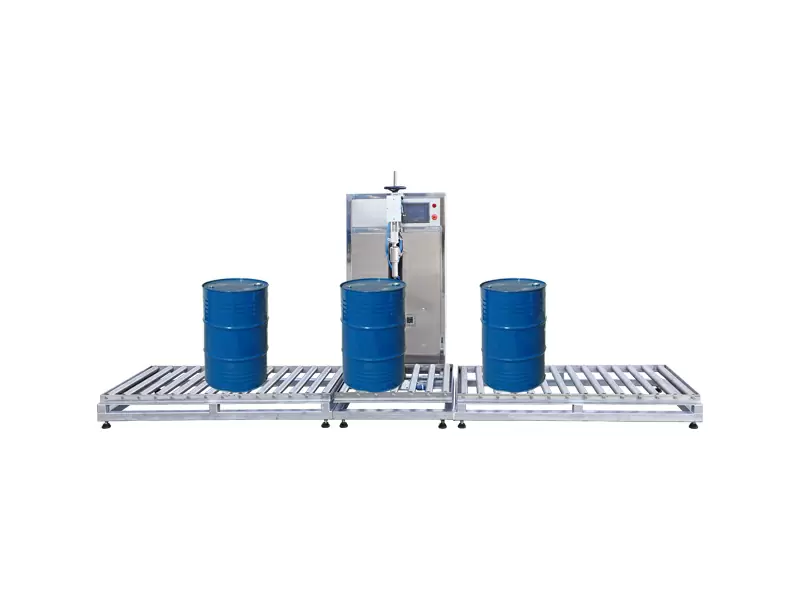
Single-head weight-controlled drum filling
Fill 100–200 kg drums to a target net weight
This single-head filler uses electronic weighing control for large steel or plastic drums. The controller subtracts the container tare, starts with fast filling, changes to a slower approach near the target, and stops at the programmed weight. A source-listed back-suction function helps control liquid remaining at the nozzle; the required drum-handling automation level must be specified separately.
Measuring principle
The load platform measures mass while the drum is being filled
Weight control is distinct from timed gravity filling and flow-meter filling. The useful result depends on scale setup, tare stability, product feed behavior, nozzle cutoff, vibration, drum positioning, and the programmed fast-to-slow transition.
Mass range does not define liquid volume
A 100–200 kg target produces a different filled volume for liquids with different densities. Drum capacity, safe headspace, product temperature, density, and the legal or commercial declaration basis must be reviewed together.
Application boundary
Use it for compatible fluid products and drums that can sit reliably on the scale
The current page lists edible oil, palm oil, lubricating oil, biodiesel, chemical liquids, and other industrial fluids. This list is not a universal compatibility statement; the actual liquid, temperature, hazard classification, and wetted materials must be approved.
100–200 kg net-fill target
The published range is expressed in kilograms for steel drums or plastic barrels. Confirm the permitted gross load including the drum tare.
Automatic or manual tare entry
The source states that the controller can deduct tare automatically and also allows manual tare input when required.
Two-stage filling
Fast filling handles the main quantity and slow filling approaches the target. The change point must be set for the actual liquid and feed system.
Back-suction at cutoff
The source describes vacuum back-suction for drip control. Confirm the mechanism, utility needs, recovery path, and behavior with the selected product.
Published technical data
Retain the source values, then define the missing test conditions
The live page does not identify the test liquid, density, viscosity, temperature, supply arrangement, drum geometry, target weight, calibration method, or accuracy calculation behind the stated performance.
| Parameter | Source-listed value | Buyer confirmation |
|---|---|---|
| Filling range | 100–200 kg | Confirm net or gross basis, normal target weights, drum tare range, and maximum scale load. |
| Filling precision | ≤1.0% | Request the denominator, test weight, number of fills, liquid condition, calibration status, and whether this is accuracy or repeatability. |
| Published capacity | 15–25 barrels/hour | Confirm target weight, product flow, drum handling time, nozzle positioning, operator count, and refill or supply conditions. |
| Power | 2.2 kW | Confirm which pump or machine functions are included and match the final voltage, frequency, and phase. |
| Machine weight | 200 kg | Confirm net and shipping weight plus lifting, floor loading, and anchoring requirements. |
| Machine dimensions | 1200 x 500 x 800 mm (L x W x H) | Add drum approach, removal, spill control, service clearance, and any conveyor or feed equipment to the layout. |
| Source-listed voltage options | 220 / 380 / 415 V | Options are not one universal nameplate; specify the required voltage, frequency, phase, and local standard. |
The accuracy claim has no published test basis
Treat ≤1.0% as a source-listed reference, not a guaranteed result for every product and drum. A useful acceptance protocol should define the product, temperature, target net weight, drum, fill count, reference scale, allowable error calculation, and treatment of drips after cutoff.
Drum and product compatibility
Approve the package opening and liquid path
- Steel or plastic drum material, nominal capacity, outside dimensions, tare tolerance, and condition
- Bung or open-head geometry, opening diameter, fill height, safe headspace, and closure method
- Product name, density, viscosity, filling temperature, solids, foaming, and tendency to crystallize or solidify
- Required contact-material grade, gasket and hose compatibility, surface finish, and cleaning method
- Hazard classification, grounding and bonding, ventilation, spill containment, and local regulations
Food-contact construction is not specified on the source page
The page offers a stainless-steel body as an option but does not identify the grade or the materials of the nozzle, pipework, hose, pump, seals, or holding tank. For edible oil, place a component-level wetted-material schedule and sanitation method in the order documents.
Controls and utilities
Define the product feed and scale environment
- Confirm whether the 2.2 kW value includes a feed pump and how product reaches the filling valve.
- Specify supply tank level, inlet pressure, hose or pipe size, recirculation, and product-temperature control.
- Keep the scale level and isolated from vibration, hose pull, pipe stress, and contact with surrounding structures.
- Request the controller recipe, tare, fast/slow change point, overfill response, alarm, and batch-record functions.
- The source does not state a compressed-air requirement; confirm all utility connections on the final drawing.
Optional configuration
Turn source-listed options into an exact scope
- Stainless-steel body and specified product-contact components
- Conveyor or roller handling for drum entry and discharge
- Semi-automatic or automatic drum-handling arrangement
- Voltage selection for the destination installation
- Source-listed explosion-proof motor option, with the complete area classification and certification scope confirmed separately
Maintenance and verification
Protect the weighing chain from drift and mechanical interference
- Verify the scale with suitable reference weights at a defined interval and after relocation or repair.
- Inspect the load cell, platform stops, cables, junction box, controller, and mounting hardware.
- Clean the nozzle, valve, back-suction path, hoses, pump, and spill area for the selected product.
- Check seals, valve seats, clamps, flexible connections, electrical protection, and emergency stop.
- Keep recommended load-cell, controller, valve, seal, hose, and pump-service parts on site.
Safe drum handling
Plan movement for the filled gross weight
- Use an approved drum trolley, roller bed, pallet, forklift, or conveyor arrangement.
- Keep operators clear of pinch points around the scale and filled-drum transfer path.
- Provide bunding or spill containment sized for the site risk assessment.
- Do not use an optional motor label as proof that the complete machine suits a hazardous area.
- Follow the delivered operating, lockout, cleaning, and emergency procedures.
Buyer configuration checklist
Send the liquid, drum, and acceptance method together
- Product name, composition, density, viscosity, fill temperature, and safety data
- Target net weights, expected variation, daily drum count, and operating hours
- Drum drawings, samples, tare range, opening, closure, and handling method
- Supply tank, pump, pipework, available pressure, and required cleaning or product changeover
- Accuracy definition, reference scale, sample count, and factory acceptance criteria
- Voltage, frequency, phase, hazardous-area classification, and utility availability
- Workshop dimensions, floor condition, spill plan, destination, and documentation needs
Request a filled-drum trial at the normal target
A test near the actual 100–200 kg production target is more useful than a general statement of precision. Record tare, gross and net weight, cutoff behavior, residual drips, cycle time, and scale verification for each test fill.
Related filling equipment
Compare container size and measuring principle
Configure the drum filler from the net-weight acceptance test
Send the product data, normal target weight, drum drawing, feed arrangement, daily volume, accuracy method, utilities, workshop layout, safety requirements, and destination country.