
On this page
- Why hydraulic pressing is the right route for peanut oil
- Recommended Shengshi Hecheng models for peanut
- Why Model 325 specifically for peanut
- Peanut hot-press process flow
- Three project tiers (with FOB pricing)
- Spec sheet — Model 325CG-A (the peanut workhorse)
- What peanut pressing looks like in practice
- Common peanut-pressing mistakes that cost yield
- FAQ
- Related pages
A peanut oil hydraulic press machine is the core piece of equipment for any aromatic peanut oil project — from a 200 kg/day fresh-oil shop to a 5 t/day commercial workshop. Peanut oil is high-margin (35–48% oil content, premium retail price) and consumers can taste the difference between a roasted-and-pressed batch and an industrial solvent-extracted bottle. This page explains which Shengshi Hecheng hydraulic oil press models are right for peanut, the real heat-press process, daily output you can expect, common mistakes that destroy yield and FOB price ranges from a single shop press up to a full 5 t/day workshop. All numbers come from active project specs, not estimates.
Why hydraulic pressing is the right route for peanut oil
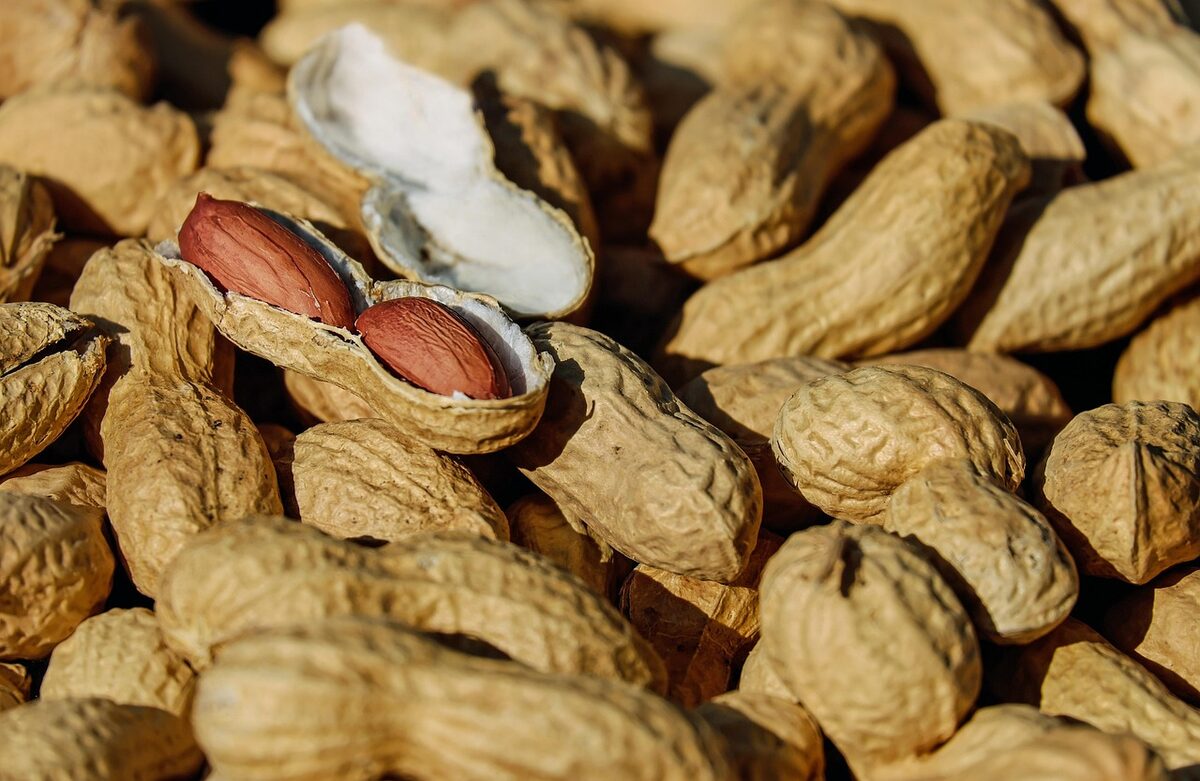
Peanut has 35–48% oil content depending on variety, with the redskin and Virginia-type giving the highest yields. Two pressing routes are realistic: hydraulic hot-press for premium aromatic oil, or screw expeller for bulk industrial supply. For any project that wants to sell the oil under a brand — at a city market, in a retail bottle, on an export label — hydraulic hot-press wins for three reasons:
- Aroma development — the roast-then-press cycle creates the toasted-peanut aroma the market actually pays for. A screw press at 80–110°C cannot match it.
- Visible process — buyers can watch the machine work, see the cake come out, smell the fresh oil. This is a real selling point in a fresh-oil retail format and the reason behind the popular Korean-type shop press.
- Lower capex per shop — a single Model 325 hot-press unit with one roaster and a paper-leaf filter starts around $13,000–$15,000 FOB. The same throughput on a screw line needs more supporting equipment.
Realistic yield: 440–470 kg of crude peanut oil per ton of shelled kernel on a properly tuned hot-press cycle, leaving 11–13% residual oil in the cake. Skip the roasting / steaming step and yield drops 4–6 percentage points even with the same machine. For oilseeds where you want the lowest residual on a cold cake (flax, walnut, tea seed), the higher-tonnage 355–500 cold-press series is the better fit, but for peanut hot-press the 300/325 frame is the sweet spot.
Recommended Shengshi Hecheng models for peanut
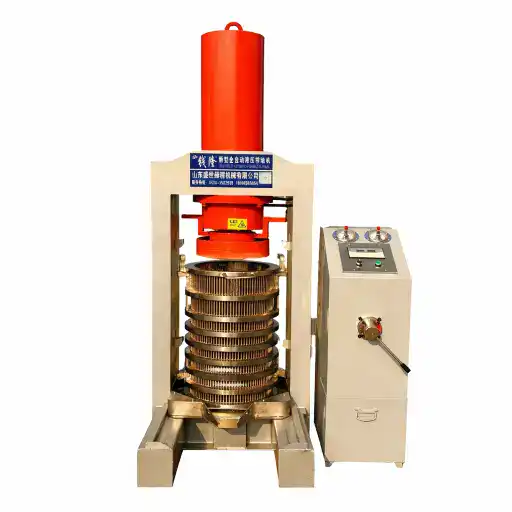
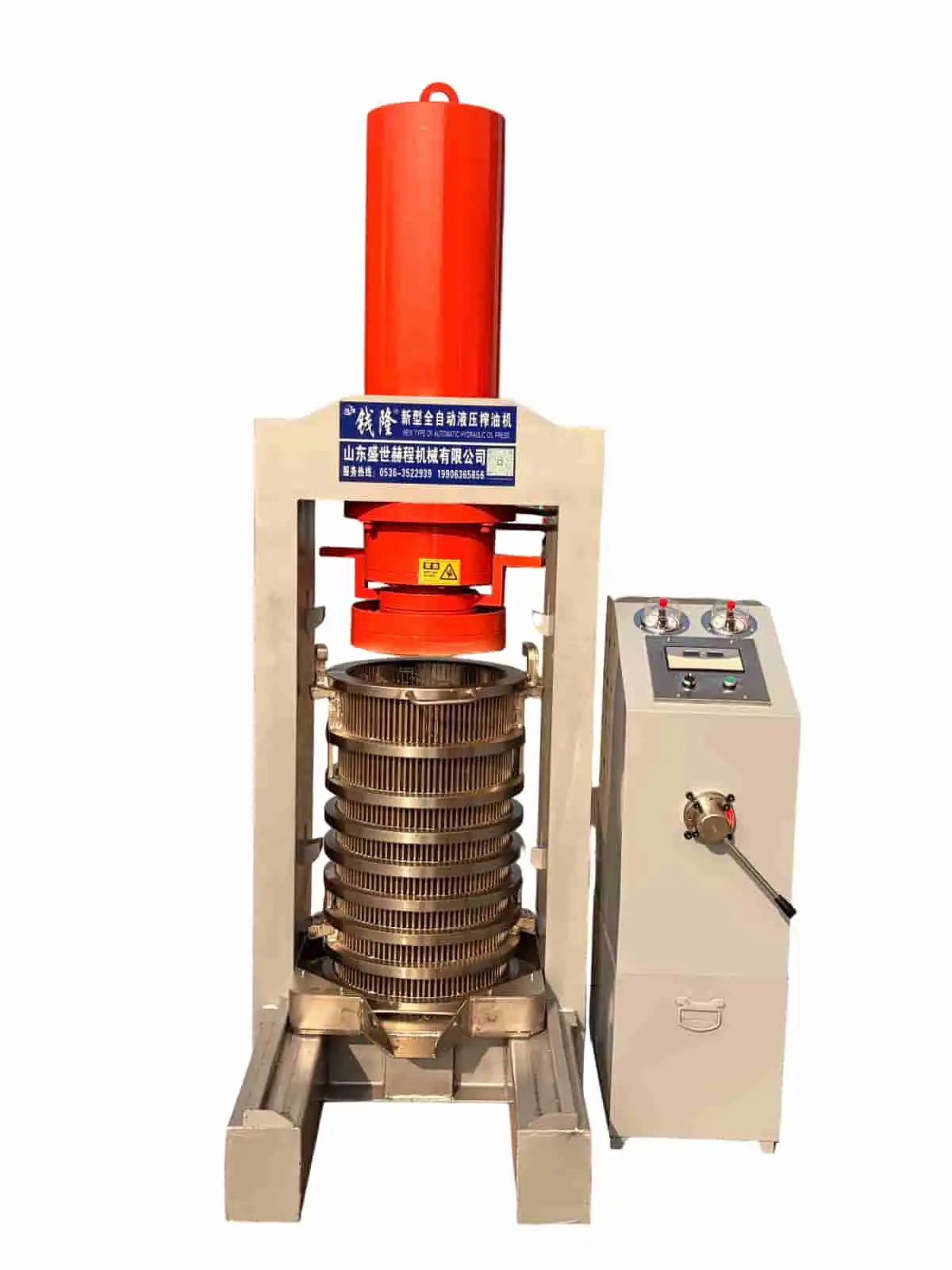
The Model 325 hydraulic oil press machine (325 tons real pressure, 60 MPa system pressure) is the workhorse for peanut oil in our product line. Its standard 390 mm × 800 mm barrel takes a 100 kg crushed-and-roasted peanut load per stroke — that is the working batch the shop uses every cycle, not a theoretical maximum. Model 300 is the slightly cheaper alternative with the same envelope; the cold-press 355–500 series is over-spec for peanut and is reserved for premium specialty oils where extra tonnage drives residual oil down on a cold cake.
| Model | Press tonnage | Barrel (Ø × H) | Batch / stroke | Cycle time | Daily output (single shift) |
|---|---|---|---|---|---|
| Model 300 | 300 t | 390 × 800 mm | 100 kg standard (5 kg min) | 15–22 min | 1.5–2.4 t/day kernel |
| Model 325 (recommended) | 325 t | 390 × 800 mm | 100 kg standard (5 kg min) | 15–22 min | 1.8–2.6 t/day kernel |
| Model 325 BC (twin barrel) | 325 t | 390 × 800 mm × 2 | 100 kg per barrel (200 kg/stroke) | 15–22 min | 3.5–5.2 t/day kernel |
| Model 325 AS (mother-daughter barrel) | 325 t | 390 mm + 300 mm | 100 + 60 kg combined | 15–22 min | 2.8–4.2 t/day kernel |
Daily output assumes 8-hour single-shift operation (15–22 minute press cycle, ~24 strokes/day at the high end) and a peanut moisture-after-roasting target of 4–6%. For multi-shift commercial operation, multiply by 1.6–1.8 (not 2× — you lose time on shift-change cleanup). Shop-format buyers usually run only 2–8 strokes/day, matched to their retail demand, not the full ceiling. For configurations smaller than this — a fresh-oil shop pressing 10–20 kg per stroke — see the Korean-type small hydraulic oil press.
Why Model 325 specifically for peanut
The 325 t hydraulic model presses peanut at a cake-face pressure of about 27 MPa/cm² on the 390 mm barrel. That number matters: peanut cake is hard and fibrous, and lower-pressure cake-face values (under 20 MPa/cm²) leave too much residual oil. The 325 is also where our barrel-to-frame design sweet spot is — the trapezoidal-bar key construction gives an oil-discharge surface 15× larger than a drilled barrel, which is why peanut crude flows out fast and the press does not stall on a hot, oily cake. The 60 MPa system pressure / 80 MPa pump capacity gives enough overhead that the press stays safe and cool over a full day’s operation. Full spec table is on the 300/325 hot-press product page.
Peanut hot-press process flow
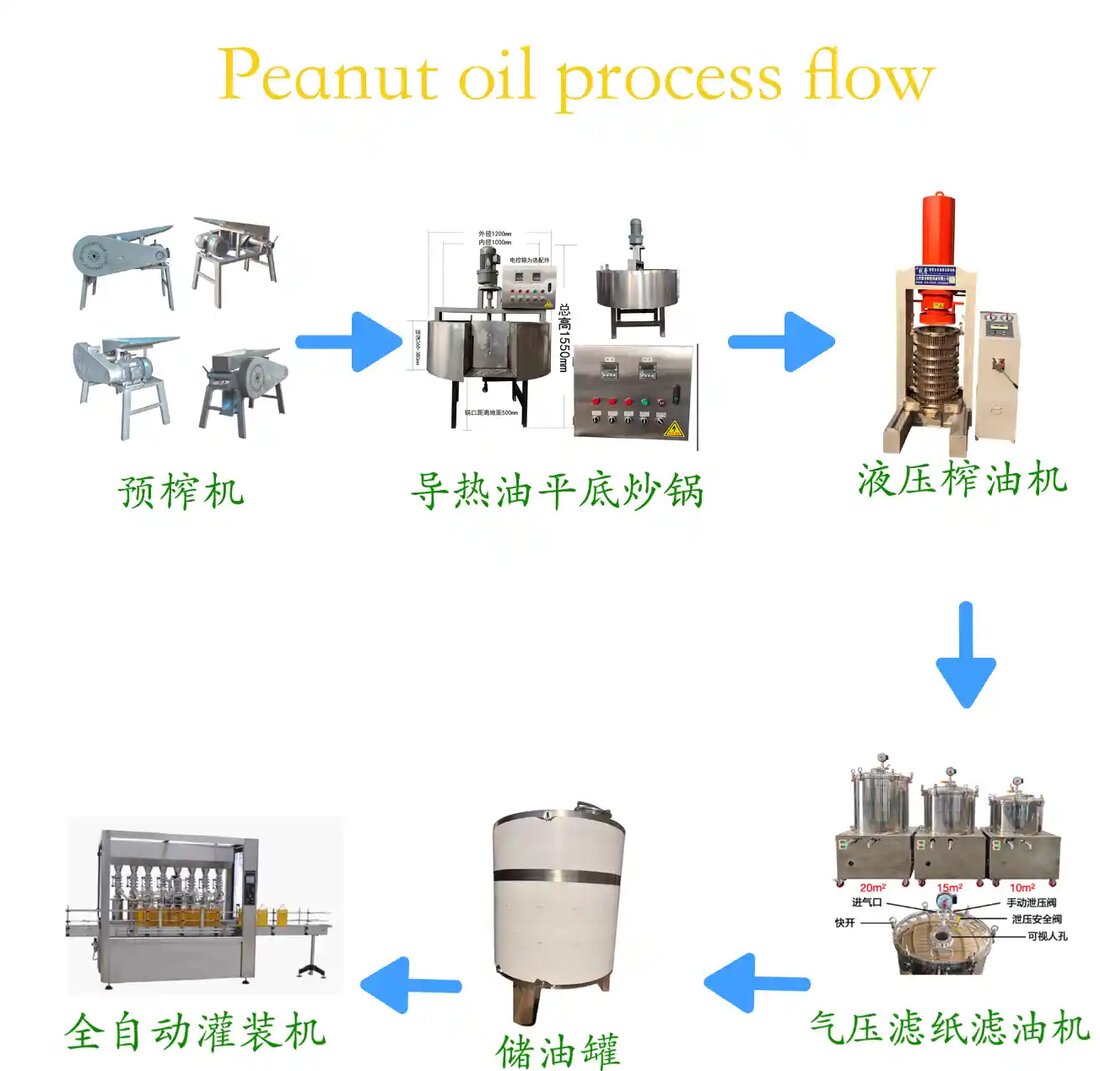
This is the canonical Shengshi Hecheng peanut hot-press route, used in our 5 t/day commercial workshop spec and in every smaller shop project. Each step matters; skipping any one of them costs 3–8 percentage points of yield. The same backbone applies to sesame oil production lines and to our sunflower hydraulic press setup — what changes between oilseeds is roast temperature, moisture target and stroke loading.
- Cleaning & destoning — combination vibrating screen + gravity destoner removes stones, sand, soil. Magnet trap catches any iron contamination. Pulse dust collector keeps the workshop clean.
- Shelling — a peanut sheller separates shells from kernels. Shells are sold separately as biomass fuel; kernels go to the next step. Skip if buying pre-shelled.
- Crushing — high-speed pulverizer breaks the kernels first, before any heat is applied. Smaller particle size shortens the oil path during pressing and raises yield. Order matters: never roast whole kernel and then crush — the broken-open surfaces lose oil and aroma during crushing.
- Roasting / cooking — the crushed peanut is then loaded into the flat-bottom thermal-oil pan and brought to 110–130°C with the right moisture profile. This is where the aroma compounds form on the freshly exposed surfaces. Three pans typically run on rotation against five Model 325 presses.
- Pressing — Model 325 hydraulic press at 60 MPa system pressure. Cake comes out hard and dry. Cake is recycled to a separate stream or sold as livestock feed.
- Filtration — pneumatic paper-leaf filter (multi-layer style) clarifies the crude oil. Fine sediment is removed; finished oil is bright and stable.
- Storage / filling — SUS304 storage tanks or direct-to-bottle filling line for retail format.
Three project tiers (with FOB pricing)
USD ranges below are FOB China, ex-works equipment only. They do not include sea freight, duty, installation labor at your site or local civil works. All numbers come from real Shengshi Hecheng quotations. For a sesame-side breakdown of the same logic, see our sesame oil production line cost page.
Tier 1 — Fresh-oil shop / startup workshop (200–800 kg/day, 2–8 strokes)
One Model 325 hydraulic press with a 390×800 mm standard barrel (100 kg kernel per stroke), one thermal-oil flat-bottom pan (~200 kg capacity), one high-speed crusher, a 10 m² paper-leaf filter, one bucket elevator and three 1-ton SUS304 storage tanks. This is the “Binzhou-style” shop configuration that sells aromatic peanut oil straight to walk-in customers — 2–8 strokes per day covers the typical 200–800 kg/day retail volume. See the full SOP in our fresh-pressed peanut oil shop business guide.
| Equipment | Spec | Qty |
|---|---|---|
| Hydraulic oil press | Model 325 single-barrel 390 mm extended | 1 |
| Thermal-oil flat-bottom pan | 200 kg / batch, 27 kW heating | 1 |
| High-speed crusher | 300–350 kg/h | 1 |
| Pneumatic paper-leaf filter | 10 m², SUS304 | 1 |
| Bucket elevator | 1.5 m lift | 1 |
| SUS304 storage tank | 1 ton | 3 |
FOB price range: $13,000 – $15,000. Buyers typically pay back the equipment cost in 4–8 months on a busy retail location with reasonable peanut sourcing — at 200 kg/day kernel input, fresh peanut oil retail margin clears roughly $200/day gross.
Tier 2 — Commercial workshop (3.6–7.8 t/day)
Two or three Model 325 presses running on rotation against one or two thermal-oil pans, plus shelling, crushing, filtration and 5–10 ton storage. Each single-barrel 325 averages 18–26 strokes per shift × 100 kg/stroke = 1.8–2.6 t/day; two presses on rotation deliver 3.6–5.2 t/day, three reach 5.4–7.8 t/day. This is the format for a city-level brand or regional distributor who wants stable daily output without committing to a full automated line.
FOB price range: $35,000 – $55,000. Pressing output 3.6–7.8 t/day kernel input depending on number of presses, shift pattern and downstream filtration speed.
Tier 3 — 5 t/day full peanut oil workshop
This is our flagship commercial spec, deployed for buyers who want a complete pressing line with edible-oil-grade construction. Five Model 325CG-A hydraulic presses on a shared header give a 9–13 t/day pressing ceiling (5 × 1.8–2.6 t/day each); the line is balanced down to 5 t/day finished refined-and-bottled output by the LYG-1300 refining train and the 6-head filling line downstream. Three thermal-oil flat-bottom pans run on a roast-rotation schedule, with a full pre-cleaning + shelling + crushing-first line, paper-leaf filtration and SUS304 storage. Output is GB/T 1534 compliant grade-1 / grade-3 peanut oil after refining.
| Section | Equipment | FOB price (USD) |
|---|---|---|
| Pressing workshop | 5 × Model 325CG-A presses, 3 × thermal-oil pans, crusher, destoner, sheller, paper-leaf filter, conveyor, control panels | $40,000 – $45,000 |
| Refining workshop (optional) | LYG-1300 neutralizing pot, TSG-1300 bleaching, TXG-1300 deodorizing, vacuum pump, heat exchanger, bleaching earth feed, 115 kW total install | $50,000 – $60,000 |
| Storage tank section | 9 × 5 m³ SUS304 tanks, transfer pump, piping | $13,000 – $16,000 |
| 1–5 L automatic filling line (optional) | 6-head flow-meter filler, capper, induction sealer, labeler, laser coder, case packer | $22,000 – $30,000 |
Pressing workshop only: $40,000 – $45,000 FOB. Pressing + refining + storage: $95,000 – $115,000 FOB. Full integrated workshop with bottling: $120,000 – $145,000 FOB.
Spec sheet — Model 325CG-A (the peanut workhorse)
| Parameter | Value |
|---|---|
| Model | YY325CG-A |
| Press tonnage | 325 tons |
| System pressure | 60 MPa |
| Pump max pressure | 80 MPa (high-low double-pump station) |
| Top-face pressure | 27 MPa |
| Barrel diameter | 390 mm |
| Barrel height | 800 mm |
| Stroke | 850 mm (5 kg start) / 750 mm (40 kg start) |
| Batch range | 5–100 kg per stroke (100 kg is the standard working load on the 390×800 mm barrel) |
| Motor | 2.2 kW, 6-pole, pure copper |
| Power supply | 380 V / 220 V, 50 Hz |
| Barrel construction | Trapezoidal-bar key strips, Q690 forged flange, 15× discharge area vs drilled barrel |
| Cylinder material | 27SiMn alloy, heat-treated, Hubei Daye (state-owned) source |
| Seals | Japanese-import Glyd ring + back ring, Y-type combination, dual seal |
| Frame | Welded channel steel, anti-deformation |
| Control | Microcomputer PLC, software-linked program, dual pressure gauges |
| Machine weight | 1.3–1.4 tons (single barrel) |
What peanut pressing looks like in practice
A few details from real peanut pressing runs are worth knowing before you buy:
- Grind then roast: for hot-pressed peanut oil the kernels are ground into grits and roasted before pressing — this is what gives the deep aroma and lifts yield.
- Loaded in layers, no cloth: peanut is loaded one layer of material between one carbon-steel separator plate — no cake cloth to wrap or replace. Oil runs straight out of the barrel slots.
- Bar-slot barrel, large drainage area: the slotted barrel gives a big open drainage area so oil flows fast and the channels do not clog.
- Bottom-up cake ejection: the cake is pushed up and out from the bottom, so unloading is quick between batches.
- Batch sizing is flexible: a standard run presses about 100 kg of crushed material per barrel, and larger batch builds can be configured to your target output.
- Proven export machine: peanut presses on this platform are running in markets such as Nigeria and Ethiopia.
Common peanut-pressing mistakes that cost yield
- Skipping the roasting step — costs 4–6% yield and kills aroma. Hot-press peanut oil without roasting is just expensive cold-press peanut oil.
- Roasting too dry — peanut moisture below 3% gives a hard cake but ruptures the oil cells too aggressively; oil clarity drops and color darkens. Target 4–6% moisture out of the roaster.
- Loading the barrel cold — hot peanut into a cold press barrel condenses moisture inside the cake and chokes oil flow. Pre-warm the barrel for the first stroke of the day.
- Roasting before crushing — the standard 390×800 mm barrel takes 100 kg per stroke; that 100 kg is crushed-then-roasted peanut. Reversing the order (roast whole, then crush) tears open oil cells before the press can capture them and costs 4–8 percentage points of yield.
- Re-pressing without re-crushing — second-pass cake needs to be broken up first or the press just compacts a brick.
- Filtering hot oil through cold paper — paper-leaf filters work best at 60–70°C oil temperature; below that, the filtration rate drops by half.
FAQ
How much peanut oil can I get from 1 ton of shelled peanut?
440–470 kg of crude oil on a tuned hot-press hydraulic line, with cake retaining 11–13% residual oil. After paper-leaf filtration you lose 5–8% to filter cake, so sellable oil is 410–440 kg/ton. Cake (530–560 kg/ton) is sold as livestock feed at $200–$280/ton.
Hot press or cold press for peanut?
Hot press for almost all commercial peanut oil. The aromatic toasted-peanut profile only develops on roasted-then-pressed kernel. Cold press peanut oil is a niche health-food product; it gives lower yield (390–420 kg/ton) and a flat flavor that does not justify the price most markets will pay. If your market is specifically cold-pressed premium oils, the 355–500 cold-press series is the right frame.
Do I need a refining section?
Depends on your market. Crude hot-press peanut oil is sold directly in fresh-oil retail and informal markets. For bottled retail under a brand, GB/T 1534 grade-1 / grade-3 compliance usually requires neutralizing + bleaching + deodorizing — that’s the LYG-1300 / TSG-1300 / TXG-1300 refining set. Add about $50,000–$60,000 FOB for the refining section.
Can I use Model 325 for both peanut and other seeds?
Yes — Model 325 also handles sesame, soybean, rapeseed, mustard seed, sunflower kernel, walnut, flax and similar oilseeds. Peanut and sesame are the two highest-volume hot-press use cases. For cold-press premium oils (flax, walnut, almond, tea seed, perilla) the higher-tonnage 355–500 cold-press series gives lower residual on a cold cake.
What’s the smallest peanut oil press I can buy from Shengshi Hecheng?
For a true shop format, the Korean-type / KHOP-10/15/20 KG small press handles 10–20 kg per stroke and starts around $3,500 FOB. It’s lower throughput than Model 325 but fits a smaller storefront and matches retail-pressing visual appeal.
Get a custom peanut oil project quotation
Send us your daily kernel input target, whether you want pressing only or pressing + refining + filling, and your destination port. We’ll come back with a configured equipment list, FOB and CIF pricing, payment terms and an honest delivery / installation timeline. Most projects ship within 30–45 days of order confirmation. Browse the full hydraulic oil press machine models hub before sending the brief, so you can reference the exact frame size and barrel option that matches your throughput.
Related pages
Project planning
Configure the right oil press and production line
Send your oilseed, target output, bottle or packaging requirements, power supply, and destination country. We will match the machine, supporting equipment, and line layout.