
On this page
- Why the Binzhou shop model works
- The Binzhou shop bill of materials
- Storefront location: what actually drives sales
- Daily output you can sell from one press
- The shop day — typical SOP
- Retail pricing, daily revenue and gross margin
- Six mistakes that destroy a new shop
- Permits and food-safety paperwork (most countries)
- Scaling up: when one press isn’t enough
- FAQ
- Get a configured Binzhou-format quotation
- Related pages
A fresh-pressed peanut oil shop is one of the lowest-capex food-processing businesses you can open today. With a single hydraulic oil press, a thermal-oil pan and three storage tanks you have a fully working retail operation: the customer walks in, watches you roast and press their kernel, and walks out with a bottle of warm aromatic oil. This guide is built around the “Binzhou shop model” — a 32 m² storefront pressing 200–800 kg of peanut kernel per day (2–8 press strokes) — and covers equipment, layout, daily SOP, retail pricing, payback math, the mistakes that bankrupt new shops, and the regulatory paperwork you actually need. All numbers come from real Shengshi Hecheng project specs, not estimates.

Why the Binzhou shop model works
Binzhou (Shandong) is where the modern fresh-pressed peanut oil retail format was born — a small storefront where the press, roaster and storage tanks are visible from the street, and customers buy oil that was pressed within the last 48 hours. The format scaled because it solves four real consumer concerns at once: provenance (you watched the press run), aroma (a roasted-and-hot-pressed bottle smells nothing like a supermarket commodity bottle), shelf turnover (oil leaves the shop hot, not after months in a warehouse), and price (no broker margin between farmer and bottle). The same playbook works in Lagos, Manila, Lahore, Dar es Salaam and any city with a strong peanut culture and skeptical edible-oil shoppers.
If you want the bigger picture on machine selection, working pressure and process before you commit to the shop format, read the full peanut oil hydraulic press machine pillar guide first. This page is specifically about the storefront business: the bill of materials, the layout, the day, the money.
The Binzhou shop bill of materials
This is the exact equipment list from a recent Shengshi Hecheng quotation for a 32 m² peanut oil shop in Shandong. The store can press anywhere from 200 kg to 1,200 kg of shelled kernel per day on a single Model 325 — most shops start at 200–400 kg/day and dial up as retail demand grows. Every item below is on the hydraulic route — no screw expellers — because hydraulic is what gives the aromatic, visible-process result the retail customer is paying for. For the underlying machine spec sheet, see the Model 300/325 hot-press product page.
| Item | Spec | Qty | Footprint |
|---|---|---|---|
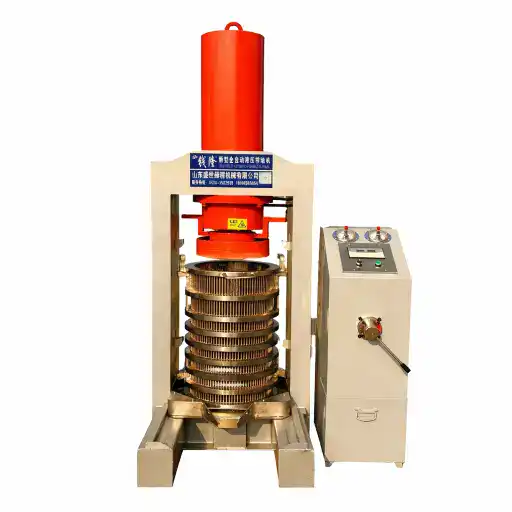
| Model 325 extended hydraulic oil press | 325 t pressing tonnage, 60 MPa system pressure, 390 mm × 800 mm barrel, 5–100 kg per stroke | 1 | 1.1 × 0.8 m, 2.45 m tall |
| Thermal-oil flat-bottom pan | 1 m pan, 100 kg (200 斤) / batch, 27 kW heating + 1.1 kW motor, 350# thermal oil, electric heating | 1 | 1.2 × 1.2 m, 1.55 m tall |
| High-speed crusher / pulverizer | 300–600 kg/h depending on seed, 11 kW drive | 1 | 1.85 × 0.85 m |
| Pneumatic paper-leaf filter | 10 m² SUS304, electric pump + air compressor, transparent inspection cover | 1 | 1.0 × 1.0 × 1.2 m |
| Bucket elevator | 1.5 m lift, low-power feed-style hopper | 1 | 0.5 × 0.5 m |
| SUS304 storage tank | 1 ton each, sediment drain valve, sealed cover | 3 | 1.0 m diameter each |
Total floor area used: about 18–22 m² for the equipment, leaving 10–14 m² for retail counter, customer queue, bottle display and a small office. A 32 m² storefront with one entrance and one back door fits this layout comfortably.
Equipment FOB price range: $12,000 – $15,000. CIF to most ports lands at $14,000 – $18,000 depending on port and 20 ft container utilization. Compare with the smaller-format Korean-type 10/15/20 kg shop press if your storefront is under 18 m² or you’ll never realistically need more than 100–200 kg/day.
Storefront location: what actually drives sales
Six location signals correlate with profitable peanut oil shops in our customer base. None of them are surprising once you see them written down, but most failed shops we’ve seen ignored at least three.
- Wet market or fresh-food street — sit next to butchers, vegetable stalls, fresh-tofu shops. Foot traffic is already in food-buying mode.
- Visible from the street — the press needs to be seen from outside the door. A back-room press converts at half the rate of a front-window press, all else equal.
- Power supply ≥ 30 kW available — the thermal-oil pan alone is 27 kW. Skip locations where the landlord caps you at 15 kW.
- Floor that can take 1.4 t point load — Model 325 weighs 1.3 t before the cake hopper. Concrete ground floor, not a wooden second floor.
- Ventilation to outside — roasting peanut at 110–130°C produces real smoke. A dedicated extraction fan into a flue or open alley keeps the shop pleasant, not hazy.
- Within 30 km of a peanut wholesale market — your input cost is 60–70% of revenue. Long sourcing trips kill margin.
Daily output you can sell from one press
One Model 325 hydraulic press, run on a single shift with one thermal-oil pan, processes 50–200 kg of shelled peanut kernel per day depending on shift length and how aggressively you queue cycles. The arithmetic from a shop in Shandong:
- Crushing: 300–600 kg/h on the high-speed pulverizer — done first, before any heat is applied
- Roasting cycle: 100 kg of already-crushed kernel per batch on the 1 m thermal-oil pan (200 斤 — that is the pan’s working load), ~30–40 min including loading + heat-up + stir to 110–130°C
- Press cycle: 100 kg crushed-and-roasted kernel per stroke on the standard 390×800 mm barrel (this is the working load, not a maximum), 15–22 min per stroke
- Press ceiling: 8–12 strokes per single shift = 800–1,200 kg/day of kernel if you run flat-out
- Shop-format daily volume: most Binzhou-style shops choose to run only 2–8 strokes (200–800 kg/day), matched to retail demand — not the press ceiling
- Crude oil yield: 440–470 kg per ton of kernel on a tuned hot press
- Sellable bottled oil after filter loss: 410–440 kg per ton of kernel
For a shop pressing 200 kg/day of kernel (2 press strokes plus two matching 100 kg roast batches), that is 82–88 kg of bottled fresh peanut oil per day — roughly 90–95 L. At a 5 L bottle that is 18–19 bottles a day; at 1 L, 80+ bottles. Most shops dial throughput up to 400–600 kg/day (4–6 strokes) within a few months as retail demand builds. The press itself has plenty of headroom — the ceiling is retail, not the machine.

The shop day — typical SOP
- 06:30 — Sourcing & intake. Sacks arrive from the wholesaler. Visual check, moisture meter on a sample (target 8–10% inbound moisture), weigh and log into a simple input ledger.
- 07:00 — Cleaning & shelling (skip if buying pre-shelled). Vibrating screen to drop stones, magnet trap to catch metal. If shelling in-house, a small peanut sheller produces clean kernel + biomass shell that’s sold separately.
- 08:00 — Crushing. Run the day’s first batch of clean shelled kernel through the high-speed pulverizer first. Crushing whole kernel is fast and dry — no oil loss. If you reverse this order and crush after roasting, the broken-open surfaces lose oil and aroma to the pulverizer walls. Order matters.
- 08:30 — First roast batch. Load 100 kg (200 斤) of the just-crushed kernel into the 1 m thermal-oil pan — that is one full pan. Ramp to 110–130°C, hold and stir for ~30 min. The aroma compounds form on the freshly exposed surfaces, exactly when the oil cells are most receptive. Target moisture out of the roaster is 4–6%.
- 09:00 — First press strokes. 100 kg per stroke on the standard barrel, 15–22 min cycle. While the press runs, the next crush-then-roast batch is already moving through the pulverizer and pan. Pressed cake comes out hot and dry; collect into separate bins.
- 11:30 — Filter switch-over. When 80–120 kg of crude oil has accumulated, run it through the 10 m² paper-leaf filter at 60–70°C oil temperature. Below 60°C the filtration rate drops by half.
- 12:30 — Bottling for the lunch rush. Hot filtered oil into the SUS304 storage tank, then to the retail counter. Walk-in customers can watch the press while their bottle is filled.
- 15:00–17:00 — Second shift cycle. Repeat as demand allows.
- 17:30 — Cake collection & sale. Day’s cake (530–560 kg per ton of kernel pressed) goes out to the local livestock feed buyer or to a peanut cake collector at $200–$280/ton equivalent.
- 18:00 — Clean-down. Wipe the barrel, run a small cleaning batch through the crusher, drain a quick sediment check on each storage tank. Daily cleaning is what keeps the equipment lasting 8–10 years.
Retail pricing, daily revenue and gross margin
Pricing varies a lot by country. The framework below is a structure, not a spreadsheet — plug in your local input and retail prices to size the opportunity. Numbers shown are an illustrative middle case for an Asian wet-market shop pressing 200 kg of kernel per day (2 strokes, 2 roast batches).
| Line | Per kg of kernel | Per day at 200 kg kernel (2 strokes) |
|---|---|---|
| Kernel input cost (wholesale) | $1.20 | $240 |
| Other input cost (electricity, filter paper, bottle, label) | $0.15 | $30 |
| Bottled peanut oil yield | 0.41 kg | 82 kg |
| Retail price of fresh-pressed peanut oil | — | $5.50/kg |
| Oil revenue | $2.26 | $451 |
| Cake revenue (0.55 kg × $0.25/kg) | $0.14 | $28 |
| Total revenue | $2.40 | $479 |
| Daily gross margin (revenue – inputs) | $1.05 | $209 |
At $209/day gross margin × 26 trading days × 12 months = ~$65,000/year before rent, labor and tax — and that is at just 2 press strokes per day, well below the machine’s ceiling. Subtract $400–$1,200/month rent and one shop-keeper at $400–$800/month and a single-press shop in this scenario nets $40,000 – $55,000/year at the 200 kg/day cadence. Equipment payback at $13,500 CIF lands in the 4 to 8 month band, in line with what Shengshi Hecheng customers in Shandong, Henan and Hebei report on similar setups. Shops that run 4–6 strokes/day shorten payback further. Customers who want to extend this into a larger production line (refining, filling) can read our sesame oil production line cost page — the cost structure for peanut is closely parallel.
Six mistakes that destroy a new shop
- Buying a screw expeller “to save money” — the whole retail thesis is the visible hydraulic press and the aromatic hot-press oil. A screw expeller running at 80–110°C does not produce the aroma profile the customer is paying for. Stay on the hydraulic route. The full machine catalog is on the hydraulic oil press machine models hub.
- Putting the press in the back room — invisible press, no theater, no premium. The press belongs at the front window.
- Skipping the roasting step on day 1 — costs 4–6 percentage points of yield and kills aroma. New owners sometimes try it to “save time”; they end up with cold-press peanut oil at hot-press prices.
- Reusing seed-oil bottles from the supermarket — opaque and old. Use clean, food-grade PET or glass with your shop’s label. Provenance is the product.
- Storing crude unfiltered oil in plastic drums — the fine sediment goes rancid faster than the oil itself. Always filter before storage. The paper-leaf filter is not optional kit.
- No moisture meter on inbound peanut — high-moisture peanut roasts unevenly and presses at 4–6 percentage points lower yield. A $40 grain moisture meter pays for itself in week one.

Permits and food-safety paperwork (most countries)
Specific rules vary by jurisdiction, so check with your local food authority. The following structure is what most national edible-oil regimes ask for at the small-shop level — the same template applies in China (SC license), India (FSSAI), Nigeria (NAFDAC), Philippines (FDA-LTO), and most Sub-Saharan and Middle East markets.
- Business registration — sole proprietorship or LLC, plus a tax ID.
- Food production / processing license — usually inspected on equipment cleanliness, premises hygiene, water source, waste disposal, pest control. Expect a site visit.
- Edible oil quality compliance — meet the local crude peanut oil grade (analogous to GB/T 1534 grade-1 / grade-3 in China). Most shops sell crude unrefined oil within the day, but bottled retail with a brand often triggers a refining requirement. See the pillar guide’s section on refining and the LYG-1300 / TSG-1300 / TXG-1300 set.
- Labeling requirements — name, ingredient (100% peanut oil), volume, production date, best-before date, manufacturer, batch number, allergen warning (peanut).
- Worker health certificates — typical food-handler health screen, annually.
- Fire and electrical inspection — usually required because of the 27 kW thermal-oil heater and the open-flame option some shops add.
Scaling up: when one press isn’t enough
The natural growth path: a second Model 325 next to the first, then a third pan running on rotation, and eventually a satellite location pressing for the same brand. When one location consistently runs out of oil before lunch, that is the signal — not before. Retail-pressing demand is sticky and follows reputation, so over-investing too early in a 1–2 t/day commercial workshop without a proven retail brand is the most common scaling mistake. Read the peanut pillar guide for the Tier 2 (1–2 t/day commercial) and Tier 3 (5 t/day full workshop) configurations and pricing.
For owners considering a premium specialty oil sideline (cold-pressed flax, walnut, almond) once the peanut business is humming, the higher-tonnage 355–500 cold-press series is the appropriate machine — Model 325 is hot-press optimized.
FAQ
How much capital do I need to open a peanut oil shop?
Equipment $12,000 – $15,000 FOB plus shipping, install and a 1-month working-capital buffer (one month of peanut sourcing + rent + labor) usually puts the all-in start at $18,000 – $25,000 for the Binzhou format. Add another $4,000 – $8,000 if your country requires a higher-spec ventilation install or a refining-stage filter for bottled retail.
Can I run the shop on single-phase power?
The Model 325 press itself is 2.2 kW (six-pole motor) and accepts 380 V three-phase or 220 V single-phase on the small-motor configuration. The bottleneck is the 27 kW thermal-oil pan — it really wants three-phase. If three-phase is unavailable, options are a smaller 9 kW pan (lower throughput, longer roast time) or a propane-fired pan as a workaround.
Do I have to do my own shelling?
No. Most Binzhou-format shops buy pre-shelled kernel from a regional sheller and skip that step entirely. In-house shelling makes sense when you have a steady local farmer supply at a meaningful per-kg discount versus shelled wholesale, and where shells can be sold separately as biomass fuel.
How long does the equipment last?
The Model 325 frame, barrel and cylinder are designed for 8–10 years of daily single-shift operation with annual seal replacement and quarterly hydraulic-oil checks. The thermal-oil pan typically asks for a heating-element check at year 4–5. The paper-leaf filter consumes filter paper as a regular consumable but the SUS304 frame is essentially indefinite. Read the Model 300/325 product page for the build details.
Should I sell crude or refined peanut oil at retail?
For a walk-in fresh-pressed format, crude — that is the entire point. Customers are paying for the pressed-today experience, not laboratory-grade clarity. Once the shop adds bottled retail through other channels (supermarkets, online, export) under a registered brand, the regulatory path usually pushes you toward the GB/T 1534 grade-1 / grade-3 refining set. Plan for that as a phase-2 capex.
Can I press other oilseeds in the same shop?
Yes — Model 325 also handles sesame, soybean, sunflower kernel, walnut, rapeseed and similar oilseeds. Sesame is the natural second product (high-margin, similar process). For details, see the related shop write-up on sunflower oil hydraulic press machine or the sesame-line cost guide linked above.
Get a configured Binzhou-format quotation
Send us your storefront size, daily kernel target and destination port. We’ll come back with the configured equipment list (Model 325 + thermal-oil pan + filter + tanks + crusher + elevator), FOB and CIF pricing, payment terms and a delivery timeline. Most Binzhou-format shop orders ship in 30–35 days. Browse the full hydraulic oil press machine models hub first if you want to compare the 325 against neighboring frames before sending the brief.
Related pages
Project planning
Configure the right oil press and production line
Send your oilseed, target output, bottle or packaging requirements, power supply, and destination country. We will match the machine, supporting equipment, and line layout.