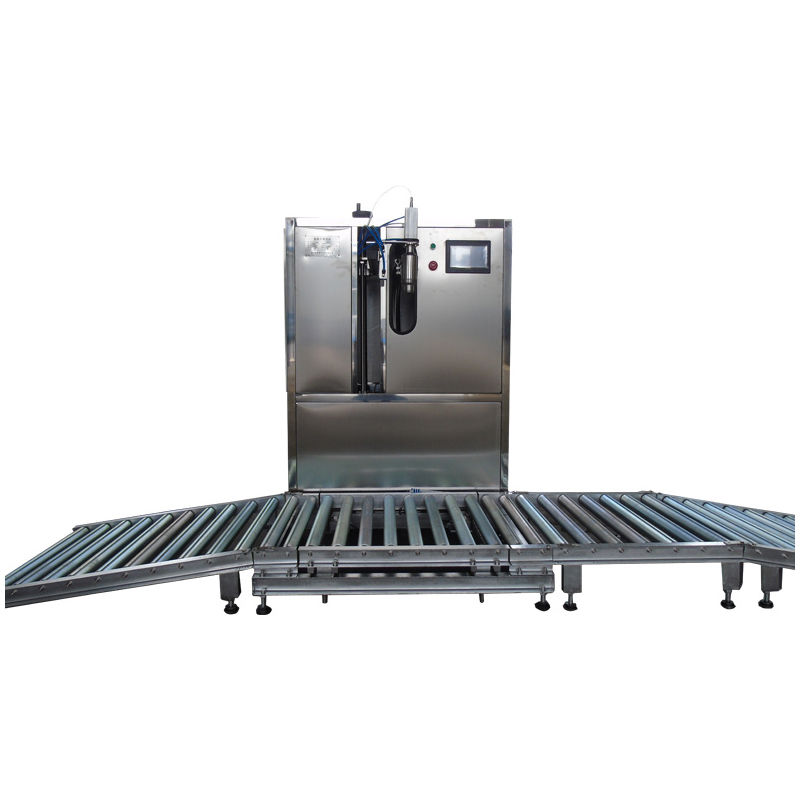
Single-head drum weighing filler
Fill 100-200 kg barrels with real-time weight control
The ZRCZ semi-automatic machine is the large-container option in this filling range. A load cell tracks net weight while the PLC controls fast and slow filling through one filling head, helping the operator approach the target in two stages.
Filler selection
Reserve this model for large barrels and drums
Package size and the required measuring principle determine the correct machine. The values on this page apply only to the ZRCZ drum weighing filler.
Small bottles
Use the piston filler for the source-listed milliliter and 1-5 L configurations, especially with viscous products.
View piston filling →Medium jugs and pails
Use the separate two-head weighing filler where medium containers and target net weight are the primary requirements.
View medium-container weighing →Free-flowing edible oil
Consider a flow-meter filler when the liquid is pumpable and meter compatibility has been validated.
View flow-meter filling →100-200 kg drums
Use this single-head weighing machine for the source-listed mass range and suitable barrel handling.
Current machineOperating sequence
Use fast filling for approach and slow filling near the target
The source identifies a load cell, PLC, feeding pump, and fast-plus-slow filling valve system. Final timing must be set with the actual product and drum.
Application boundary
Define the drum, liquid, and handling method before selection
- Source-listed products: edible oils, coatings, antifreeze, urea solution, daily chemical products, industrial liquids, and viscous materials.
- Mass range: the technical list states 100-200 kg; confirm empty drum weight and target net product weight.
- Drum geometry: provide height, diameter, opening, closure, material, pallet use, and sample photos.
- Liquid behavior: provide density, viscosity and temperature range, foam tendency, solids, and chemical safety data.
- Handling: plan how a filled drum reaches and leaves the scale without side-loading the load cell.
Mass and volume must remain separate
The page specification states 100-200 kg, while the hosted demonstration is titled as a 200 L machine. A 200 L container does not establish a 200 kg fill. Product density, drum working volume, headspace, and the required net mass must be confirmed independently.
Source-hosted machine video
Review drum positioning and the single-head workflow
The source provides a QuickTime demonstration but does not publish the liquid, density, net fill, cycle time, valve setting, or acceptance result shown. Browser playback support for the hosted MOV file can vary.
- Confirm drum entry and exit direction against the workshop layout.
- Check opening alignment and nozzle clearance for each drum type.
- Define whether rollers, conveyors, pallets, or lifting assistance are required.
- Plan closure fitting, labeling, spill containment, and finished-drum storage.
Published reference data
ZRCZ source-listed specification
The live source does not publish dimensions, machine weight, compressed-air demand, product-contact grades, or detailed test conditions. Confirm them in the final technical offer.
| Parameter | Source-listed value | Confirmation required |
|---|---|---|
| Model | ZRCZ | Confirm the final model suffix and configured bill of materials. |
| Filling heads | Single head | Confirm nozzle and valve type for the product and drum opening. |
| Filling range | 100-200 kg | Confirm net product mass and drum tare range. |
| Capacity | 40-60 drums/hour, depending on viscosity | Fill mass, liquid, drum handling, and test method are not published. |
| Filling accuracy | ±0.5% | The percentage basis, calibration method, target, and test conditions are not stated. |
| Power supply | 380 V | Confirm phase, frequency, cable, plug, and protection. |
| Installed power | 2.5 kW | Confirm included pump and motor configuration. |
| Packaging type | Drum / barrel | Provide every drum drawing and closure specification. |
Source-listed configuration
Weighing controls and product delivery
- PLC control system
- Weighing sensor or load cell
- Fast and slow filling valve system
- Feeding pump
- Stainless steel or PTFE pipeline options
- Emergency-stop function
Hazardous-liquid configuration is not automatic approval
The source says an explosion-proof design with a separated control cabinet is available. It does not state an area classification, protection method, certificate, applicable standard, or approved liquid. Flammable or explosive applications require a formal process-hazard and electrical-classification review before configuration.
Line integration
Treat drum movement as part of the filling cycle
- Define buffer tank, pump suction, hose routing, valve location, and drain or product-recovery points.
- Keep connected piping from applying force to the weighing structure.
- Confirm roller, pallet, conveyor, forklift, or lifting-device interfaces.
- Provide bunding, drain control, and a response plan for spills or overfills.
- Coordinate bung insertion, cap tightening, labeling, coding, and pallet storage.
Utilities and controls
Close the gaps left by the public specification
- Confirm voltage, phase, frequency, control voltage, and available electrical load.
- Ask whether the configured valves or actuators require compressed air; no air specification is published.
- Define recipe access, batch records, weight display, alarms, and upstream interlocks.
- Confirm earthing, area classification, ventilation, and control-cabinet position.
- Agree the factory acceptance liquid, drum, target, sample size, and weighing standard.
Maintenance planning
Maintain the scale, valve, pump, and product path
- Keep the weighing deck clear and verify zero before production.
- Inspect the load cell, mechanical stops, cables, nozzle, valve seats, pump, hoses, and pipeline joints.
- Calibrate with traceable test weights at the interval required by the quality plan.
- Drain, flush, or clean the product path using a method compatible with the liquid and selected pipeline material.
- Confirm spare seals, valve components, load cell, sensor, and pump parts from the final serial-numbered machine.
Safe operation around heavy filled drums
Use suitable material-handling equipment, protect pinch and crush zones, prevent unintended drum movement, and isolate electrical, pump, and any pneumatic energy before service. Chemical and food applications also require site-specific hygiene, exposure, grounding, ventilation, and spill-control procedures.
Quotation checklist
Provide the data needed for a drum-filling acceptance plan
Related equipment
Compare package sizes before fixing the filling section
Configure the filler around the actual drum and net mass
Send liquid data, drum drawings, target net weight, required output, handling method, acceptance procedure, utilities, and site classification for review.