
On this page
Hemp seed oil is sold as a cold-pressed product, so the line is built around a hydraulic oil press instead of a screw press, and every step before it is kept cool. This article walks through a line we quoted in 2026 for a hemp seed oil start-up in Russia: the equipment, why each item is there, and the technical questions the buyer asked before ordering. Those questions are the ones most hemp buyers should ask.
The line, step by step
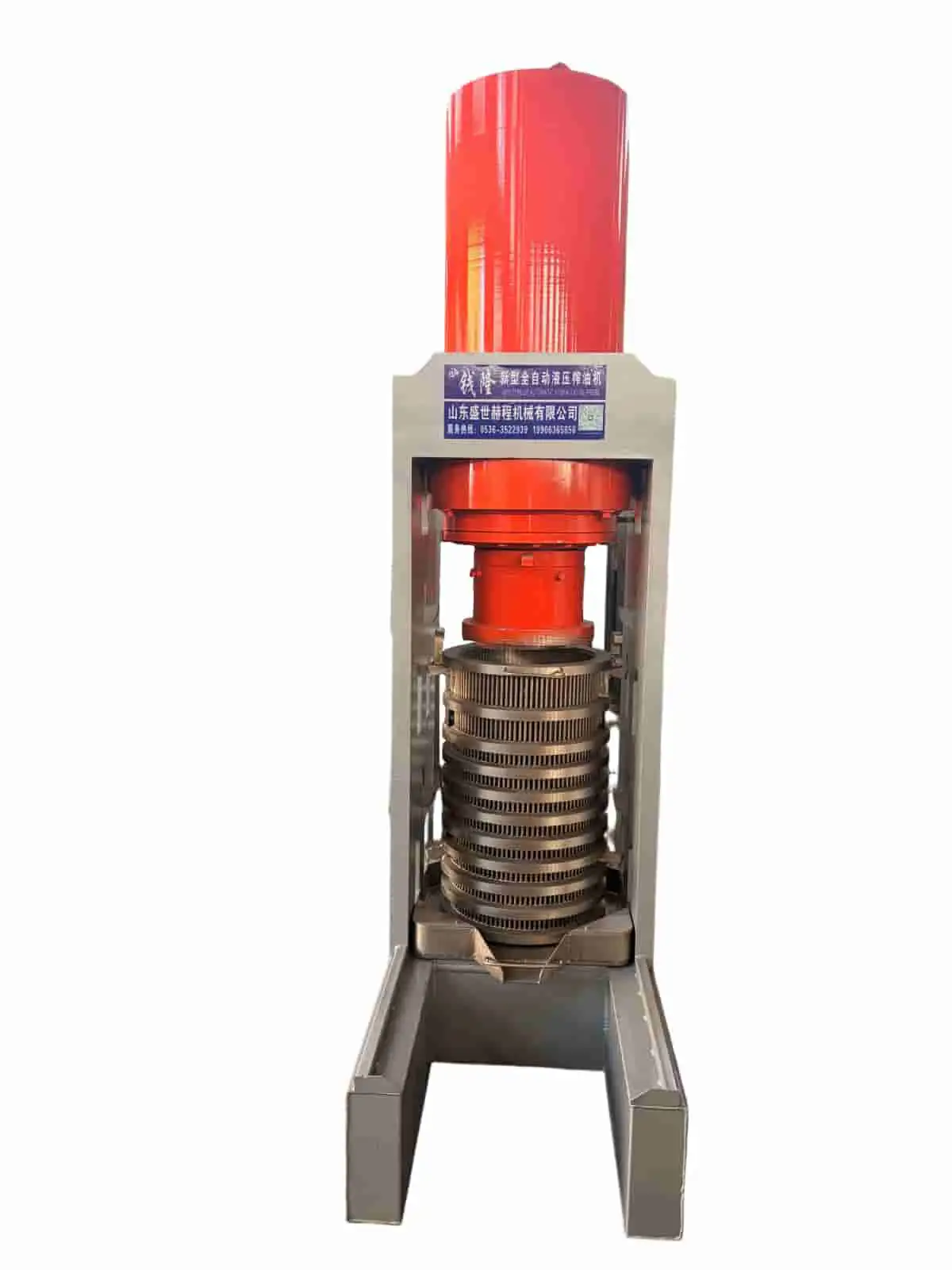
| Step | Equipment | Key specification |
|---|---|---|
| 1. Screening | Screening machine | 750–1,000 kg/h, galvanized carbon steel, 1250 × 760 × 940 mm |
| 2. Buffering | Buffer hopper before the screener | Conical bottom with manual slide gate |
| 3. Drying | Low-temperature dryer | Seed and crushed cake kept below 38°C |
| 4. Lifting | Elevator to the pre-press | 201 stainless steel |
| 5. Pre-pressing | YZJ-7.5 pre-press machine + hopper | 7.5 kW, adjustable pressing clearance |
| 6. Pressing | Model 426 dual-barrel hydraulic oil press | 500 tons, 2.2 kW, hydraulic cake ejection |
| 7. Filtration | Pneumatic paper-stack filter | Also used for the dewaxing filtration |
| 8. Transfer | Food-grade centrifugal pumps | Stainless pump head, 4 m³/h |
| 9. Dewaxing | 5 HP winterization system | About 250 kg; crystallization, crystal-aging and dewaxing tanks |
| 10. Storage | 304 stainless oil tanks | 1 t each, food grade |
| 11. Packaging | Filling, capping, labeling, laser coding | Sized to the bottle |
Why a hydraulic press for hemp
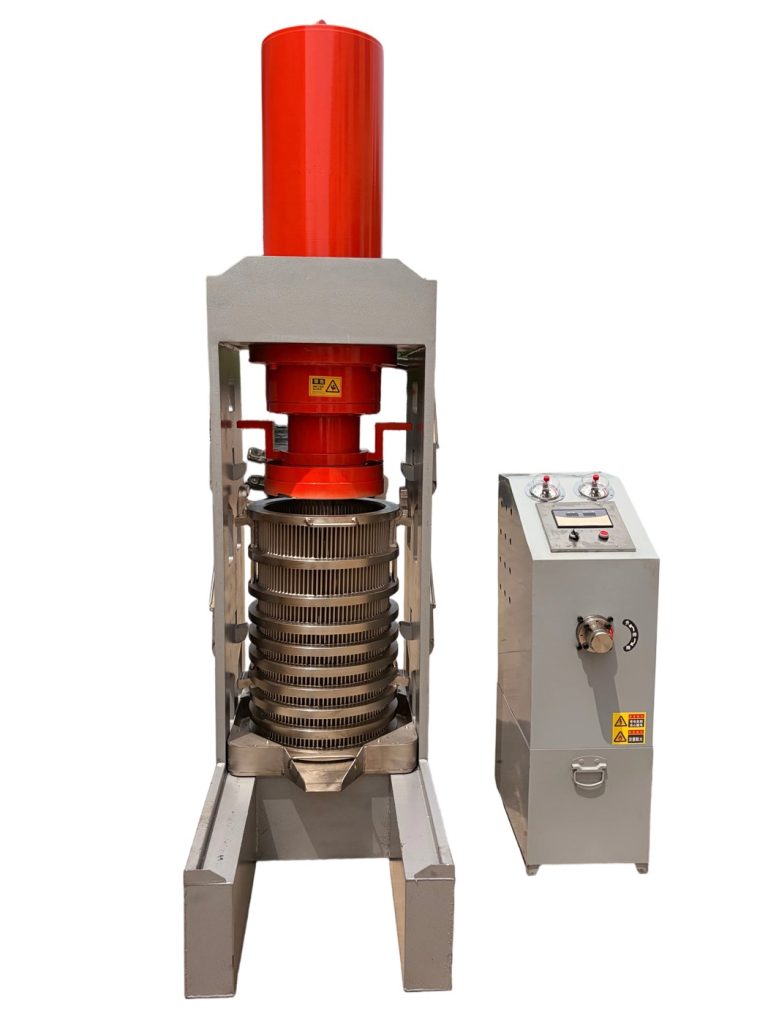
A screw press heats the seed by friction. A hydraulic press only applies pressure, so the oil leaves the barrel at close to the temperature it went in. No roaster or steamer is needed in a cold-press line, which is also why the press itself draws only 2.2 kW.
The Model 426 presses at 500 tons on a 60 MPa system. On this line it is the dual-barrel build: the two barrels are pressed one after the other, about 2 hours each, and the operator loads and unloads one barrel while the other is under pressure. Single vs dual barrel explains when the second barrel pays off.
Keep it cold before the press
The buyer’s hard limit was a drying temperature of no more than 38°C, for both the seed and the crushed cake (10–18 mm pieces, 10–12% moisture going in). That ruled out a standard belt dryer. They also wanted to remove about 2% moisture per hour in 1–1.5 t batches, which is why the dryer was the slowest item to settle.
The questions the buyer asked, and our answers
| Question | Answer |
|---|---|
| Can the screener be made in stainless steel? | Not this model: it would need new tooling. It comes in galvanized carbon steel. |
| Can the screens be customized? | Yes. Upper screen 4.5 × 4.5 mm holes, lower screen 2.5 × 30 mm slots, both with 2 mm between holes. Anything near 1 mm bridges tears too easily. |
| How big should the hopper before the press be? | The buyer cut the height to 1,000 mm, about 0.55 m³. At 9% moisture that holds roughly 270 kg, more than two 100 kg press loads. |
| What spare parts come with the pre-press? | They ordered 2 spare screw shafts and 2 sets of belts (3 belts per set). |
| How is the cake taken out? | The press ejects the cake hydraulically and the operator lifts it off. A floor-mounted lifter that pushes the cake up is possible, but we do not guarantee its long-term reliability. |
| What are the two seal rings in the kit for? | They are oil seals inside the hydraulic cylinder. They only need replacing if the cylinder leaks and can no longer build pressure. |
| Which filter for crude oil and which for wax? | The same pneumatic paper-stack filter does both: first-pass filtration of crude oil, then filtering out wax after the oil is chilled. |
| Why not use a centrifuge? | A centrifuge needs added water, which shortens the oil’s shelf life. |
What to send us for a hemp line quote
- Daily seed input or finished oil target, and working hours
- Seed moisture on arrival, and whether the seed is cleaned
- Whether the oil will be dewaxed (winterized) for retail clarity
- What happens to the cake: sold as is, milled into protein powder, or dried
- Bottle sizes and output for filling
Send these and we will size the screener, dryer, pre-press, press barrel and filter to your volume. Contact us.
Related Reads
- How to Choose a Cold-Press Hydraulic Oil Press: Models 355 to 500
- Single vs Dual Barrel: Throughput Math
- How to Choose Oil Filtration Equipment
- Does Pressed Oil Need Refining?
FAQ
Which hydraulic press is used for hemp seed oil?
On this line, the Model 426 dual-barrel cold press: 500 tons on a 60 MPa system, 2.2 kW, with hydraulic cake ejection. Smaller volumes can use a smaller cold-press model.
Does hemp seed need roasting before pressing?
No. Cold-pressed hemp seed oil needs no roaster or steamer. The seed is screened, dried at a low temperature and pre-pressed before the hydraulic press.
What drying temperature does hemp seed need?
The buyer on this project set a maximum of 38°C for both the seed and the crushed cake, a common limit for cold-pressed oil.
Does hemp seed oil need winterization?
Only if you sell it in clear bottles and want it to stay clear when cold. This buyer included a 5 HP dewaxing system, about 250 kg, filtered on the same paper-stack filter.
Why is there a pre-press machine in a cold-press line?
It crushes and compacts the seed so a full load fits the barrel. On the 390 mm barrel that is up to about 100 kg per load.
Project planning
Configure the right oil press and production line
Send your oilseed, target output, bottle or packaging requirements, power supply, and destination country. We will match the machine, supporting equipment, and line layout.