
On this page
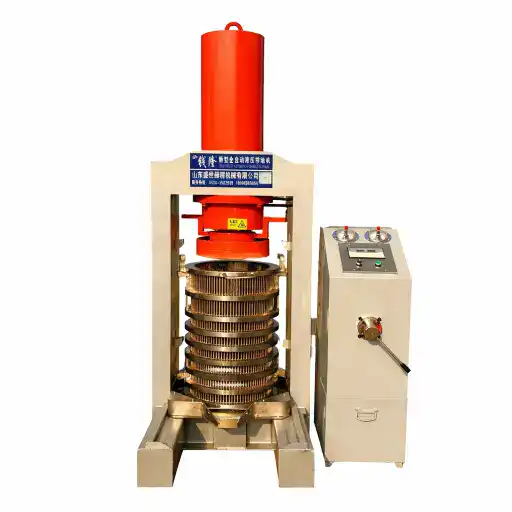
A buyer asked us for a hot-pressed peanut oil workshop producing 10 tons of finished oil a day. This is the plan we sent, with the arithmetic behind every machine count, so you can redo it for your own target. The core of the line is 18 units of our Model 325 hydraulic oil press; everything else is sized to keep those presses fed.
The brief
| Question | Buyer’s answer |
|---|---|
| Output | 10 t of finished oil per day |
| Working hours | 10 hours a day (not 24) |
| Roaster heating | Electric |
| Material of contact parts | Stainless steel |
| Filling | Fully automatic line: filling, capping, inspection, labeling, coding, carton sealing |
| Aflatoxin | Reduction equipment required |
| Front end | Shelling and cleaning included |
Working hours matter more than buyers expect. Running 24 hours cuts the number of machines by more than half, but needs three shifts. With a 10-hour day, every number below is sized per hour of a 10-hour day.
Step 1: how much peanut kernel you need
We plan peanut kernels at a conservative 44% oil yield (hot-pressed kernels usually give 44–48%).
10,000 kg oil ÷ 0.44 ≈ 23,000 kg kernels a day, or about 2.3 t per hour over 10 hours.
Step 2: how many presses
The press is Model 325-390-850 AC. The code reads directly:
- 325: hydraulic cylinder diameter, 325 mm
- 390: inside diameter of the barrel, 390 mm
- 850: cylinder stroke, 850 mm
- AC: single barrel
One hot-press cycle is about half an hour. After pre-pressing, one barrel takes up to 100 kg. Including loading and unloading, one press handles 2 barrels in 1.5 hours, or about 1.3 barrels per hour. At 44%, each barrel gives about 44 kg of oil.
10,000 kg ÷ 10 h ÷ 1.3 barrels/h ÷ 44 kg = 17.5, so 18 presses.
Step 3: pre-press machines
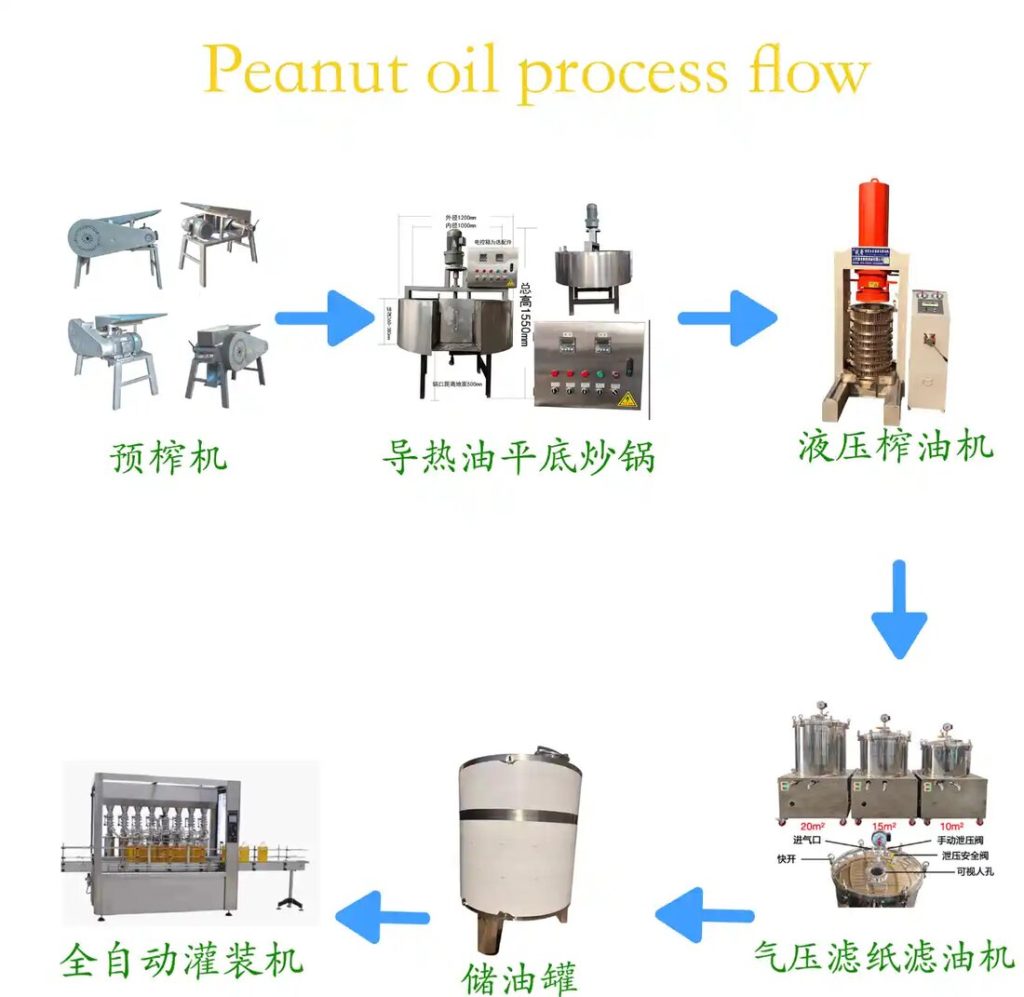
Kernels are pre-pressed (crushed and kneaded) before they go into the barrel. That is what allows a 100 kg load. We use the YZJ-11 quiet pre-press machine: 11 kW, 380 V, 300–350 kg/h, 174 kg, 103 × 100 × 75 cm.
23,000 kg ÷ 10 h ÷ 300 kg/h = 7.7, so 8 pre-press machines.
Step 4: roasters
Peanut for hot pressing is roasted in a flat-bottom thermal-oil roaster: 100 kg per pot, about half an hour per pot, so 200 kg per hour per roaster. It uses 27 kW of electric heating (9/18/27 kW steps) plus a 1.1 kW stirring motor, holds 50 kg of No. 350 heat-transfer oil, and measures 1200 × 1200 × 1550 mm (pot inside diameter 1000 mm, about 308 kg).
23,000 kg ÷ 10 h ÷ 200 kg/h = 11.5, so 12 roasters running. We quoted 13 so one can be cleaned or serviced without slowing the presses.
Step 5: shelling, aflatoxin and filling
- Shelling and cleaning: 2 sets of the 1500-type combined peanut elevator, destoner and sheller (1,500 kg/h each; cleaner 1.5 kW × 2, sheller 3 kW + 1.5 kW, about 1,500 kg per set).
- Aflatoxin reduction: 1 continuous-flow aflatoxin degradation machine on the oil side.
- Filling: one fully automatic line: 4-head PLC filler (GCP-4L), LED light inspection box, automatic capper with cap feeder, 15 m of 152 mm stainless conveyor, self-adhesive labeler, 40 W CO₂ laser coder, packing platform and a top-and-bottom carton sealer.
The full equipment list
| Equipment | Specification | Qty |
|---|---|---|
| Peanut elevator + destoner + sheller | 1,500 kg/h | 2 sets |
| YZJ-11 pre-press machine | 11 kW, 300–350 kg/h | 8 |
| Flat-bottom thermal-oil roaster | 27 kW, 100 kg per pot | 13 (12 + 1 standby) |
| Hydraulic oil press 325-390-850 AC | 325-ton class, single barrel | 18 |
| Aflatoxin degradation machine | Continuous flow | 1 |
| Automatic filling line | Filling to carton sealing | 1 line |
Carbon steel or stainless steel?
The standard press has a carbon-steel frame, a 27SiMn steel cylinder and a carbon-steel barrel with a nickel-plated outer surface. The parts that touch the oil and material can be made in 304 stainless steel instead: the press head, oil tray, separator plates and barrel. That roughly doubles the price of each press. Carbon steel does not change oil quality; stainless steel is mainly about appearance and easier cleaning.
On the roaster, the contact base can be upgraded to 304 stainless. On the sheller and pre-press machine, stainless steel is not worth the money.
Is a hydraulic line the right choice at 10 tons?
At 10 t of oil a day you are at the size where a screw-press line is also realistic. The hydraulic route means more machines, but every batch is pressed the same way and the oil carries the roasted flavor that hot-pressed peanut oil buyers pay for. If your market is bulk commodity oil, compare both in hydraulic vs screw press before you decide.
Want this plan for your own numbers? Send us your daily oil target, working hours, raw material and whether you need shelling or filling. We will send back the same calculation and an itemized quote. Contact us.
Related Reads
- Hydraulic Oil Press Machine 300 & 325: The Hot-Press Models
- Peanut Oil Hydraulic Press Machine
- Single vs Dual Barrel: Throughput Math
- How to Choose Oil Filtration Equipment
FAQ
How many hydraulic oil presses do I need for 10 tons of peanut oil a day?
With a 10-hour day, 18 units of Model 325 single-barrel: 10,000 kg ÷ 10 h ÷ 1.3 barrels per hour ÷ 44 kg oil per barrel. Running 24 hours needs far fewer presses.
How much peanut kernel makes 10 tons of oil?
About 23 tons at a conservative 44% yield. Hot-pressed kernels typically yield 44–48%.
How much material goes into one barrel?
Up to about 100 kg per load on the 390 mm barrel after pre-pressing. Loose material gives a smaller load.
Why plan 13 roasters when the math gives 12?
Twelve keep the presses fed exactly. One standby lets you clean or service a roaster without stopping a press.
Does stainless steel improve peanut oil quality?
No. Carbon steel does not affect oil quality. Stainless contact parts mainly improve appearance and cleaning, and roughly double the press price.
Project planning
Configure the right oil press and production line
Send your oilseed, target output, bottle or packaging requirements, power supply, and destination country. We will match the machine, supporting equipment, and line layout.